
The Unseen Architecture: Where is the AI Revolution Going?
By James and Michael Hall
James and Michael Hall—authors of the popular The Sword of Damocles: Our Nuclear Age, now on Audible, Kindle and Amazon books. jameshall042999@gmail.com
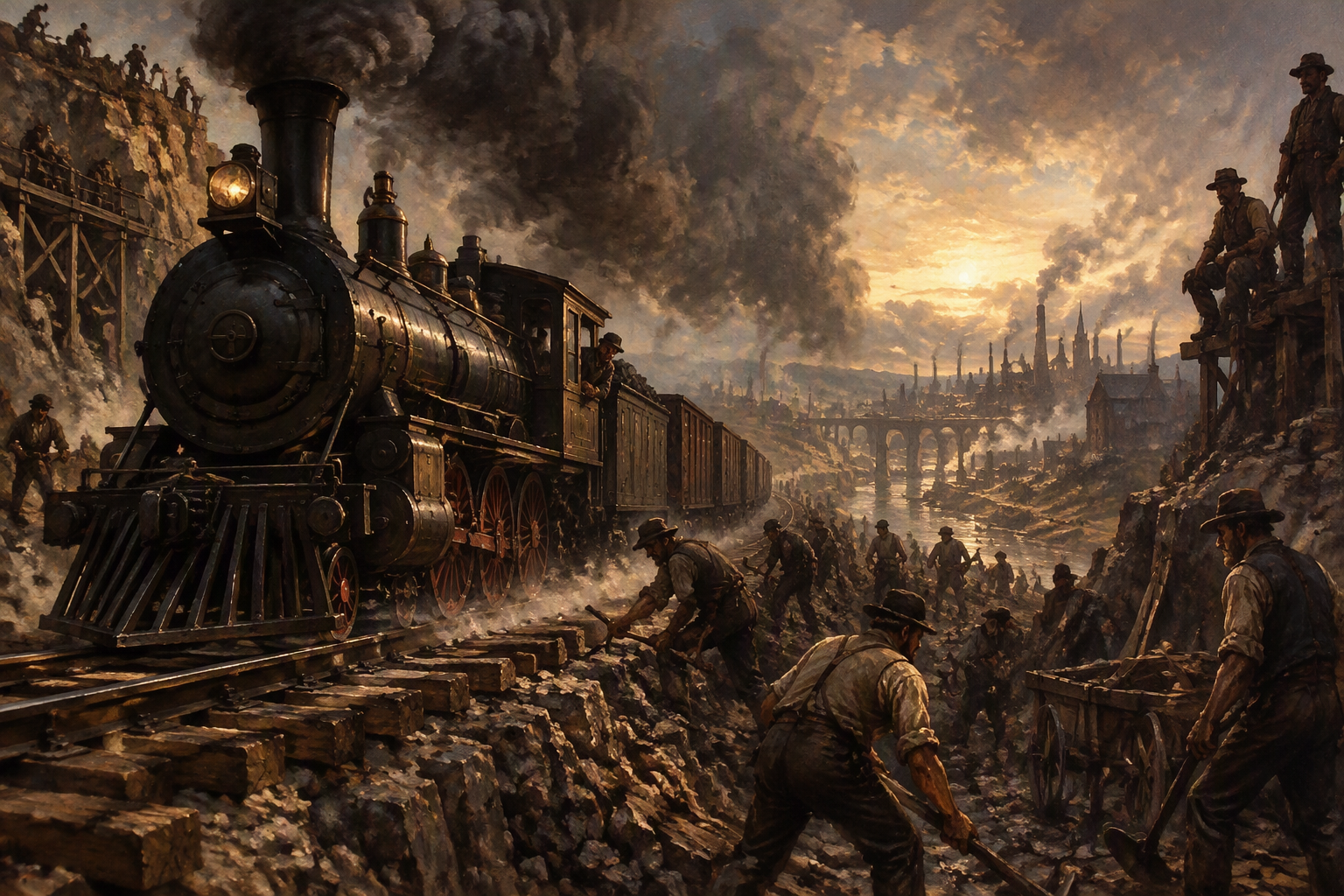
The people who built the rails thought they were moving trains. They were moving history.
Art and poetry by James Hall. (Art inspired by German realist Adolph Menzel.)
The enormous data centers going up across the country are not the AI revolution itself. They are the track being laid for it.
Picture a passenger on one of the first steam trains in the 1830s. Nobody on board could have imagined what was to come. None could have seen Chicago's stockyards, the Sears catalog, or the time zones the railroads gave us, which we still set our watches by. The machinery came first. The world it made possible came later, and it looked nothing like the machinery.
We're at a similar moment now. The data centers, chips, power plants and fiber-optic cables being built today are not the destination. They are the foundation. The more interesting question is what will grow on top of them: what new businesses, industries and institutions will appear once machine intelligence becomes cheap and available to everyone. History suggests that a great technology's biggest effects usually show up one or two steps removed from the technology itself.
What Comes Next
Once the foundation is in place, AI will probably develop in several overlapping stages.
Right now, most of us meet AI through chatbots and digital assistants that answer questions and help us write. The next step is what the industry calls an "agent": software that doesn't just help with a task but finishes it. Picture a program that handles an insurance claim from start to finish, writes and tests computer code, balances the books, manages purchasing, or researches a question and drafts a recommendation. That shift matters. Answering questions makes workers more productive. Completing the work starts to replace the work itself. Much of AI's economic value may come from this change.
The deeper story may be in science. AI is already helping researchers predict how proteins fold, search for new drugs, and design new materials and chemicals. Used well, it can point scientists toward the most promising ideas before they spend years on expensive lab tests, turning years of trial and error into months. In the long run, AI's greatest gift may not be a clever assistant on your phone. It may be a faster pace of discovery: new medicines, better batteries, hardier crops, stronger materials and cleaner energy, all arriving sooner than they otherwise would.
Then there is the physical world, which is still much larger than the digital one. AI-powered robots are starting to appear in warehouses, factories, farms and construction sites, and one day they may be common in homes and hospitals. Progress here will be slower. The real world is messy, unpredictable and sometimes dangerous. When software makes a mistake, you get a wrong answer. When a robot makes a mistake, it can break equipment, damage property or hurt someone. Still, demographics are pushing hard in this direction. Many wealthy countries have aging populations and shrinking workforces, which gives them strong reasons to automate physical labor.
Finally, AI will spread out. Today's most powerful systems live in giant central data centers. Over time, smaller and more efficient versions will run directly on our phones, cars, appliances, factory machines and medical devices. Intelligence may become an invisible feature of everyday products, much as the electric motor quietly disappeared into everything from refrigerators to elevators. When that happens, we'll probably stop talking about "AI products" altogether. Intelligence will simply be something things have.
The Missing Piece: People and Institutions
Technology alone has never transformed society. Railroads needed new kinds of banking, new business law, standard time zones and a new style of corporate management. Electricity forced factories to be redesigned from the ground up. The internet brought new ways to communicate, shop, advertise and regulate.
AI will demand the same kind of adjustment. Schools will need to rethink what education means when information is everywhere. Professional licensing may change when machines can handle parts of legal, medical, engineering and financial work. Regulators will face hard new questions about privacy, accountability, liability, intellectual property and national security. Some of the most important changes may happen not in the technology at all, but in the institutions that learn to work alongside it.
Will Human-Level AI Need Quantum Computers?
Probably not.
Today's AI runs on ordinary, or "classical," computers that perform enormous numbers of fairly simple calculations. The graphics chips and specialized processors behind it were built for exactly this kind of work.
Quantum computers are a different kind of machine altogether. They shine at certain specialized problems, such as simulating molecules, finding the best solution among countless options, and breaking or creating codes. But they aren't seen as a general replacement for the computers that power AI today. If artificial general intelligence (AI that can match people across a wide range of tasks) ever arrives, it will most likely come from ever more capable classical machines. Quantum computers may end up as specialized tools that AI uses, the way scientists use specialized lab instruments.
There is an intriguing twist, though: advanced AI may help engineers solve the stubborn scientific problems that have held quantum computing back.
What the Railroads Teach Us
The steam engine's greatest legacy wasn't the engine. It was everything the railroads reshaped around them. They created national markets and made mass distribution possible. They fueled demand for steel, coal, banking, manufacturing and the telegraph. Whole cities grew up around rail hubs. Most of all, they changed the economic map of the country.
AI may do something similar. Just as the railroad let a business reach customers across a continent, AI may let a small team do what once took a large organization. A company of ten people may someday accomplish what used to require hundreds. Of course, any organization still needs leadership, trust, customer relationships, legal compliance and sound judgment. AI may make companies smaller, but it is unlikely to make human institutions unnecessary.
Railroads collapsed the cost of distance. AI may collapse the cost of expertise. Medical, legal, financial, engineering and educational knowledge could become far cheaper and easier to reach. But expertise is more than information. It also involves judgment, responsibility, ethics and accountability. So professionals probably won't disappear. More likely, they'll become far more productive.
Railroad junctions became boomtowns. In the AI era, the map may be drawn by energy. Regions with plentiful electricity, friendly regulations, water for cooling and strong transmission lines may become the industrial centers of the coming decades. Coal powered the railroad age. Electricity powers the AI age. Data centers are already straining the power grid, and transmission lines, transformers, power plants and cooling systems are fast becoming strategic assets. The biggest bottleneck in AI's future may not be computer chips at all. It may be power.
The Question of Jobs
Every major industrial revolution has upended the job market. Farm machinery reduced the need for agricultural workers but created factory jobs. Computers automated many office tasks but gave rise to entirely new industries. AI will likely follow the same pattern: some jobs will shrink sharply, others will be strengthened by the new tools, and new professions we can barely imagine will appear.
The hard part is that the transition may be uneven. Consumers and businesses can feel the benefits quickly, while workers and institutions take much longer to adapt. History suggests that societies tend to underestimate not just the opportunities a new technology creates, but also the strain of the years spent adjusting to it.
A Warning from Railway Mania
The railroad story also holds a lesson for investors. In 1840s Britain, railway shares became a national obsession. Money poured in, many of the projects never made economic sense, and the speculative bubble eventually burst. Yet the railroads still transformed society. The investors who lost money weren't wrong about the technology. They were wrong about the price they paid, the timing, or the competition.
Electricity followed a similar path. At first the gains were modest, because factories simply swapped their steam engines for electric motors and kept the old layouts. The big productivity gains came later, once businesses reorganized around what electricity made possible.
AI may go the same way. The technology can be revolutionary while many of the investments tied to it disappoint. Being right about the future is not the same as being right about a stock.
Where the Opportunities May Be
The opportunities run all the way from the companies building the infrastructure to ordinary businesses that quietly use AI to work smarter.
Energy. Reliable electricity is becoming a strategic resource. Utilities, power-line operators, natural gas pipelines, nuclear plants and companies developing next-generation energy could all benefit.
The grid's hardware. Transformers, switchgear, substations, transmission equipment and cooling systems have become real bottlenecks. Without them, the power can't reach the computers.
Networking and memory. As AI systems grow, the equipment that links computers together and the advanced memory chips that feed them data are becoming just as essential as the processors themselves, and may prove as important as the well-known chipmakers.
Robotics and automation. As AI moves into the physical world, makers of sensors, motors, motion-control systems and factory automation equipment may benefit.
The users. History suggests that some of the biggest winners won't be infrastructure companies at all. Many railroad-era fortunes were made by businesses that simply used the railroads well. The same may happen with AI. Insurers, healthcare administrators, shipping companies, manufacturers and other ordinary-looking businesses may capture a great deal of value by becoming dramatically more productive.
Security. As AI gives us more power, it also creates more risk. Cybersecurity, identity protection, fraud prevention and digital resilience will stay essential no matter which AI companies come out on top.
The Long View
The people who laid the first rail lines were building something larger than they understood. The same is probably true of those building today's data centers.
The most important results of AI may not be the AI systems themselves, but the new institutions, businesses, industries, discoveries and economic structures that grow up around them. In time, the machines will become ordinary and the infrastructure will fade into the background. What will matter is the world built on top of it.
If history is any guide, that world will surprise both the optimists and the skeptics.