
St. Jude Children’s Research Hospital Enters the Quantum‑AI Era
By James Hall
St. Jude Children’s Research Hospital has taken a major step into the future of medical science. In partnership with the University of Toronto, researchers at St. Jude have become the first in the world to use quantum computing to successfully guide a drug‑discovery project that was later confirmed in real laboratory experiments. Their work, published in Nature Biotechnology, is already being recognized as a turning point—not only for quantum computing, but for the entire field of artificial intelligence.
As www.authorshall.com has been reporting, the future is here. AI and quantum computing is our new reality.
Drug discovery is one of the most difficult challenges in modern medicine. Scientists must sort through millions of possible molecules to find the few that might become safe and effective treatments. Classical AI models already help narrow the search, but even the most powerful traditional computers struggle to capture the full complexity of chemistry.
Molecules behave in ways that are deeply mathematical and often too intricate for classical systems to model with complete accuracy.
This is where quantum computing changes the picture. Quantum processors operate using the strange rules of quantum physics, allowing them to represent information in richer, more flexible ways. The St. Jude team built a hybrid architecture that allowed classical AI and quantum computing to work side by side. The classical AI model learned patterns in chemical data, while the quantum processor generated deeper, more expressive representations of the molecules being studied. When these quantum‑enhanced features were fed back into the AI model, its predictions improved substantially.
The most important part is what happened next. The team took the top candidates suggested by this hybrid system and tested them in the lab. Two of the molecules showed real, measurable promise.
This marks the first time that a quantum‑enhanced AI model has produced drug candidates that were validated experimentally—a milestone many in the field have been anticipating for years.
The breakthrough signals something larger than a single scientific achievement. It shows that quantum computing is no longer confined to theory or small‑scale demonstrations. It is beginning to enter real research pipelines, where it can influence decisions, guide experiments, and accelerate discovery. But perhaps the deeper story is that AI itself is now stepping into the quantum era. Instead of replacing AI, quantum processors are expanding what AI can see and understand, revealing patterns that classical machines cannot easily capture.
In simple terms, classical AI is like a powerful camera, and quantum computing is like adding a new lens that reveals details the camera could never see before. Together, they create a clearer picture—one that may lead to new medicines and new hope for children facing life‑threatening diseases.
St. Jude’s achievement is a glimpse of what the future of scientific discovery may look like, which represents classical intelligence and quantum intelligence working together, each amplifying the other. It is a quiet but profound shift, and it may be remembered as the moment when AI truly entered the quantum age.
Suggested Reading:
Biamonte, Jacob, Peter Wittek, Nicola Pancotti, Patrick Rebentrost, Nathan Wiebe, and Seth Lloyd. “Quantum Machine Learning.” Nature 549, no. 7671 (2017): 195–202.
Cao, Yudong, Jonathan Romero, and Alán Aspuru‑Guzik. “Potential of Quantum Computing for Drug Discovery.” IBM Journal of Research and Development 62, no. 6 (2018): 6:1–6:20.
Dunjko, Vedran, and Hans J. Briegel. “Machine Learning and Artificial Intelligence in the Quantum Domain.” Reports on Progress in Physics 81, no. 7 (2018): 074001.
Harrigan, Matthew P., et al. “Quantum Approximate Optimization of Non‑Convex Problems with Applications to Chemistry.” Nature Physics 17 (2021): 332–336.
McArdle, Sam, Suguru Endo, Alan Aspuru‑Guzik, Simon C. Benjamin, and Xiao Yuan. “Quantum Computational Chemistry.” Reviews of Modern Physics 92, no. 1 (2020): 015003.
Moll, Nikolaj, et al. “Quantum Optimization Using Variational Algorithms on Near‑Term Quantum Devices.” Quantum Science and Technology 3, no. 3 (2018): 030503.
Peruzzo, Alberto, et al. “A Variational Eigenvalue Solver on a Photonic Quantum Processor.” Nature Communications 5 (2014): 4213.
Rebentrost, Patrick, Maria Schuld, and Nathan Killoran. “Quantum Machine Learning in Feature Hilbert Spaces.” Physical Review Letters 122, no. 4 (2019): 040504.
Schuld, Maria, and Francesco Petruccione. Supervised Learning with Quantum Computers. Cham: Springer, 2018.
St. Jude Children’s Research Hospital; University of Toronto. “Quantum‑Enhanced Machine Learning for Drug Discovery.” Nature Biotechnology (2024). (Original research article describing the breakthrough.)
Tang, Eleanor. “How Quantum Computing Is Transforming Drug Discovery.” MIT Technology Review, 2023.
Wittek, Peter. Quantum Machine Learning: What Quantum Computing Means to Data Mining. Amsterdam: Elsevier, 2014.
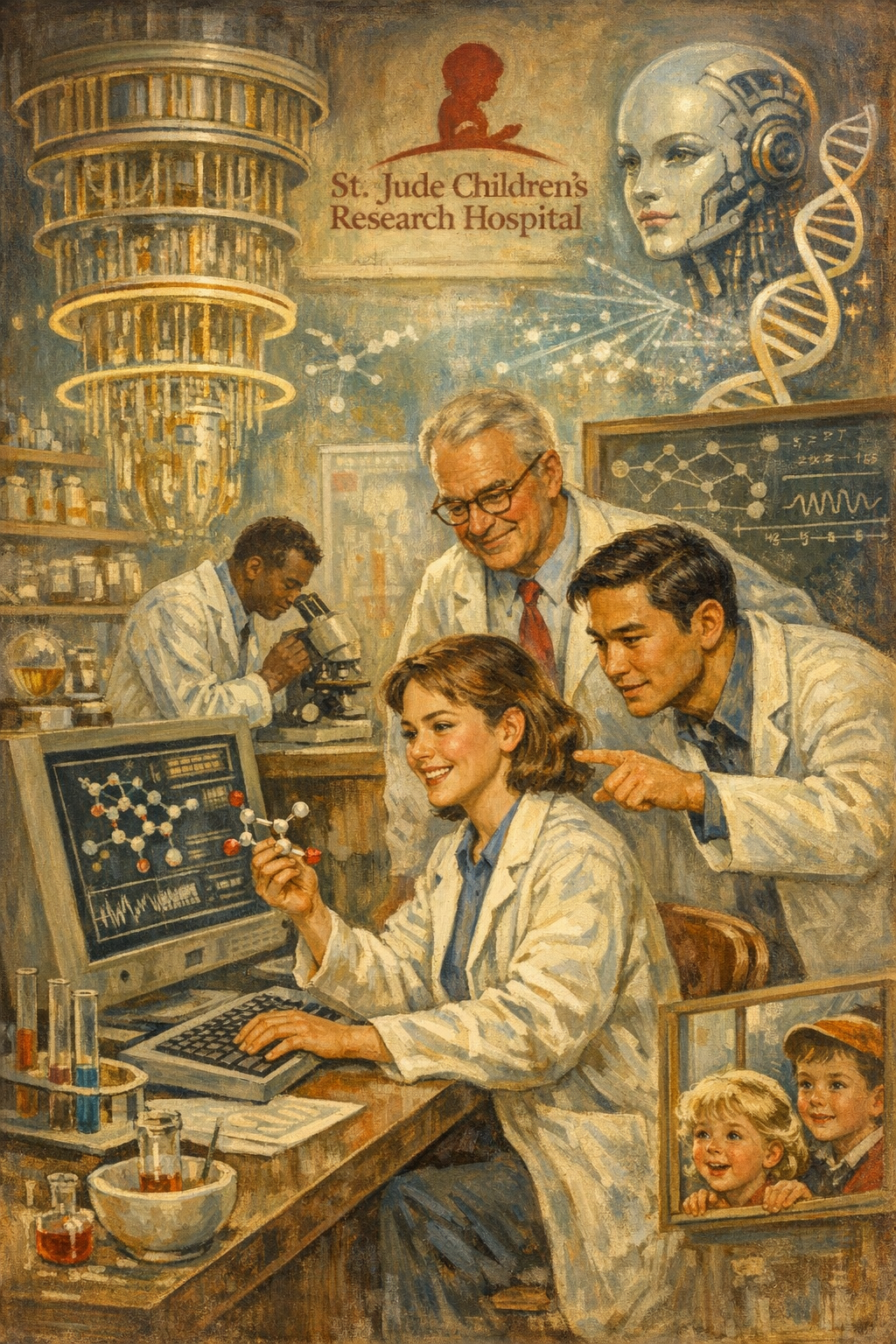
“In the hush of the lab, tomorrow’s cure begins—drawn from light, logic, and hope.”
Art and poetry by James Hall