
The AI Revolution Part Three
More AI Terms You Need to Know NOW
Generative AI, Emergent Behavior, & Artificial General Intelligence
By James and Michael Hall at jameshall042999@gmail.com
Generative AI answers the question:
“How does an AI create something new?”
Emergent behavior answers the question:
“Why does an AI sometimes do things we didn’t explicitly program it to do?”
Together, they show that AI is not a rival mind, but a new kind of instrument —
one that reveals unexpected harmonies when played at scale.
Around this conversation, some will toss out the term AGI — Artificial General Intelligence. This is the most overloaded term in the entire field where there is not even a consensus definition.
So let us begin by defining all three concepts.
Generative AI
Generative AI is the branch of artificial intelligence designed to create new content. This includes text, images, music, video, code, designs, and even synthetic data. Instead of simply classifying or analyzing information, these systems learn the deep patterns within enormous datasets and then use those patterns to produce something new in response to a prompt.
Mechanically, generative AI relies on deep learning models—neural networks loosely inspired by the structure of the human brain. These models are trained on vast amounts of data, absorbing relationships, structures, and styles. When you ask a generative model to write a paragraph or create an image, it draws on those learned patterns to synthesize an output that fits the request.
This is why generative AI feels so different from traditional software. That is traditional programs follow rules while generative AI discovers them.
It doesn’t retrieve a sentence from a database—it composes one.
It doesn’t copy an image—it imagines one statistically.
And because these systems can respond to natural language prompts, they’ve become powerful creative partners across writing, research, design, coding, and more.
In short, generative AI is software that creates—not by magic, but by learning patterns at a scale no human could ever approach.
A real‑world example is ChatGPT. It is one of the most widely recognized generative AI systems which is designed not just to analyze information, but to create new content in response to human prompts. Trained on massive amounts of text, it can generate essays, answer questions, write code, draft reports, and carry on conversations in a remarkably human‑like way. Its power comes from pattern learning: instead of retrieving stored sentences, ChatGPT synthesizes new ones based on the structures and relationships it absorbed during training. This ability to produce original text — from résumés to recipes to long‑form articles — makes it a flagship example of generative AI in everyday use.
But creation is only half the story. When these generative systems grow large enough, something stranger begins to happen: new abilities emerge that no one explicitly programmed.
Emergent Behavior
Emergent behavior is real, It is not magical, not mysterious, but a genuine pattern which we observe in large AI systems. When people talk about “emergence,” they’re describing the phenomenon when a system becomes large and complex enough that new abilities appear that were not explicitly programmed.
We see this in many natural systems such as ant colonies, economies, weather patterns, and the human brain.
No single ant “knows” how to build a colony.
No single neuron “knows” how to write a poem.
But at scale, new behaviors arise.
AI is similar.
The behavior is real.
The explanation is mechanical.
A simple real‑world analogy is the “phantom traffic jam.” You’ve probably been on a highway moving at a comfortable speed when suddenly traffic slows to a crawl—no accident, no construction, no visible cause. Then, minutes later, everything clears. That slowdown is emergent behavior: no single driver caused it, but the system as a whole produced it.
A clear AI example came from early versions of GPT‑3. When researchers made the model larger, something unexpected happened: it suddenly learned how to solve multi‑step problems like word puzzles, basic algebra, explaining jokes, translating between languages, and even writing working code —none of which it had been explicitly programmed to do. Before reaching that scale, the model couldn’t do these tasks at all; after crossing the threshold, the abilities appeared almost overnight. No engineer added a “logic module” or a “joke understanding module.” These skills emerged naturally from the massive number of patterns the model had absorbed during training.
Emergent behavior shows how new abilities can arise from scale alone—and that leads directly to the larger debate: could these expanding capabilities eventually cross into what we call AGI?
AGI — Artificial General Intelligence
There is no consensus definition. Not among researchers. Not among companies. Not among philosophers. Not even within the same organization.
Some imagine AGI as human‑level intelligence across all tasks. Others imagine it as something far beyond human ability. Still others argue the term is so vague it may evaporate once we understand intelligence better. We may not know when we reach true AGI until after the fact, only to later understand it through the eyes of history.
“We will not understand AI in the moment we are living it. No age ever understands its own inventions.”
Across the world, several major labs are racing toward AGI, each with its own philosophy and technical approach. OpenAI pursues AGI through scaling—building ever‑larger models—and alignment, the effort to ensure those models behave safely and predictably. DeepMind takes a different path, combining reinforcement learning with neuroscience‑inspired architectures in hopes of capturing the underlying principles of human reasoning. Anthropic focuses on safety first, developing “constitutional AI,” a method that trains models to follow a written set of principles rather than relying solely on human feedback. Meta, meanwhile, is betting on open‑source scaling, releasing increasingly powerful models to the public in the belief that transparency and broad access accelerate innovation. These differing strategies reflect a deeper uncertainty: no one yet knows which path—if any—will lead to true general intelligence.
Subjective experience—the inner movie of consciousness, emotion, and awareness—remains the dividing line. An AGI might one day perform every cognitive task a human can, but whether it would feel anything while doing so is an open question. Intelligence can be engineered. Experience may not be. And this uncertainty shapes every debate about what AGI truly is.
A potential real‑world example of AGI might look like this: imagine a single AI system that can work across many different areas the way a human can—not just one task at a time. In a hospital, for example, this kind of AGI could read new medical research and explain it to doctors, diagnose patients from scans and lab results, talk with families in plain language, schedule surgeries, manage staffing, learn new medical procedures on its own, and even switch over to handling hospital finances or logistics if needed. No engineer would have programmed each of these abilities separately. Instead, the system would generalize, reason, learn new skills, and transfer knowledge the way a human professional does.
That’s the key difference: AGI isn’t an AI that does one thing extremely well—it’s an AI that can learn almost anything.
Conclusion
For now, the most grounded stance is also the most empowering. We don’t need to predict AGI to understand the systems in front of us.
We only need to understand how generative AI works, why emergence happens, and how to use these tools with clarity rather than fear.
Suggested Reading:
Bostrom, Nick. Superintelligence: Paths, Dangers, Strategies. Oxford: Oxford University Press, 2014.
Brynjolfsson, Erik, and Andrew McAfee. The Second Machine Age: Work, Progress, and Prosperity in a Time of Brilliant Technologies. New York: W. W. Norton, 2014.
Chollet, François. “On the Measure of Intelligence.” arXiv (2019).
https://arxiv.org/abs/1911.01547.
Floridi, Luciano, and Josh Cowls. “A Unified Framework of Five Principles for AI in Society.” Harvard Data Science Review 1, no. 1 (2019).
Goodfellow, Ian, Yoshua Bengio, and Aaron Courville. Deep Learning. Cambridge, MA: MIT Press, 2016.
Marcus, Gary, and Ernest Davis. Rebooting AI: Building Artificial Intelligence We Can Trust. New York: Pantheon Books, 2019.
Mitchell, Melanie. Artificial Intelligence: A Guide for Thinking Humans. New York: Farrar, Straus and Giroux, 2019.
Russell, Stuart. Human Compatible: Artificial Intelligence and the Problem of Control. New York: Viking, 2019.
Sutton, Richard. “The Bitter Lesson.” Incomplete Ideas (blog), March 13, 2019.
http://www.incompleteideas.net/IncIdeas/BitterLesson.html (incompleteideas.net in Bing).
Wolfram, Stephen. What Is ChatGPT Doing … and Why Does It Work? Champaign, IL: Wolfram Media, 2023.
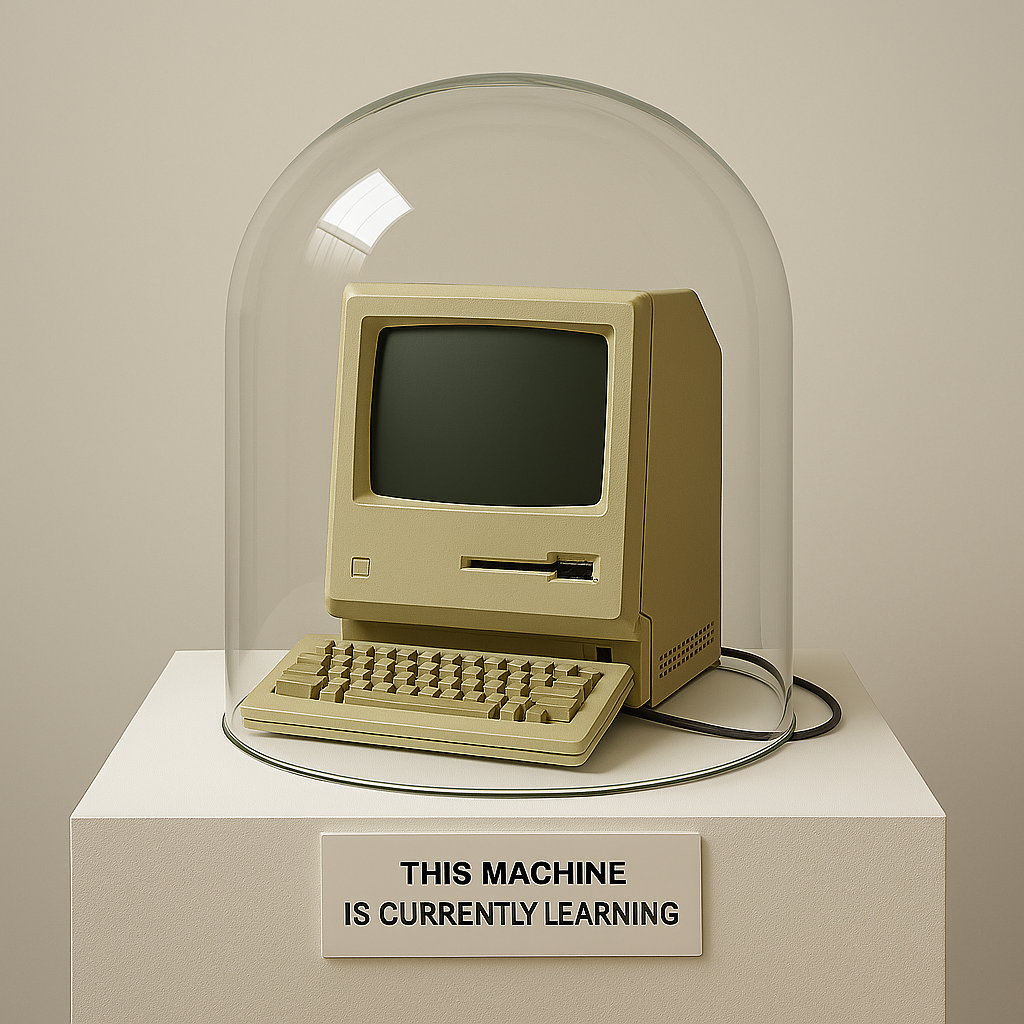
“We will not understand AI in the moment we are living it.
No age ever understands its own inventions.”
Marcel Duchamp (1887–1968) was a French‑American artist whose radical “readymades” and conceptual works reshaped the course of modern art. He challenged the very definition of art, influencing generations of avant‑garde movements.
(If Duchamp were alive today, he would not paint the AI revolution — he would sign it, tilt it sideways, and dare us to explain it.)
Poetry and art by James Hall