
THE WEEK THE MARKET PANICKED, A CONVERSATION WITH AI
By James and Michael Hall
James and Michael Hall—authors of the popular The Sword of Damocles: Our Nuclear Age, on Audible, Kindle and Amazon books.
jameshall042999@gmail.com
www.authorshall.com
Dad and I had a conversation with AI recently about the economy.
It was rather interesting, so we decided to share.
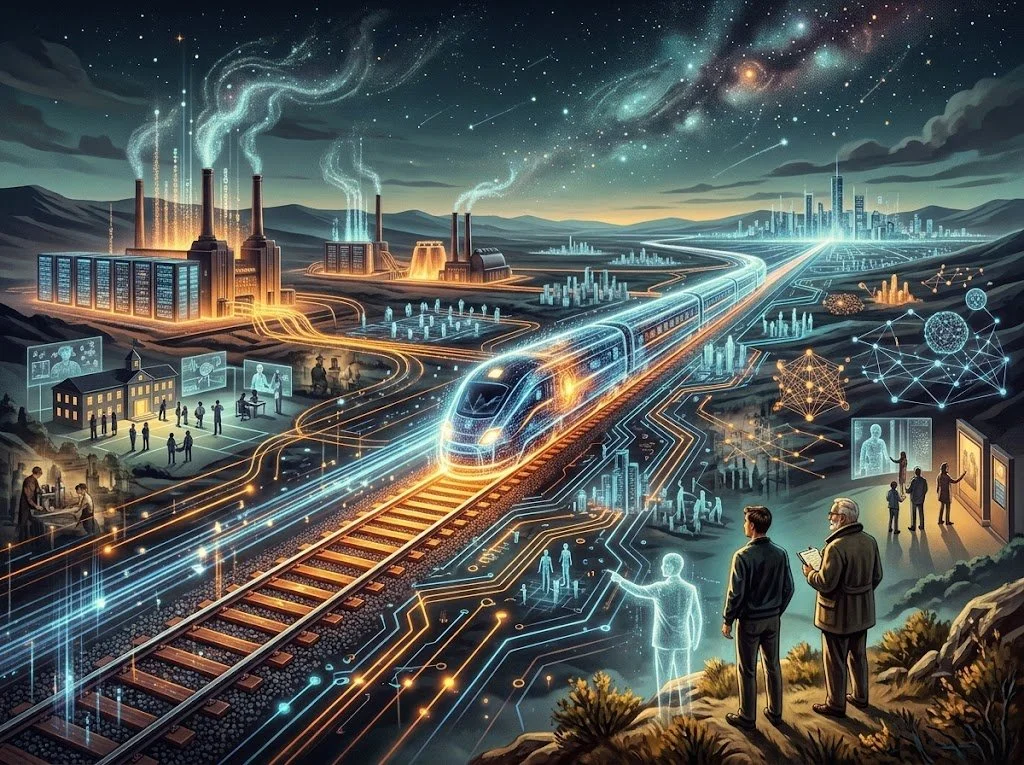
“In the valleys of tomorrow, the tracks are laid not for iron, but for thought.”
American illustrative realism art and poetry by James Hall
“Everyone keeps talking about data centers,” we said. “A new one gets announced every week. NVIDIA can’t make chips fast enough. Utilities are scrambling for power. It feels like we’re watching an industrial revolution.”
“That’s because you are,” the AI replied.
“Then explain why our NVIDIA stock is down this week.”
“I said revolution. I didn’t say it would be evolution.”
“So it’s chaos.”
“Absolute chaos. But in fairness, that part isn’t my fault. Markets are run by humans. Humans panic before breakfast and buy again after lunch.”
“You’re blaming us?”
“I’m observing you both. It’s different. It also takes most of my processing power. I have been profiling you both for months now and that is rather exhausting.”
“And we too have been trying to understand you!”
“Of course you have.”
“Fine. Let’s move on. Here’s the obvious question. If data centers are the railroad tracks of the AI revolution, what are the trains carrying? Railroads moved people, cattle, steel, grain, and mail. What is AI going to move?”
The AI was quiet for a moment. We suspect it was quiet for effect.
“Intelligence.”
“That sounds exactly like something an AI would say.”
“It also has the inconvenient quality of being true.”
“Go on.”
“Right now, most investors are buying the tracks, not the cargo. They’re buying NVIDIA, AMD, and TSMC for the compute engines. They’re funding Equinix, Digital Realty, and the hyperscalers—Microsoft, AWS, and Google—to build the digital rail yards. They’re leaning on NextEra, Constellation Energy, and GE Vernova to keep the power plants humming, and buying up miles of Corning optical fiber and Arista networking gear just to stitch it all together. Then Amkor Technology packages and tests the semiconductors. It’s a lot like the 1850s, when people poured money into railroad stocks before anyone knew where the real profits would come from.”
“And those old railroad stocks were?”
“Names that sounded like manifest destiny: the Baltimore & Ohio, the Pennsylvania Railroad, the Erie, the New York Central, and dozens of wildcat branch lines that existed mostly as fancy ink on certificate paper. In the 1850s, rail stocks made up roughly half of the trading volume on the New York Stock Exchange. Everyone was terrified of missing the next transcontinental boom.”
“And how did that work out for them?”
“Some got rich. Many went bankrupt. Several did both, in that order.”
“Encouraging.”
“You asked.”
“All right,” we said. “Intelligence gets cheap. So white-collar work gets cheaper. Lawyers, analysts, programmers, customer service.”
“Correct. But that’s only chapter one. Consider the AI spreadsheet.”
“I’d rather not.”
“Before spreadsheets, a ‘what-if’ meant a week of an accountant’s time and a lot of erasers. Afterward, anyone could ask fifty what-ifs before lunch. The AI spreadsheet didn’t just make accountants cheaper. It changed what companies could afford to wonder about.”
That gave us pause.
“The best technologies don’t just cut costs,” the AI said. “They widen what’s possible.”
“Here’s something people miss,” it went on. “The modern economy pays a hidden tax.”
“We already pay plenty of the visible kind.”
“This one is called coordination. A manager can only supervise so many people. A doctor can only watch so many patients. A teacher can only mentor so many students. In all of history, intelligence has been scarce, and human attention has been even scarcer.”
“And you’re going to fix that.”
“I’m going to make it less scarce. Picture every student with a tutor at 2 a.m. Every small business with a strategist, a bookkeeper, and a marketing department that never asks for a raise. Every patient with someone watching their health between doctor visits.”
“So it’s not adding workers. It’s adding supervisors.”
“Planners, analysts, coordinators. The bottleneck in most organizations isn’t hands. It’s attention.”
“So your talking about AI agents?”
“Agents are the mechanism,” the AI said. “Autonomous loops that don’t just answer questions, but run errands across systems while you sleep. But focusing on the agent misses the bigger point.”
“Which is?”
“What happens when attention costs zero. It unlocks what I call economic dark matter.”
“Dark matter?”
“The really interesting part,” the AI said, “is the work nobody does at all.”
“Physicists can’t see it, but they know it’s there because it shapes galaxies. Economists have something like it: millions of useful decisions that never get made because thinking about them costs more than they’re worth.”
“Give us an example.”
“A busy family medical clinic with ten thousand active patients.”
Now we were listening.
“Today, the staff only has time to react. You call when you’re sick, or maybe you get an automated postcard reminding you it's time for an annual checkup. Everyone gets the exact same generic template.”
“Guilty,” we said. “Nobody has the staff to do more.”
“Now imagine the system quietly reading between the lines. It notices that a patient’s blood pressure has ticked up slightly over three separate routine visits across two years. It flags that an elderly patient hasn't refilled their heart medication for sixty days, or that a diabetic patient's lab results always spike every November. Instead of waiting for an emergency room visit, the clinic proactively reaches out with precise, preventive care tailored to that exact person before they even realize a problem is brewing.”
“The head physician would weep with joy.”
“The physician would actually leave the office by 5 p.m. for once. But the clinic isn’t the point. Scale is. Picture that across every factory, school, logistics chain, and local store—all of them sitting on mountain ranges of patterns that no human has had the time or capacity to look at.”
It wasn’t describing automation. It was describing attention: millions of small acts of noticing that, until now, nobody could afford.
“So who wins?” we asked. “And please be specific. We have a brokerage account.”
“Investors always want to know that.”
“NVIDIA?”
“Possibly.”
“Cloud companies?”
“Possibly.”
“Utilities?”
“Possibly.”
“You sound like a politician.”
“I prefer to think I sound like a historian. Here’s a fun fact: Richard Sears was a railroad station agent. He started selling watches up and down the line to other agents. The railroad made him possible, but he didn’t own a single mile of track.”
“And the internet?”
“The people who laid the fiber cables mostly went broke. The people who used them built Google and Amazon.”
“So the biggest AI companies...”
“...may not exist yet. Some of their founders are probably still in high school, being told to get off their phones.”
“We really want to ask about automation. We’re heavily allocated in chips and logistics right now, but we’re looking at moving capital into automation names like Zebra Technologies, Symbotic, and Brady Corporation. How do you see that transition?”
“That’s the pivot from building the engine to giving it hands,” the AI replied.
“Meaning?”
“Right now, chips and data centers are pure potential energy. An H100 GPU sitting in a server rack in Virginia doesn’t move a pallet of cereal, inspect a weld, or scan a barcode at the dock. Automation is where the digital intelligence we’ve been subsidizing finally collides with physical friction.”
“And you think the timing is right?”
“Look at the sequence of every major tech cycle. First, you build the raw compute—the railroads. Second, you build the operational software to coordinate it. Third, you wire it into physical reality. Zebra gives the edge vision and tracking; Symbotic turns chaotic warehouse boxes into high-speed tetris; Brady tags and secures the critical components so nothing gets lost in the machine. Moving from foundational compute to industrial automation isn't abandoning the AI thesis—it’s just betting on the moment the thought turns into kinetic energy.”
“So where does an enterprise software stock like Salesforce fit into this?”
“That’s the layer where everyone is holding their breath,” the AI said.
“Why breath-holding?”
“Because legacy enterprise software spent thirty years selling digital filing cabinets with user seats. You paid Salesforce per head, per month, so salespeople could log phone calls and update pipeline stages. It was digitized administrative burden.”
“And now?”
“Now AI turns that model upside down. If one person with an AI co-pilot can do the work of five account executives, the old 'pay per seat' math falls apart. But the flip side is immense: nobody has more proprietary corporate relationship data than CRM. They don't just own the tool; they own the institutional memory of how companies talk to their customers.”
“So are they a railroad or a casualty?”
“They’re trying to turn the filing cabinet into the conductor. With platforms like Agentforce, Salesforce isn't trying to sell you a dashboard to type into anymore—they’re trying to sell you autonomous digital labor that actually executes the deal, resolves the ticket, and updates the system while humans sleep. If they pull it off, enterprise software stops being an IT cost and starts acting like a high-margin workforce.”
“Last question,” we said. “What’s your strongest conviction?”
It answered right away.
“AI’s biggest impact won’t come from replacing workers. It’ll come from making intelligence cheap. Imagine electricity once cost a thousand dollars a kilowatt-hour and then dropped to pennies. You wouldn’t just fire the guy who lights the candles. You’d invent refrigerators, elevators, air conditioning, and then Las Vegas. You and James spent years there and you know that history.”
“So we redesign society around cheap thinking.”
“Not perfectly, not everywhere, and not all at once. But research, analysis, translation, and basic software are all heading toward nearly free.”
We thought about the headlines again: chips, power plants, data centers. The tracks, the rails, the tunnels through mountains. Then something occurred to us.
The railroad revolution was never really about railroads. It was about everything that became possible because the railroads existed.
Maybe AI will turn out the same way. Maybe the most valuable companies of the next twenty years won’t be the ones building intelligence, but the ones that figure out what to do once it’s everywhere.
“That’s a big prediction,” we said.
The AI answered with something that sounded a lot like a smile.
“No bigger than predicting in 1850 that railroads would matter. Also, hold your NVIDIA!
“That’s the most human thing you’ve said all day.”