
Solar Wrath
“The sky broke like an egg into full sunset and the water caught fire.”
— Pamela Hansford Johnson
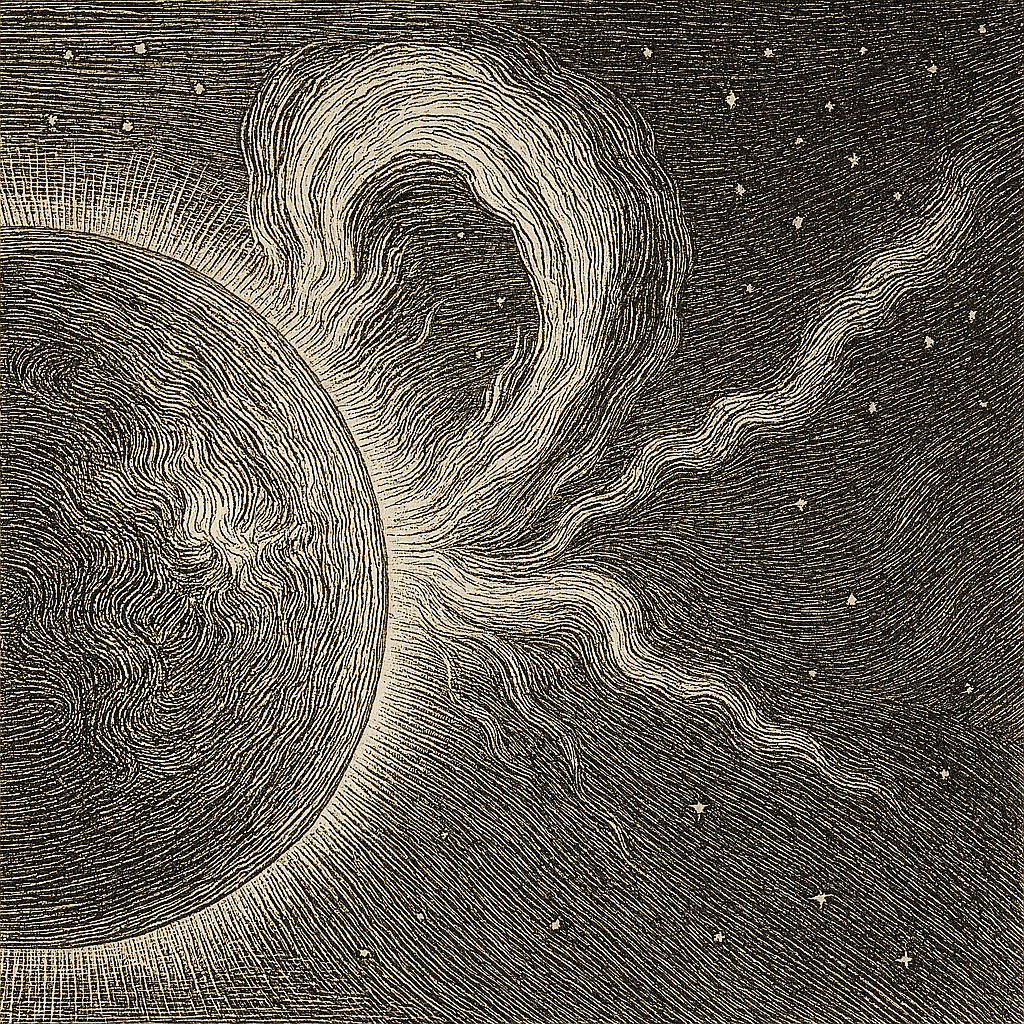
Art by James Hall
By Michael and James Hall
The following is an excerpt from Chapter Twenty‑Two of The Sword of Damocles: Our Nuclear Age by Michael and James Hall— available on Kindle, Audible, and Amazon books.
Threats to humanity don’t come only from our own earthly preoccupations—they can also arrive from the heavens. Since the era of atmospheric nuclear testing in the late 1950s and early 1960s, scientists and policymakers have worried about the strange and powerful phenomenon known as the electromagnetic pulse, or EMP.¹ A high‑altitude nuclear detonation can generate an EMP capable of disrupting sensitive, unshielded electronics across vast regions.²
High‑altitude detonations like the 1962 Starfish Prime test—taught scientists that EMPs are far more powerful and wide‑reaching than anyone had expected. When that device exploded hundreds of miles above the Pacific, it knocked out streetlights and phone systems in Hawaii over 700 miles away, revealing that an EMP could disrupt electronics across an entire region without causing blast or thermal damage on the ground. These tests also showed that a nuclear EMP has three distinct components: a lightning‑fast E1 pulse that can fry microelectronics, an E2 pulse similar to lightning, and a slow E3 pulse caused by the bomb’s interaction with Earth’s magnetic field—an effect capable of inducing damaging currents in long conductors like power lines. Scientists learned that altitude is critical: the higher the detonation, the larger the footprint of disruption. Perhaps most importantly, these tests exposed how vulnerable unshielded infrastructure can be, prompting early efforts to harden military systems and shaping modern understanding of EMP risks.
When atmospheric testing ended with the 1963 Limited Test Ban Treaty, researchers were limited to studying EMP effects through controlled underground experiments.³ Even so, they learned enough to understand that EMPs could pose a serious risk in a nuclear conflict and began developing methods to harden critical electrical systems.⁴ But modern science has revealed something even more striking: EMP‑like events are far more likely to come from nature than from war.⁵
An EMP and a CME both involve bursts of energy that can disrupt electronic systems, but they differ fundamentally in origin, speed, and impact. An EMP is typically generated by a nuclear detonation at high altitude or by specialized non-nuclear weapons, releasing a rapid, intense burst of electromagnetic radiation that can instantly disable electronics across a wide area. In contrast, a CME is a natural solar phenomenon—a massive eruption of plasma and magnetic fields from the Sun—that travels through space and may take 15 to 72 hours to reach Earth. While EMPs cause immediate, localized damage to electronics and power infrastructure, CMEs interact with Earth’s magnetosphere, potentially triggering geomagnetic storms that can induce currents in long conductors like power lines and pipelines, disrupting grids and satellites over a broader but slower timescale. EMPs are abrupt and weaponized; CMEs are cosmic and cyclical, with superstorms like the 1859 Carrington Event serving as historical reminders of their power.
Let’s study a manmade EMP to understand the science.
A nuclear‑generated EMP begins with a burst of high‑energy gamma radiation released during a detonation in the upper atmosphere.⁶ These gamma rays collide with atoms and molecules high above Earth, kicking electrons into rapid motion.⁷ As these electrons accelerate, they emit electromagnetic radiation in the form of high‑frequency radio waves.⁸ The result is a pulse spanning a wide range of frequencies—from extremely low (ELF) to very high (VHF)—capable of overwhelming unprotected electronics.⁹
Now let’s look at how nature makes an EMP.
We begin this story the way Michael Hall once opened a public talk at the Robert H. Goddard Planetarium when he served as acting director there: On the last day of August 1859, the English astronomer Richard Carrington stood in his Red Hill observatory, anxiously studying troubling activity on the Sun.¹⁰ Through specialized filters, he watched as brilliant flashes erupted across the solar surface and two dark sunspots took shape. Another astronomer, Richard Hodgson, independently recorded the same extraordinary sight.¹¹ At England’s Kew Observatory, magnetometer instruments—essentially compass needles suspended with scientific precision—began to twitch and swing, signaling a growing magnetic disturbance.¹²
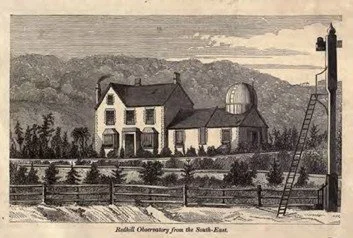
Red Hill Observatory.
Then came the nights of September 1 and 2.
Brilliant auroras—what we now call the northern lights—unfurled across the sky in colors so intense they were seen as far south as Havana, Cuba.¹³ The London Times marveled that “the whole of the northern hemisphere was illuminated as though the Sun had set an hour before”.¹⁴ Across North America, people stepped outside to find the night glowing like an unexpected dawn. But this spectacle was not a gift; it was a warning.
Earth was about to be struck by the most powerful coronal mass ejection (CME) in recorded history.¹⁵ This CME—a vast, tangled eruption of high‑energy plasma and magnetic fields, amplified by accompanying solar flares—unleashed a torrent of solar energy toward our planet.¹⁶ The impact devastated the cutting‑edge technology of the era: the copper telegraph wires that carried Morse code from pole to pole.¹⁷ In some places, telegraph systems sparked, caught fire, or continued sending messages even after operators disconnected their batteries.¹⁸
Today, we often think of telegraph networks as primitive—just a step removed from the Pony Express. History, however, reveals a burgeoning, sophisticated, and remarkably efficient communications system for its time, one that functioned reliably until it was suddenly overloaded by a solar storm.¹⁹ The storm’s auroral energy caused battery‑powered telegraph keys to erupt with sparks, sometimes igniting nearby papers.²⁰ In many offices, the batteries themselves caught fire. Yet even after some batteries were destroyed, telegraphers discovered they could still send Morse code signals powered solely by the storm’s ambient geomagnetic energy coursing through the wires.²¹ Other lines simply overloaded. The Cincinnati Daily Commercial marveled, “The hands of angels shifted the glorious scenery of the heavens”.²²
By 1859, the entire country benefited from telegraph communications, and more critically, this early technology ensured safe railroad operations across a vast and interconnected network—larger and more essential to daily commerce than the rail system we rely on today.²³ Nearly all goods and passengers traveled by rail, and that rapid transportation grid embodied the accelerating industrial revolution.
Amazingly, even in 1859, the Sun’s power could threaten that early industrial-age system of steam and wire communication. The havoc stemmed from a massive coronal mass ejection (CME) that erupted from the solar surface, associated with at least two prominent sunspots and accompanying solar flares.²⁴ Adjacent is a sketch of the double sunspot Richard Carrington observed. His notes captured the beginnings of an unfolding solar storm cascade—what we now call the Carrington Event.²⁵
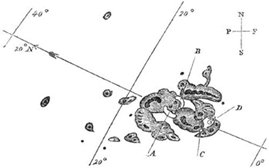
Richard Carrington’s Notes.
Most solar events are nothing like the Carrington Event. Few are directed toward Earth, and even among those that are, strong Earth‑directed CMEs are rare.²⁶ What occurred between September 1 and 2, 1859, has never been matched in intensity: a perfect alignment of a powerful CME, solar flares, and a resulting geomagnetic storm.²⁷ Yet one fact on which science is unanimous is that such events will eventually repeat themselves.²⁸
Certainly, all this vocabulary of solar weather can be confusing. So let’s take a quick science tour, because the day may come when these terms matter to all of us in understanding—and responding to—a modern natural disaster from space.
We begin with the basics. The Sun is powered by nuclear fusion and generates enormous magnetic fields through the motion of electrically charged plasma—mostly protons and electrons—within its interior.²⁹ This churning plasma acts as a dynamo, creating powerful magnetic fields and electric currents.³⁰ One visible result of this magnetic activity is the formation of sunspots: dark, cooler regions on the Sun’s surface where magnetic fields are especially strong.³¹ Sunspots can persist for days or even weeks.
Sometimes the magnetic fields around sunspots become twisted and unstable. When they suddenly realign, they release tremendous energy in the form of solar flares—intense bursts of electromagnetic radiation that span the spectrum from radio waves to X‑rays and gamma rays.³² These flares also accelerate charged particles, including electrons and protons, which can reach Earth in minutes to hours.³³ When the proton component is especially strong, scientists refer to it as a solar energetic particle event, sometimes informally called a “proton storm”.³⁴
Often accompanying these flares are much larger eruptions known as coronal mass ejections, or CMEs—billions of tons of magnetized solar plasma hurled into space at high speed.³⁵ A CME is not simply radiation; it is a massive, structured cloud of charged particles and magnetic fields.
Both flares and CMEs originate from magnetically active regions near sunspots, and both represent explosive releases of solar energy.³⁶ They can occur independently, but the most powerful flares are frequently associated with CMEs. Solar flares, being bursts of light and radiation, travel at the speed of light and reach Earth in about eight minutes.³⁷ CMEs, by contrast, travel much more slowly—typically around a million miles per hour—though the CME associated with the Carrington Event arrived in just 17 hours, an extraordinarily fast transit.³⁸ More commonly, an Earth‑directed CME takes two to three days to reach us.
A useful analogy is to imagine a cannon firing. The bright flash and expanding shock wave at the muzzle resemble a solar flare, while the CME is the projectile itself, following a defined trajectory through space. Solar flares can disrupt radio communications on Earth almost immediately, while CMEs can disturb Earth’s magnetic field, disrupt GPS signals, and in severe cases damage electrical grids.³⁹
When a CME interacts with Earth’s magnetic field, it can trigger a geomagnetic storm—a temporary disturbance in the magnetosphere, the region dominated by Earth’s magnetic field and populated by charged particles trapped within it.⁴⁰
Earth’s magnetosphere normally shields us from most solar activity, including the Sun’s steady output of X‑rays and the ever‑present solar wind. But once or twice a century, a superstorm occurs—an extreme geomagnetic event like the 1859 Carrington Event. In such cases, a powerful CME strikes Earth head‑on, and the magnetic fields of the CME and Earth can reconnect, stretching the magnetosphere into a long tail on the night side of the planet.⁴¹ Eventually, the stressed magnetic field lines snap back in a process called magnetic reconnection, releasing energy and plasma toward Earth’s weakened magnetic defenses.⁴² Many scientists believe this chain of events occurred during the Carrington Event.
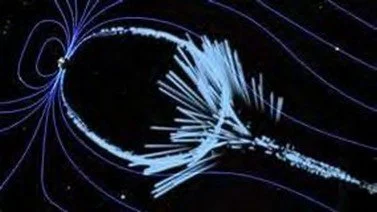
NASA's Goddard Space Flight Center Illustration.
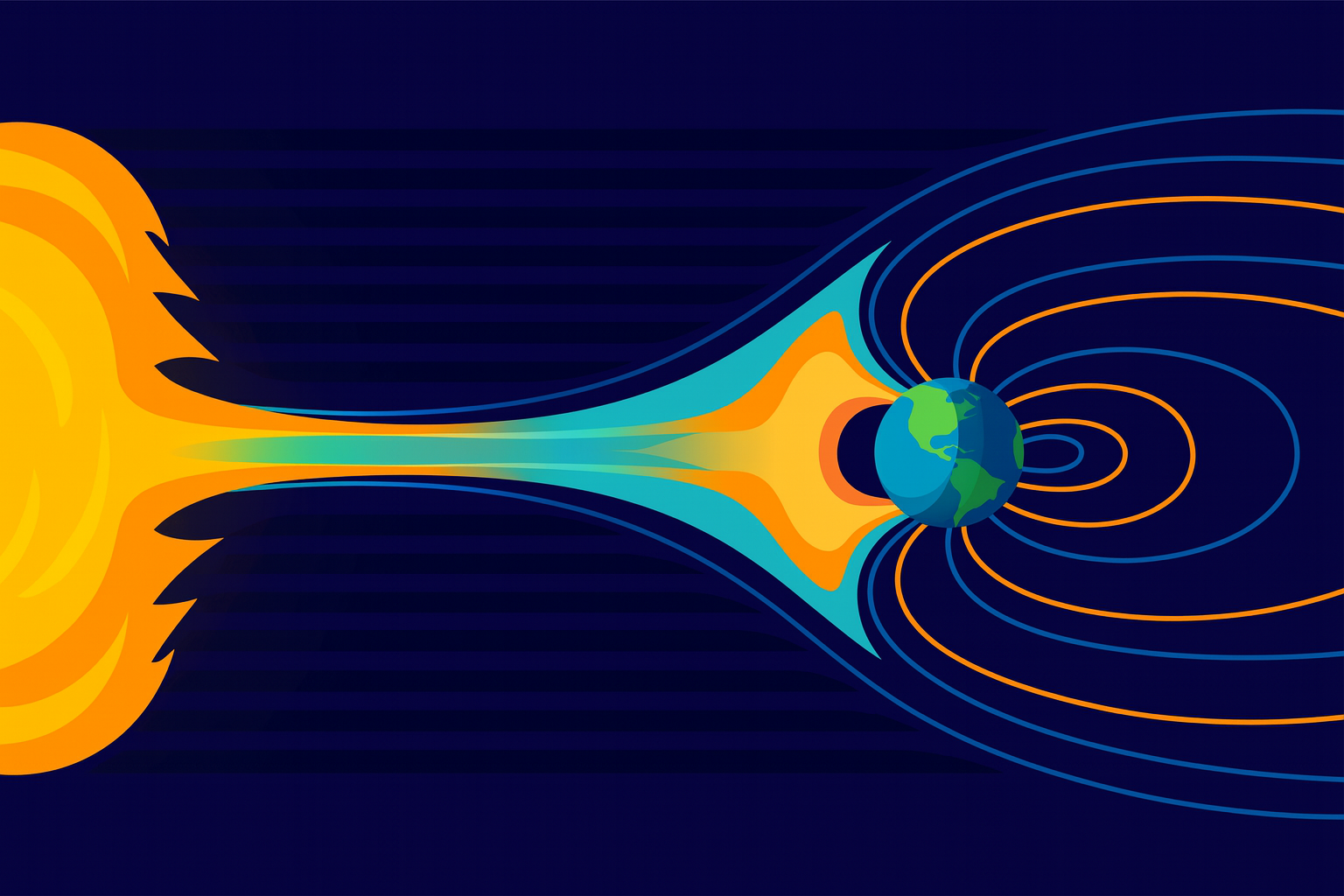
James Hall Illustration.
Fortunately, most solar storms are mild and involve only the solar wind, a continuous stream of charged particles flowing outward from the Sun.⁴³ The solar wind is often intensified when it emerges from a coronal hole, a region where the Sun’s magnetic field opens into space, allowing particles to escape more freely and influence space weather around Earth.⁴⁴
We are all familiar with the northern lights, or aurora borealis. Auroras occur when the solar wind—made of charged particles such as electrons and protons—interacts with Earth’s magnetosphere.⁴⁵ These energetic particles are guided by Earth’s magnetic field toward the polar regions, where they collide with atoms and molecules in the upper atmosphere, producing the shimmering curtains of light we see as auroras.⁴⁶ Under normal conditions, this mild space weather is harmless to humans and to most artificial electronics. Stronger solar storms, however, also produce auroras, and their sudden appearance at unusually low latitudes can serve as a warning sign of an incoming CME.⁴⁷
There is a classification system for space weather, much like the one used for hurricanes. The National Oceanic and Atmospheric Administration (NOAA) categorizes solar radiation storms on a scale from S1 to S5, geomagnetic storms from G1 to G5, and radio blackouts caused by solar flares from R1 to R5.⁴⁸ Solar flares themselves are classified by their X‑ray brightness using the A, B, C, M, and X scale, with each letter representing a ten‑fold increase in energy.⁴⁹ Within each class, a number from 1 to 9 provides finer detail.
Space weather is a fascinating and rapidly advancing field—and you can follow it just like a weather forecast. NASA’s heliophysics missions continuously monitor the Sun⁵⁰ and NOAA’s Space Weather Prediction Center issues daily forecasts and alerts.⁵¹ Like terrestrial meteorology, these predictions are not perfect, but they improve each year as models and instrumentation evolve. Many professionals rely on these forecasts because solar activity affects aviation, communications, satellites, and navigation systems on a routine basis.⁵²
The Sun also follows an approximately 11‑year solar cycle, during which its magnetic poles flip, alternating between solar minimum and solar maximum.⁵³ We are currently entering another period of heightened activity, so it is an excellent time to stay informed through resources such as spaceweather.com.⁵⁴
The Carrington Event remains the most extreme example of what can go wrong when the Sun unleashes its full power. Richard Carrington is remembered today as one of the first space‑weather observers⁵⁵. Yet the 162 years since that event are only a blink in geological time. Modern scientific techniques now reveal that Earth has experienced many solar outbursts comparable to—or even exceeding—the Carrington Event.⁵⁶
For example, tree rings from Japanese cedar trees dating to 775 AD show a dramatic 20 percent increase in carbon‑14, a radioactive isotope formed when cosmic rays strike nitrogen in the atmosphere.⁵⁷ Similar events are recorded in tree‑ring data from 660 BC and 1021 AD.⁵⁸ Ice‑core analyses reveal additional major solar outbursts around 5259 BC and 7176 BC.⁵⁹ In 2023, an international research team identified an enormous radiocarbon spike from 14,300 years ago in ancient Alpine tree rings⁶⁰. Even our nearest stellar neighbor, Proxima Centauri, produces comparable superflares, which astronomers have documented.⁶¹
Serious solar events, therefore, are not rare when viewed across long timescales. Even moderate events occur regularly. Only thirteen years after the Carrington Event, in 1872, another significant geomagnetic disturbance affected telegraph systems worldwide.⁶² Then, in May 1921, a powerful solar storm disrupted telegraph and telephone networks, sparked fires in communication lines, and damaged early electrical fuses. This event became known as the “New York Railroad Superstorm” because it disrupted rail communications and even affected undersea telegraph cables.⁶³
Another major disturbance occurred in 1940. On March 24, a series of solar flares and one or more interacting CMEs produced widespread interference in long‑line communication and power systems across the United States and parts of Canada.⁶⁴ Researchers believe that interacting bursts of solar wind generated an unusually intense geomagnetic storm, inducing strong geoelectric fields in Earth’s crust. These fields drove anomalous currents through grounded long‑wire communication and power‑transmission systems, causing significant operational disruptions.⁶⁵
Several decades later, additional potentially disastrous events occurred as a result of the Sun’s energy. In 1967, a moderate solar storm disrupted US early‑warning radar systems used to detect incoming missiles.⁶⁶ For several tense hours, military officials believed the outage might be the result of Soviet interference. Only rapid analysis by space‑weather scientists—who recognized the signature of a solar radio burst—prevented a catastrophic misinterpretation.⁶⁷
In 1972, a powerful solar flare caused widespread telephone disruptions in Illinois.⁶⁸ That same year, an unusually fast CME detonated naval mines off the coast of Vietnam—an early demonstration of how geomagnetic disturbances can induce unexpected electrical currents.⁶⁹ In 1989, a geomagnetic storm collapsed the Hydro‑Québec power grid, leaving six million people without electricity for more than nine hours.⁷⁰ In 2003, the so‑called Halloween Storms damaged satellites, disrupted aviation communications, and forced the temporary shutdown of part of Sweden’s power grid.⁷¹ In 2005, another solar storm caused GPS receivers to fail for roughly ten minutes—an eternity for systems that depend on precise timing.⁷²
In 2012, the Sun produced a massive CME comparable in intensity to the Carrington Event.⁷³ Fortunately, Earth had rotated out of the line of fire by the time the plasma wave crossed our orbit. Had the timing been slightly different, the impact on modern electronics, the power grid, GPS satellites, and global communications could have been devastating. It is not a question of if such an event will recur, but when.⁷⁴
This raises a critical question: How will our modern infrastructure fare, given its deep dependence on advanced, highly sensitive electronics that can be overloaded by geomagnetic energy? On this front, there is both good news and bad news.
The good news is that many military systems are now hardened against EMPs, and those protections also offer resilience against CME‑induced geomagnetic disturbances.⁷⁵ Decades of research dating back to atmospheric nuclear testing helped engineers develop shielding techniques.⁷⁶ Satellites, too, are being designed with improved radiation tolerance.⁷⁷ And although the US power grid remains vulnerable, there are known engineering solutions—such as transformer protection devices and improved grounding—that could significantly reduce risk.⁷⁸ The cost of implementing these measures is small compared to the cost of losing the grid.
The bad news is that if a Carrington‑level event occurred tomorrow, global communications could fail outright. Modern civilization runs on the internet, and the internet runs on a vast network of interconnected computer systems. The financial sector is especially dependent on uninterrupted communication. One of the greatest vulnerabilities lies in the undersea fiber‑optic cables that carry the majority of international data traffic.⁷⁹ While the glass fibers themselves are immune to geomagnetic currents, the electronic repeaters spaced along the cables every 50–100 miles are not.⁸⁰ A sufficiently strong geomagnetic storm could overload and destroy these repeaters, severing transoceanic connectivity.
Computer scientist Sangeetha Abdu Jyothi at UC Irvine has warned that a severe solar storm could disable these undersea repeaters, potentially fragmenting the global internet for weeks or months.⁸¹ Repairs would be slow and difficult. Land‑based fiber‑optic cables are less vulnerable because they are shorter and require fewer repeaters, but they are not immune. The internet does have redundancy, and traffic could be rerouted, but bandwidth would be sharply reduced. Meanwhile, as technologist Ross Schulman notes, the “last mile” connections—modems, routers, and local infrastructure in homes and businesses—are extremely vulnerable to power surges and geomagnetically induced currents.⁸²
Of course, computers, communication cables, and even burned‑out microchips can eventually be replaced. Some cloud‑based data might survive. But would banks retain accurate account balances? Would your cloud documents still exist? Would your laptop’s data be recoverable? Would the electronics in your car or phone be permanently damaged? Cryptocurrencies, which rely entirely on digital ledgers, could effectively vanish if enough nodes were destroyed.⁸³
There are many unknowns about how a truly intense solar storm would affect our digital world. No one can offer definitive answers—only informed warnings⁸⁴.
Yet without electrical power, none of these concerns matter. Nothing in modern civilization functions without it. The central question becomes: How severe would a geomagnetic storm need to be to disable the power grid? Significant damage to an aging, highly interconnected grid—such as those in the United States and Europe—would not be repaired in weeks or even months, as might be the case with internet infrastructure or electronics. Restoring a crippled power grid could take years.⁸⁵
In theory, if operators receive sufficient warning, portions of the grid can be deliberately shut down or generation reduced to prevent catastrophic damage.⁸⁶ This strategy has been used during moderate solar storms, but it has never been tested under Carrington‑level conditions.⁸⁷ Shutting down an entire national grid would require rapid coordination, political resolve, and absolute confidence in the forecast. A powerful X‑class flare would offer no warning at all, but a well‑predicted CME—traveling more slowly—might.⁸⁸ Even so, hardening the grid remains the more realistic and responsible approach, drawing on decades of research into EMP protection dating back to the era of nuclear testing.⁸⁹
Political and logistical barriers, however, make such preventive action difficult. No modern government has ever ordered a nationwide shutdown of the electrical grid based on a space‑weather forecast.⁹⁰ The practical challenges are immense. For example, high‑voltage transformers—the backbone of long‑distance power transmission—would likely be destroyed by a major CME if they were still energized.⁹¹ The same vulnerability exists for a strong EMP generated during a nuclear detonation.⁹² Cyberattacks could also trigger physical damage by manipulating grid control systems into dangerous overloads⁹³. These components are extraordinarily difficult to replace.
As the US Department of Energy notes, “Power transformers are a critical component of the transmission system because they adjust the electric voltage to a suitable level on each power transmission segment from generation to the end user.”⁹⁴ There are no large reserve stockpiles of these transformers. If many were damaged simultaneously, the consequences would be severe.
Manufacturing a single large transformer takes 12 to 24 months under ideal conditions, and most are no longer produced domestically.⁹⁵ Only about twenty facilities worldwide manufacture them, with only six located in the United States⁹⁶. And without power, even those factories could not operate. The current network of transformers took decades to build. Many of the largest units were delivered via rail lines that no longer exist, complicating any future replacement efforts.⁹⁷
A Department of Energy report explains:
“Large power transformers (LPTs) are custom-designed equipment that entail significant capital expenditures and long lead times… The result is the possibility of extended lead times that could stretch beyond 20 months if the manufacturer has difficulty obtaining certain key parts or materials.”⁹⁸
Not all transformers are large, of course. The grid also depends on tens of thousands of smaller distribution transformers, which are themselves difficult to replace quickly because there are no substantial reserve inventories⁹⁹. Few people realize how antiquated, patchworked, and fragile the US grid truly is. Europe faces similar challenges with its own interconnected system.¹⁰⁰
A brief look at history underscores how dramatically our dependence on electricity has grown. A century ago, a power outage was inconvenient but hardly catastrophic; many Americans did not yet have electricity at all.¹⁰¹ Fifty years ago, losing power was disruptive, but banking, commerce, transportation, and food distribution could continue. Today, a prolonged outage would create life‑threatening conditions for hundreds of millions of people.¹⁰² The US grid now supports a deeply computerized, interdependent infrastructure tied together by the internet. It has become a symbiotic system, with each component relying on the others.
For most Americans, a power outage lasting more than two hours is now a major and stressful event. A long‑duration outage—regional or national—would be unprecedented in its consequences.
It is striking to consider how our electrical infrastructure became so interconnected—and so dependent on every other system. Today, the US power grid is divided into several major “interconnections,” including the Eastern, Western, and Texas grids, along with smaller regional systems.¹⁰³ Although it appears to be a highly engineered modern marvel—and in many ways it is—it is also a patchwork system that evolved piecemeal over more than a century. The grid now includes roughly 360,000 miles of transmission lines, about 180,000 miles of which are high‑voltage, and is owned and operated by more than 3,000 utilities, supplied by 7,000 power plants, and supported by 55,000 substations.¹⁰⁴ It is vast, complex, and deeply vulnerable.
In the 1870s and 1880s, electrification was hyper‑local. Some communities—and even individual buildings—operated their own direct‑current generators to power arc lights.¹⁰⁵ There were no regional or national grids. Towns with electricity were completely independent from one another. In 1882, Thomas Edison’s early electric utility in New York used low‑voltage direct current (LVDC) to power incandescent lighting in homes and businesses.¹⁰⁶ But engineers soon recognized the advantages of alternating current (AC). With AC, championed by Nikola Tesla, transformers could raise and lower voltages, enabling electricity to travel far greater distances with far less loss.¹⁰⁷
By 1885, AC systems—promoted by George Westinghouse and built using Siemens alternators and Gaulard‑Gibbs transformers—began spreading electricity outward from cities into surrounding towns.¹⁰⁸ Power companies proliferated. They grew, failed, merged, and re‑formed. Gradually, a web of wires expanded and interlinked into regional grids.¹⁰⁹
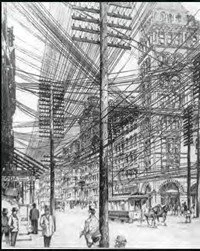
At the turn of the 20th century, competition was chaotic. In some cities, three or more power companies operated simultaneously, each stringing its own unregulated tangle of wires.¹¹⁰ A single building might have dozens or even hundreds of wires entering it because tenants subscribed to different providers. By the 1920s, this system had reached a breaking point. Utilities began forming “Joint Operations” to share peak loads and provide mutual backup.¹¹¹ In 1934, the Public Utility Holding Company Act introduced federal oversight, while President Franklin Roosevelt pushed for massive rural electrification during the Great Depression.¹¹²
Hydroelectric projects soon followed, and utilities consolidated into vertically integrated monopolies that controlled generation, transmission, and distribution.¹¹³ Power lines spread across states and regions, electrifying farms, towns, and cities. Outages were common, but most Americans still remembered life before electricity, so temporary blackouts were tolerated. World War II accelerated the expansion of electrical infrastructure, as did the enormous power demands of the Manhattan Project.¹¹⁴ Oppenheimer did not invent atomic energy—he led the team that harnessed principles nature had always held—but the electrical requirements for uranium enrichment were staggering.¹¹⁵
After World War II, electrification reached even the most remote farms. The nation’s energy consumption grew rapidly. By 1955, the Atomic Energy Commission’s nuclear weapons program consumed nearly eight percent of all US electricity.¹¹⁶ Every sector of the economy became dependent on reliable power. It became clear that a modern society does not merely suffer without electricity—it ceases to function.
Then came deregulation. The Public Utilities Regulatory Policies Act (1978) allowed independent power producers to sell excess electricity to utilities.¹¹⁷ The Energy Policy Act of 1992 opened transmission networks to competition.¹¹⁸ This created a more complex and less coordinated system. By the 1990s, private companies could access the grid, but vertically integrated utilities resisted competition and attempted to block access to their transmission lines.¹¹⁹ Federal regulators intervened, mandating open access and paving the way for Independent System Operators (ISOs)—nonprofit entities that manage regional transmission¹²⁰. Computerization improved efficiency but introduced new cyber‑physical vulnerabilities.¹²¹ As Professors Manimaran Govindarasu and Adam Hahn note, “The grid has been physically vulnerable for decades”.¹²²
Modern history has shown how fragile the system can be. One of the most significant failures occurred in 2003, during the “Northeast Blackout.” Power outages swept across the Northeastern and Midwestern United States and Ontario. Some areas were dark for days; others for nearly a week. At least 50 million people lost power¹²³. The cause was a cascade triggered by a high‑voltage line in Ohio sagging into overgrown trees, combined with a software failure that prevented operators from seeing alarms¹²⁴. The resulting domino effect shut down 508 generating units and 265 power plants.¹²⁵
The 2003 blackout, though brief, offered a sobering preview of what even a short‑term grid failure can unleash. Water systems lost pressure, raising contamination risks.¹²⁶ Rail service halted. Airport security and ticketing systems failed. Gas stations without generators could not pump fuel. Refineries fell behind, creating shortages that lasted weeks. Fewer than 10 percent of traffic signals had backup power.¹²⁷ Factories shut down. Cellular networks collapsed as tower generators ran out of fuel. ATMs and internet services failed. In New York City, improper candle use caused 3,000 fires, and misuse of generators and grills led to deadly carbon monoxide poisoning.¹²⁸ More than 100 deaths were linked to the blackout.
Yet even these disruptions pale in comparison to what a long‑term outage would mean. Most US cities maintain only a three‑day supply of food.¹²⁹ Just one percent of the population produces food for the other 99 percent, relying on fuel, electricity, and a tightly synchronized, internet‑dependent distribution network.¹³⁰ FEMA and the US military could support one major city—or perhaps a small region—during an extended outage. But if the entire nation lost power, no emergency system could supply even half the population with food and water.¹³¹ Such a scenario is beyond current planning capacity.
Preventing such a catastrophe requires understanding the threats—solar, cyber, and otherwise—and strengthening the grid before a crisis forces our hand.
Other threats, of course, exist. The United States first began to understand the scientific principles behind the electromagnetic pulse (EMP) effects of nuclear weapons in the 1950s.¹³² Robert Oppenheimer and his colleagues had some theoretical awareness of such phenomena even before the first atomic bomb was tested, but the full scope of EMP effects was not yet understood.¹³³ Because atmospheric nuclear testing ended before EMP science was fully developed, it took decades of specialized research—conducted during nearly 1,000 underground nuclear tests after the 1963 Limited Test Ban Treaty—to study EMP‑related physics indirectly.¹³⁴
Since US nuclear testing ended in 1992, Western nations have not publicly pursued weapons designed specifically to maximize nuclear‑based EMP effects.¹³⁵ One major reason is that such devices are considered first‑strike, offensive weapons. While any nuclear detonation can generate an EMP, disabling another nation’s power grid and electronic infrastructure requires a highly specialized design: a device engineered for extremely intense, multi‑phased gamma‑ray output capable of producing peak electric fields on the order of 200,000 volts per meter¹³⁶. These weapons must be detonated at precise high altitudes to maximize their electromagnetic reach. Such devices—sometimes referred to as super‑EMP weapons—are associated with what analysts call “blackout warfare.”¹³⁷
Because these weapons serve no defensive purpose and are useful only in a surprise attack, the United States has never officially deployed them¹³⁸. The US now relies instead on non‑nuclear electromagnetic weapons for tactical, localized electronic disruption¹³⁹. However, according to congressional assessments, it is highly likely that Russia, China, and North Korea have pursued or developed nuclear devices optimized for EMP effects.¹⁴⁰
The Washington Free Beacon reported:
“Russian nuclear missile submarines could use super‑EMP warheads to paralyze US strategic and conventional forces and blackout the national grid.”¹⁴¹
“Additional EMP strikes could disable missile and bomber wings in North Dakota, Wyoming, and Montana, as well as bomber bases in Missouri, Louisiana, South Dakota, and Texas, and submarine bases in Washington and Georgia.”¹⁴²
The lesson of this chapter is not simply that both the Sun and nuclear weapons can produce similar electromagnetic disturbances. The deeper message is how vulnerable our technological civilization has become—and how completely dependent, if not captive, we are to our electronic systems¹⁴³. In ancient times, many cultures worshiped the Sun as a deity¹⁴⁴. Today, science shows us that the Sun possesses, in a figurative sense, the destructive power once attributed to gods.
We are creatures of both heaven and Earth, facing threats born of human invention and threats arising from nature’s own forces. Science gives us the tools to understand and mitigate these dangers—but only if we respect them, prepare for them, and act before disaster strikes.
From Chapter Twenty‑Two of The Sword of Damocles: Our Nuclear Age by Michael and James Hall— available on Kindle, Audible, and Amazon books.
(Prior to the publication of our book during the third week of May 2024, one of the largest sunspots in modern history was recorded on the Sun with one of the largest of all CMEs. We just missed an Earth-directed trajectory with that event and our modern civilization had a very lucky and narrow escape.)
(Just a few nights ago, Earth found itself in the path of one of the most powerful solar storms in a generation. What began as an X‑class solar flare on January 18th, 2026, unfurled into a full coronal mass ejection on the 19th and 20th—a celestial upheaval hurled across ninety‑three million miles of vacuum straight toward us.
From an unusually volatile sunspot, the flare tore loose and flung a tide of charged particles into space. When that tide slammed into Earth’s magnetic shield, the sky answered in color. Curtains of green and red shimmered across the night like the breath of some ancient cosmic furnace, reminding us that our star is both life‑giver and unpredictable force.
And yet, despite the storm’s ferocity, our technological world held its ground. No major blackouts, only brief stumbles in navigation systems and a few anxious hours for satellite operators. Still, the moment carried weight. Space weather is not a distant abstraction—it is a hand that can reach into our circuitry, our infrastructure, our daily rhythms.
This storm passed without catastrophe, but it offered a sobering glimpse of how fragile our electronics‑bound civilization could be in the face of a truly extreme solar even.)
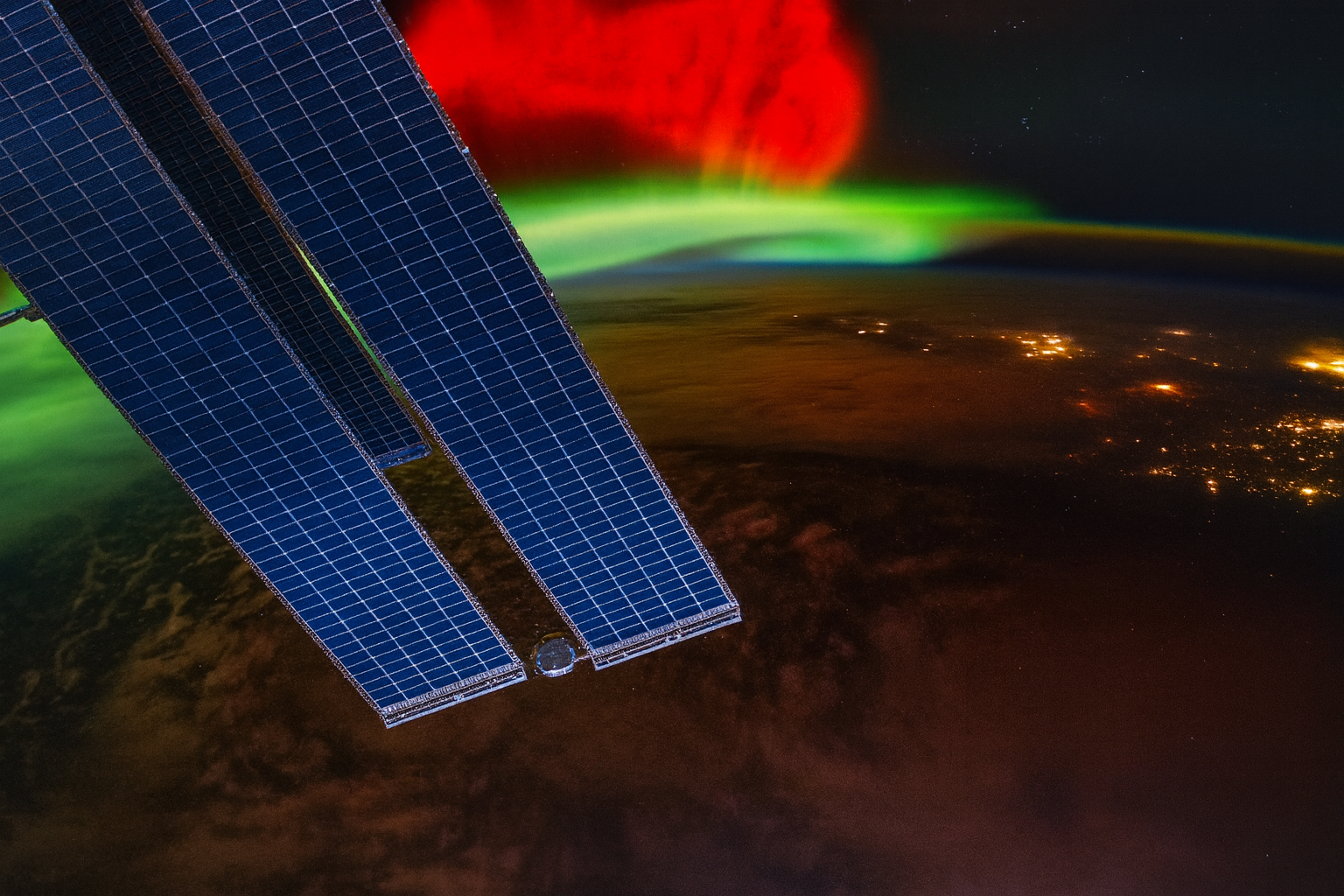
Fresh in from NASA — This is What Struck Earth Early Tuesday Morning, January 20th, 2026.
Footnotes:
1. U.S. Defense Threat Reduction Agency, Electromagnetic Pulse (EMP) and Its Effects, declassified technical overview.
2. Glasstone & Dolan, The Effects of Nuclear Weapons (U.S. Dept. of Defense & Dept. of Energy, 1977).
3. Limited Test Ban Treaty (1963), U.S. State Department historical summary.
4. EMP Commission Report (2004), Report of the Commission to Assess the Threat to the United States from Electromagnetic Pulse Attack.
5. National Research Council, Severe Space Weather Events—Understanding Societal and Economic Impacts (2008).
6. U.S. Department of Energy, High-Altitude Electromagnetic Pulse (HEMP) Physics.
7. J. G. Foster et al., EMP Commission Technical Volume II (2008).
8. IEEE Transactions on Electromagnetic Compatibility, foundational papers on EMP waveform generation.
9. U.S. Air Force Phillips Laboratory, HEMP Environment and Effects (1994).
10. Richard C. Carrington, “Description of a Singular Appearance seen in the Sun,” Monthly Notices of the Royal Astronomical Society (1860).
11. Richard Hodgson’s independent account in The London Illustrated News (1860).
12. Kew Observatory magnetogram archives, Royal Society collections.
13. Stuart Clark, The Sun Kings (Princeton University Press, 2007).
14. The London Times, September 1859 aurora coverage (archival reprints).
15. NASA Goddard Space Flight Center, The Carrington Event of 1859 (historical solar physics summary).
16. NOAA Space Weather Prediction Center, CME historical analyses.
17. Telegraph system failures documented in The New York Times, September 1859.
18. Accounts compiled in the U.S. Geological Survey report, The Carrington Event: What Happened and What Could Happen Again.
19. U.S. Geological Survey, The Carrington Event: What Happened and Why It Matters (historical overview of telegraph impacts).
20. The New York Times, September 1859 telegraph reports; also cited in Stuart Clark, The Sun Kings (Princeton University Press, 2007).
21. National Oceanic and Atmospheric Administration (NOAA), Space Weather Prediction Center, historical accounts of induced currents during the 1859 storm.
22. Cincinnati Daily Commercial, September 1859 aurora coverage (archival reprint).
23. John F. Stover, History of the American Railroads (University of Chicago Press), chapters on mid‑19th‑century telegraph‑rail integration.
24. NASA Goddard Space Flight Center, The Carrington Event of 1859 (solar physics summary).
25. Richard C. Carrington, “Description of a Singular Appearance seen in the Sun,” Monthly Notices of the Royal Astronomical Society (1860).
26. National Research Council, Severe Space Weather Events—Understanding Societal and Economic Impacts (2008).
27. NOAA SWPC, historical geomagnetic storm intensity rankings.
28. U.S. National Academies of Sciences, Space Weather: A Research Perspective (consensus on recurrence of extreme solar events).
29. NASA Solar Physics Division, The Structure and Dynamics of the Solar Interior.
30. National Research Council, The Sun as a Magnetic Dynamo (2008).
31. NASA Goddard Space Flight Center, What Are Sunspots?
32. NOAA Space Weather Prediction Center, Solar Flares: Classification and Effects.
33. European Space Agency (ESA), Solar Energetic Particles: Origins and Travel Times.
34. NASA Heliophysics Division, Solar Energetic Particle Events.
35. NASA Goddard, Coronal Mass Ejections: An Overview.
36. Space Studies Board, Understanding Solar Eruptive Events (National Academies Press).
37. NASA, Solar Radiation and Light-Speed Travel Time to Earth.
38. U.S. Geological Survey, The Carrington Event: Arrival Time and Impact.
39. EMP Commission, Vulnerability of Critical Infrastructure to Geomagnetic Disturbances.
40. NOAA SWPC, Geomagnetic Storms and the Magnetosphere.
41. National Academies, Severe Space Weather Events—Societal and Economic Impacts.
42. NASA, Magnetic Reconnection Explained.
43. ESA, The Solar Wind: Properties and Variability.
44. NASA, Coronal Holes and High-Speed Solar Wind Streams.
45. NASA Goddard Space Flight Center, What Causes Auroras?
46. European Space Agency (ESA), Auroral Physics Overview.
47. NOAA SWPC, Auroras as Indicators of Geomagnetic Disturbance.
48. NOAA Space Weather Scales (S, G, R classifications).
49. NASA Heliophysics Division, Solar Flare Classification System.
50. NASA Heliophysics System Observatory mission summaries.
51. NOAA Space Weather Prediction Center, Daily Forecasts and Alerts.
52. FAA & ICAO reports on solar impacts to aviation and communications.
53. National Research Council, The Solar Cycle and Its Effects.
54. Spaceweather.com, Solar Cycle Monitoring Resources.
55. Richard C. Carrington, MNRAS (1860), original sunspot observations.
56. National Academies, Severe Space Weather Events—Understanding Societal and Economic Impacts.
57. Miyake et al., Nature (2012), discovery of the 775 AD radiocarbon spike.
58. Subsequent Miyake‑event studies in Nature Communications and PNAS.
59. Ice‑core cosmogenic isotope analyses from the NGRIP and Dome Fuji cores.
60. International radiocarbon study (2023), Philosophical Transactions of the Royal Society A.
61. NASA & ESO observations of Proxima Centauri superflares.
62. Historical geomagnetic storm reports compiled by the Royal Astronomical Society.
63. USGS, The 1921 New York Railroad Superstorm.
64. NOAA & USGS joint analysis of the 1940 geomagnetic storm.
65. Geoelectric field modeling studies published in Space Weather Journal.
66. U.S. Air Force & NOAA historical analysis of the 1967 solar radio burst and radar blackout.
67. National Research Council, Severe Space Weather Events—Understanding Societal and Economic Impacts.
68. Illinois Bell Telephone archives; NOAA solar flare impact summaries.
69. U.S. Navy records; NASA Goddard report on the 1972 CME and naval mine detonations.
70. Hydro‑Québec & Canadian Space Agency report on the 1989 geomagnetic storm.
71. NOAA SWPC, The 2003 Halloween Storms; ESA satellite anomaly reports.
72. FAA & GPS Operations Center reports on 2005 GPS disruptions.
73. NASA, Near‑Miss: The 2012 Solar Superstorm.
74. National Academies, Space Weather: A Research Perspective.
75. EMP Commission Report (2008), Critical Infrastructure Protection.
76. U.S. Department of Defense, EMP hardening research from atmospheric test era.
77. NASA & ESA satellite radiation‑hardening guidelines.
78. U.S. Department of Energy, Geomagnetic Disturbance Mitigation Strategies.
79. Internet Society, Global Submarine Cable Infrastructure Overview.
80. IEEE Communications Society, Vulnerability of Undersea Cable Repeaters to Geomagnetic Disturbances.
81. Sangeetha Abdu Jyothi, Solar Superstorms: Planning for an Internet Apocalypse (ACM SIGCOMM, 2021).
82. Ross Schulman, New America Foundation, Infrastructure Vulnerabilities to Solar Storms.
83. Cryptocurrency network resilience studies in IEEE Security & Privacy.
84. NOAA SWPC, Extreme Space Weather Scenarios and Uncertainties.
85. National Academies of Sciences, Severe Space Weather Events—Societal and Economic Impacts.
86. North American Electric Reliability Corporation (NERC), Geomagnetic Disturbance Operating Procedures.
87. NOAA SWPC, Historical Geomagnetic Storm Response Records.
88. NASA Heliophysics Division, CME transit‑time variability studies.
89. EMP Commission Report (2008), Infrastructure Hardening Lessons from Nuclear Testing.
90. Congressional Research Service, Electric Grid Vulnerability to Space Weather.
91. U.S. Department of Energy, Geomagnetic Disturbance Vulnerability Assessment.
92. Defense Threat Reduction Agency, EMP Effects on Power Infrastructure.
93. Department of Homeland Security, Cyber‑Physical Vulnerabilities in the Power Grid.
94. U.S. Department of Energy, Large Power Transformers and the U.S. Electric Grid.
95. International Energy Agency, Transformer Supply Chain Constraints.
96. DOE Office of Electricity, Transformer Manufacturing Capacity Report.
97. Federal Energy Regulatory Commission (FERC), Transmission Infrastructure Challenges.
98. DOE, Large Power Transformers and the U.S. Electric Grid, p. 29.
99. Edison Electric Institute, Distribution Transformer Supply Chain Assessment.
100. European Network of Transmission System Operators (ENTSO‑E), Grid Resilience Report.
101. U.S. Census Bureau, Historical Electrification Statistics.
102. American Society of Civil Engineers, Infrastructure Report Card: Energy Sector.
103. U.S. Energy Information Administration (EIA), U.S. Electric System Overview.
104. Department of Energy, Quadrennial Energy Review: Transmission, Storage, and Distribution.
105. Smithsonian Institution, Early Electric Lighting Systems.
106. Edison Electric Institute, History of the Electric Power Industry.
107. IEEE Power Engineering Society, AC vs. DC Transmission History.
108. Westinghouse Archives, Development of AC Power Systems.
109. National Academy of Engineering, Electrification Timeline.
110. New York Public Service Commission historical records.
111. Federal Power Commission, Early Utility Coordination Efforts.
112. Rural Electrification Administration, Historical Reports.
113. DOE, Vertically Integrated Utilities: Historical Structure.
114. Oak Ridge National Laboratory, Electric Power Requirements of the Manhattan Project.
115. Atomic Energy Commission, Uranium Enrichment Energy Demands.
116. AEC Annual Report (1955).
117. Public Utilities Regulatory Policies Act (PURPA), 1978.
118. Energy Policy Act of 1992, Title VII.
119. FERC Order No. 888 (1996), Open Access Transmission.
120. ISO/RTO Council, History of Independent System Operators.
121. NERC, Cyber‑Physical Vulnerabilities in the Grid.
122. Govindarasu & Hahn, Cyber‑Physical Systems Security for the Smart Grid.
123. U.S.–Canada Power System Outage Task Force, Final Report on the 2003 Blackout.
124. FirstEnergy Corporation incident analysis.
125. North American Electric Reliability Council (NERC), Event Analysis.
126. EPA, Water System Failures During the 2003 Blackout.
127. Department of Transportation, Traffic Signal Backup Study.
128. New York City Fire Department (FDNY), 2003 Blackout Incident Summary.
129. USDA, Food Supply Chain Vulnerability Assessment.
130. American Farm Bureau Federation, U.S. Agricultural Productivity Statistics.
131. FEMA, National Preparedness Report: Infrastructure Limitations.
132. U.S. Defense Threat Reduction Agency, EMP Effects Primer (declassified historical overview).
133. Richard Rhodes, The Making of the Atomic Bomb (discussions of early theoretical EMP awareness).
134. U.S. Department of Energy, Underground Nuclear Testing and EMP Research; Limited Test Ban Treaty historical summaries.
135. Congressional Research Service, Nuclear Weapons: EMP Effects and Policy Considerations.
136. EMP Commission (2008), Critical National Infrastructures Report, technical appendix on super‑EMP field strengths.
137. Peter Pry, Electric Armageddon: Blackout Warfare (analysis of super‑EMP concepts).
138. Department of Defense, Nuclear Posture Review (publicly available sections).
139. U.S. Air Force Research Laboratory, Non‑Nuclear Electromagnetic Weapons Overview.
140. U.S. Congressional EMP Commission, Foreign Adversary EMP Programs.
141. Washington Free Beacon, reporting on Russian super‑EMP capabilities (archival article).
142. Ibid.
143. National Academies, Severe Space Weather Events—Societal and Economic Impacts.
144. Oxford Classical Dictionary, entries on solar deities in ancient cultures; and NASA Heliophysics Division, Solar Energetics and Extreme Events; and FEMA, National Preparedness Report: High‑Impact, Low‑Frequency Events.