
What’s the Latest in Disclosure?
By James Hall,
Co-author of the popular "The Sword of Damocles: Our Nuclear Age," now on Audible, Kindle and Amazon books.
The modern Unidentified Aerial Phenomena (UAP) disclosure movement has reached a fascinating, fractured crossroads. What once appeared to be a unified front of whistleblowers and journalists marching toward transparency has evolved into a far more complex narrative. Today, the conversation is defined by a developing narrative over who controls the information, surprising new connections between alleged legacy programs, and a striking bridge being built between hard military science and human consciousness.
We can best understand this shifting landscape through the lenses of two dynamic, honorable individuals at the forefront of recent headlines.
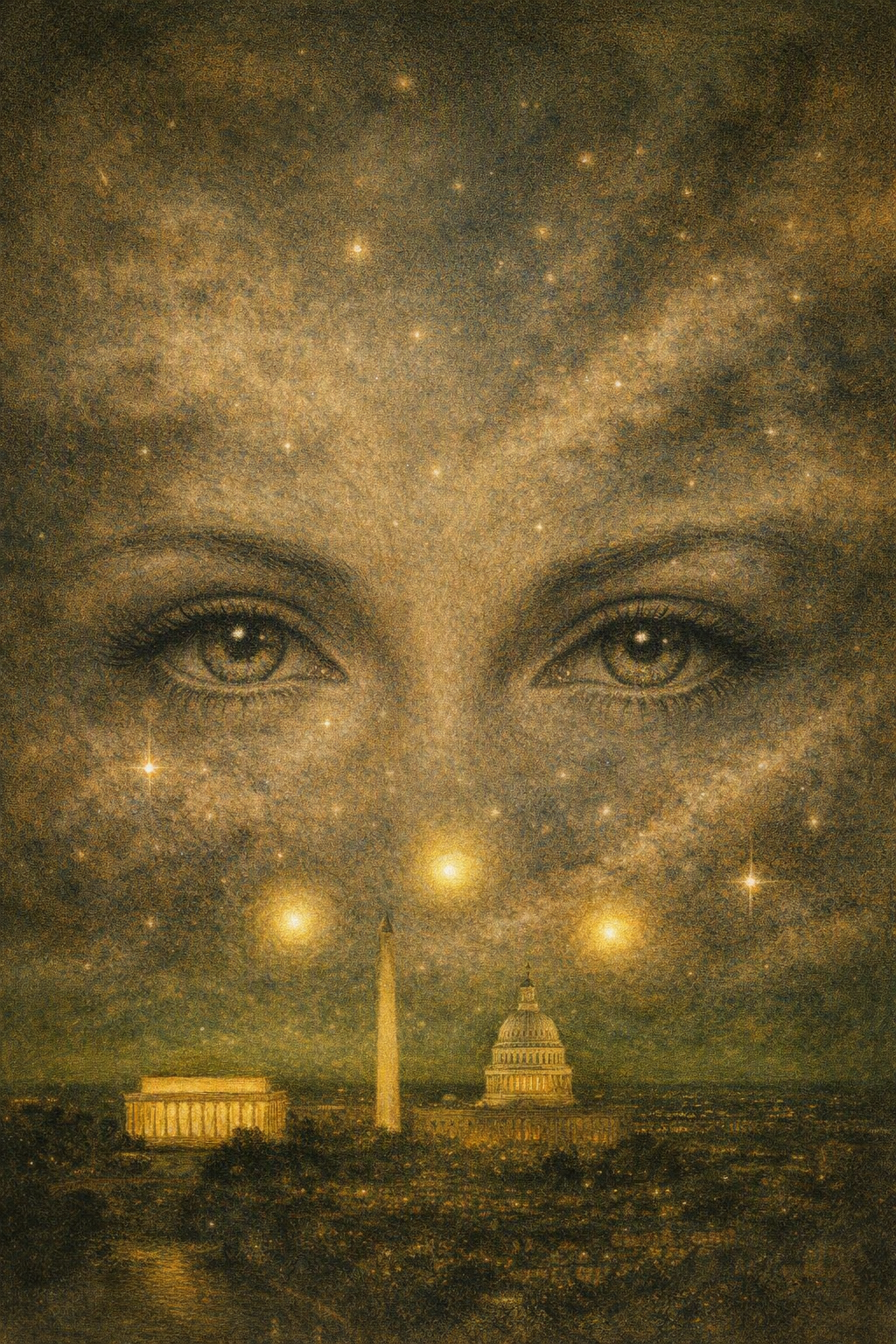
“Power and perception converge—and the line between observer and observed begins to dissolve.”
Art and poetry by James Hall
The Insider within Two Worlds: Sarah Gamm
To understand how far the disclosure lens has widened, one need look no further than Sarah Gamm—a figure who has earned significant respect and admiration within the research community.
For months, she has been a familiar voice on prominent UAP news platforms, but it is her background that gives her perspective notable weight. Gamm is a former imagery and intelligence analyst with a Bachelor’s degree in Astrophysics and a Master’s in Countering Weapons of Mass Destruction. Her professional résumé includes extensive work with the National Geospatial-Intelligence Agency (NGA) and a joint assignment under the Office of the Director of National Intelligence (ODNI).
Crucially, Gamm served as an analyst supporting the UAP Task Force (UAPTF)—the Pentagon predecessor to what is now the All-domain Anomaly Resolution Office (AARO). Based on the classified satellite telemetry and imagery she analyzed during her tenure, Gamm has publicly stated she is certain that at least some of the tracked objects definitively do not represent human technology.
Yet Gamm represents a polarizing and highly unique archetype within modern disclosure. Alongside her technical expertise, she serves as “Sarah Grace,” a spiritual medium and intuitive. Rather than separating her defense credentials from her mysticism, she openly bridges them, arguing that the study of UAPs is fundamentally intertwined with human consciousness.
For the disclosure community, she embodies a modern paradox as well as a true guiding light.
From AATIP to Space Command: Luis Elizondo’s Expanding Role
While Gamm represents the intersection of science and spirituality, Luis Elizondo remains the focal point of the political and bureaucratic narrative. For years, the public knew Elizondo as the former director of AATIP (Advanced Aerospace Threat Identification Program), focusing heavily on iconic military encounters like the Nimitz and Roosevelt carrier strike group events.
However, recent disclosures have fundamentally rewritten his post-AATIP timeline. It has now crystallized that after his high-profile public resignation from the Pentagon in 2017, Elizondo’s government advisory work did not end. During the operational peak of the UAP Task Force, reports indicate that Elizondo—alongside former intelligence officer David Grusch—was quietly brought back to serve as an advisor utilizing data within the newly minted US Space Force and Space Command.
According to Elizondo, this tenure granted access to entirely separate tiers of compartmentalized data. He has strongly hinted that the public has only seen the tip of the iceberg.
The Fight for the Truth: Controlled Disclosure vs. Full Transparency
Yet, as the puzzle pieces come together, a divide of sorts has emerged within the disclosure community. The catalyst is an ideological rift between long-standing allies, brought to the forefront by recent reporting and commentary from distinguished investigative journalist Ross Coulthart.
Rumors have intensified that the current administration has considered appointing Luis Elizondo to a formal, high-level government role—essentially a "UAP Czar"—to oversee an official, state-sanctioned disclosure process.
The core of the debate centers on a severe institutional question: critics openly ponder whether Elizondo’s deep roots in counterintelligence mean his historical role was less about exposing the secret and more about managing it. The fear among transparency advocates is that a disclosure process led by a lifetime intelligence insider will naturally result in a "controlled disclosure"—a sanitized, heavily curated version of the truth designed to protect institutional legacies and shield deep-black programs from genuine accountability.
Elizondo has aggressively pushed back against these assertions in major media appearances, framing the accusations as counterproductive infighting and "bloody nonsense" that threatens to derail actual legislative progress, such as whistleblower amnesty protections currently stalling in Congress. He steadfastly maintains his record as a genuine whistleblower who risked his own pension and career to drag AATIP into the light.
To this author, Elizondo is both a patriot and a hero.
Conclusion
What is going on in disclosure? The answer is no longer a simple quest to prove if non-human intelligence is interacting with Earth. The phenomenon is causing deep institutional and philosophical fractures.
On one side, analysts like Sarah Gamm are pushing the boundaries of the conversation past hardware and into the realm of consciousness. On the other side, the architects of the movement are locked in a fierce dispute over who controls the narrative. Whether the public receives a raw, unfiltered look into the archives or a carefully managed, state-approved introduction to the phenomenon seems to be the defining question of the modern disclosure era.