
Five Major Global Stories Almost No One Is Talking About
There are five highly significant stories unfolding this month that are receiving far too little attention. While our eye is understandably on the Iranian ball, we should also be watching these five developments.
By James Hall
jameshall042999@gmail.com
1. Cuba in Nationwide Blackout
Cuba has been plunged into a nationwide blackout, leaving roughly 10–11 million people without electricity after its already‑fragile grid collapsed under the strain of a severe fuel shortage. The immediate trigger was a boiler failure at the Antonio Guiteras thermoelectric plant—the country’s largest—which had been operating at dangerously low wattage because there simply wasn’t enough fuel to run it safely.
And that is the issue. The United States has effectively cut off Cuba’s access to imported oil, a development that has received surprisingly little attention in US media. In late January 2026, President Trump issued a full energy embargo on the island, just after the US capture of Venezuelan leader Nicolás Maduro, whose government had been Cuba’s primary supplier of crude.
With Venezuela suddenly unable to ship fuel, Cuba’s imports dropped to zero.
Because the island produces only about 40% of its own fuel, the power crisis became immediate and unsustainable. Cuban officials now say no oil has entered the country in three months. Gasoline prices have soared past $30 per gallon—more than twice the average monthly salary
This is our doing as a nation so we must ask, is this a strategy for total regime collapse, as President Trump has publicly stated is imminent? Havana has responded with a mix of fury and desperation. President Miguel Díaz‑Canel accuses Washington of trying to suffocate the island into submission, even as Cuba quietly opens talks with the US—a sign of how dire the situation has become. In a remarkable ideological reversal, the government has announced that Cuban exiles may now invest in and own businesses on the island. Thus, this is not a routine blackout. It is a geopolitical power play unfolding just 90 miles from Florida.
2. Pakistan and Afghanistan Enter Open Conflict
Almost unnoticed by the wider world, Pakistan and Afghanistan have entered a dangerous new phase of open conflict after weeks of escalating cross‑border strikes. The fighting began in late February 2026, when Pakistan launched airstrikes into Afghanistan’s Nangarhar, Paktika, and Khost provinces, claiming it was targeting militant camps linked to the Pakistani Taliban (TTP). Afghan officials and UN monitors reported significant civilian casualties, with UNAMA recording at least 75 civilians killed and nearly 200 injured in the early days.
The situation escalated sharply when Pakistan expanded its strikes to include Kabul—the first time Islamabad has bombed Afghanistan’s capital.
One strike hit a drug rehabilitation center, with Afghan Taliban officials claiming hundreds were killed, making it the deadliest single attack of the conflict. Pakistan’s defense minister declared that the two countries were now in a state of “open war,” shattering a fragile ceasefire negotiated in late 2025.
At the core is Pakistan’s long‑standing accusation that the Afghan Taliban shelters the TTP, a group responsible for a surge of deadly attacks inside Pakistan. Kabul denies this, but the dispute has repeatedly ignited violence along the Durand Line—a border contested for more than a century. The Taliban responded to Pakistan’s February strikes with their own attacks on Pakistani military positions, widening the confrontation.
More than 100,000 Afghan civilians have already been displaced. China has stepped in urgently, shuttling diplomats between Islamabad and Kabul in an attempt to prevent a full regional war. China's role is, therefore, a vital detail. It highlights how the power vacuum left by shifting US priorities is being filled by regional actors. In short, this is not a border skirmish. It is a rapidly expanding conflict between two neighbors, one nuclear‑armed .
3. One of the Largest Drone Attacks on Moscow of the War
Moscow has just endured one of the largest Ukrainian drone attacks since the full‑scale war began, with Russian officials reporting hundreds of drones intercepted over several days. According to Russia’s Defense Ministry, 206 Ukrainian drones were shot down overnight on March 17, including 40 headed directly toward Moscow—the fourth consecutive night of strikes on the capital. Moscow’s mayor confirmed that “swarms” of drones approached the city beginning around 10pm and continued into the early morning, with 39 downed by dawn.
This was not an isolated incident. Russian authorities say more than 250 drones have been intercepted over Moscow’s airspace since March 14.
This signals a sustained Ukrainian campaign to bring the war to Russia’s political and economic center. Airports around Moscow temporarily halted operations due to the threat, though no casualties were reported. Ukraine is now striking at the symbolic heart of Russia with unprecedented frequency and scale.
4. Unidentified Drones Breach Restricted Airspace Over Washington, DC
Washington, DC has experienced a series of unusual and unsettling drone incursions, with military officials confirming that multiple unidentified drones were spotted flying over Fort McNair—one of the capital’s most sensitive military installations. The sightings occurred within a single night and triggered an immediate Army investigation and heightened security measures across the base.
Fort McNair sits at a strategic point along the Washington Channel and houses senior national security officials. Any unauthorized aerial activity in its vicinity is treated as a serious breach. Although the Washington Navy Yard has not been explicitly named in official reports, the distinction is largely geographic as the two facilities lie barely a mile and a half apart, both embedded within the same highly restricted airspace that blankets central Washington.
These sightings occurred while high-ranking officials such as Secretary of State Marco Rubio and Secretary of Defense Pete Hegseth were in residence at the base.
Beyond the unidentified drones spotted over Fort McNair, a broader pattern has begun to emerge. In the past two weeks alone, Barksdale Air Force Base in Louisiana endured multiple waves of coordinated drone incursions—swarms appearing day after day over some of the nation’s most sensitive nuclear‑related infrastructure.
In mid‑March 2026, the Pentagon’s growing unease over the mystery‑drone surge became unmistakable when Gen. Gregory Guillot, commander of US Northern Command and NORAD, quietly revealed in written testimony to the Senate Armed Services Committee that US forces had recently “detected and defeated” a small unmanned aircraft over a “strategic US installation” during the opening hours of Operation Epic Fury. Though he withheld the location and technical details, the timing—just days before the Barksdale swarm became public—suggests that multiple U.S. bases were being probed in rapid succession. Guillot’s disclosure accompanied a rare joint warning from the Defense Department, Justice Department, DHS, and the FAA, announcing six‑figure fines and criminal penalties for unauthorized drone flights in restricted airspace and emphasizing that new counter‑UAS systems can now identify operators before their drones are even visible. Taken together, these developments mark a decisive shift: the US government is no longer treating these incursions as isolated anomalies but as coordinated pre‑attack indicators demanding an increasingly aggressive homeland defense posture.
Meanwhile, two major US installations—Joint Base McGuire‑Dix‑Lakehurst in New Jersey and MacDill Air Force Base in Florida have also been subjected to unknown drone incursions. Both bases escalated to Force Protection Condition Charlie, a level reserved for credible intelligence of a potential attack. The alert signaled that commanders had received specific threat indicators serious enough to restrict access, increase armed patrols, and tighten perimeter security. Though officials have released few details, the synchronized elevation at two other geographically distant bases suggests a broader concern rippling through the defense community, one tied to the same pattern of unexplained aerial activity now surfacing across the country.
5. Berlin Airport Shut Down After Unidentified Aerial Object Near Military Hangar
Berlin experienced its own moment of aerial alarm on March 11, when Berlin Brandenburg Airport abruptly halted all takeoffs and landings for roughly 38 minutes after an airport employee reported a “luminous flying object” near a Bundeswehr helicopter hangar. Air traffic control treated the sighting as a potential drone incursion and ordered an immediate suspension of operations.
Police and federal aviation authorities searched the area but found no drone, debris, or device, leaving the object officially unconfirmed. Even so, the shutdown was described as standard procedure—a reflection of how seriously European airports now treat any unidentified aerial presence near military infrastructure. Such incidents go back to last fall, when hundreds of flights around Europe were delayed during a period spanning September to December 2025. Those incidents included Munich, Bremen, Oslo, and Copenhagen, all reporting suspected drones or unexplained aerial objects.
Several of these events have occurred near military facilities including bases storing American B61 tactical nuclear bombs and French nuclear naval facilities, as well as civilian nuclear power plants.
Without doubt, Europe is experiencing a wave of unexplained airspace violations centered on military‑adjacent infrastructure just as in the United States.
In conclusion, each of these stories, in its own way, signals a world entering a new era of contested airspace, fragile states, and shifting geopolitical power—developments easy to miss amid the noise of the Iran crisis.
Suggested Reading
Bergen, Peter. Drone Wars: Transforming Conflict, Law, and Policy. Cambridge University Press, 2024.
Byman, Daniel. “The Logic of Protracted Insurgency: Afghanistan, Pakistan, and the Durand Line.” Foreign Affairs 103, no. 2 (2024): 45–58.
Cohen, Raphael S., and Gian Gentile. Russia’s War in Ukraine: Military Lessons and Future Implications. RAND Corporation, 2023.
Ellis, Evan. “Cuba’s Energy Crisis and the Geopolitics of Hemispheric Influence.” Journal of Strategic Studies 47, no. 1 (2025): 112–134.
Felbab‑Brown, Vanda. The Pakistani Taliban and Cross‑Border Militancy. Brookings Institution Press, 2023.
Gilli, Andrea, and Mauro Gilli. “The Drone Revolution and the Future of Airpower.” Survival 66, no. 4 (2024): 7–36.
Kofman, Michael, and Rob Lee. “The Evolution of Russian Air Defense Under Wartime Pressure.” War on the Rocks, May 2024.
Meyer, Carl. “Hybrid Warfare and Airspace Violations in Europe.” European Security Review 32, no. 3 (2025): 201–223.
Rashid, Ahmed. Pakistan on the Brink: The Future of America, Pakistan, and Afghanistan. Penguin Books, 2023.
Schmitt, Michael N. “International Law and Unidentified Aerial Intrusions.” Harvard National Security Journal 15, no. 1 (2025): 1–39.
Sweig, Julia E. Cuba: What Everyone Needs to Know. Oxford University Press, 2023.
Tucker, Patrick. “The Rise of Unmanned Threats to Domestic Military Installations.” Defense One, October 2025.
Weiss, Andrew S. Russia’s War and the Global Security Order. Carnegie Endowment for International Peace, 2024.
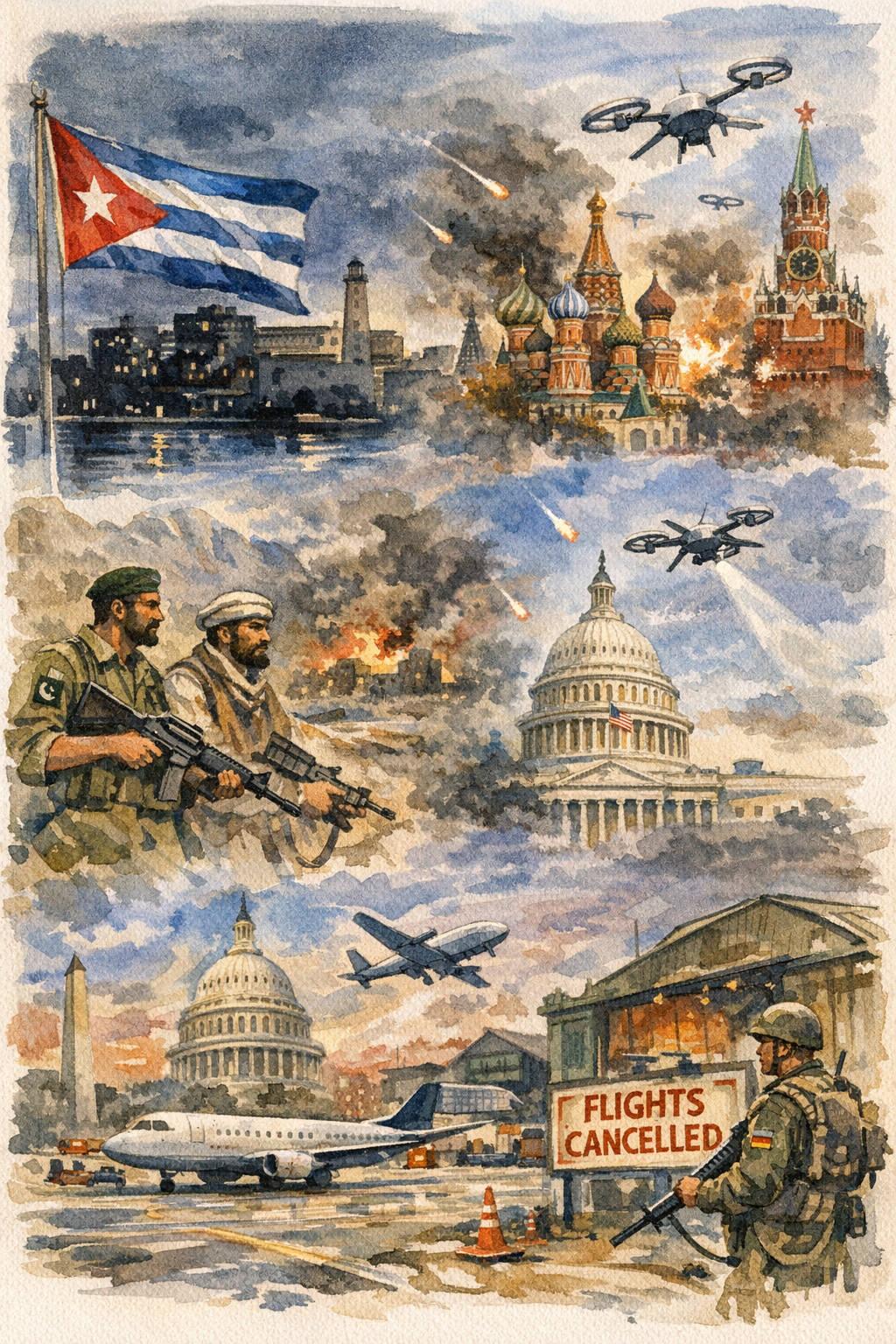
“Five shadows fall across the map. Each cast by silence. Each shaped by storm.”
Art and poetry by James Hall.