
General McCasland Mystery—Collision of Agendas
By James Hall
jameshall042999@gmail.com
How a Rock Star, a General, and a CIA Veteran Became the Strangest Triangle in the Modern UAP Era
For years, the story of Tom DeLonge’s To The Stars Academy has been treated as a curious footnote in the modern UAP era. It seemed, on the surface, like a rock star chasing classified intelligence, a handful of retired officials—among them Maj. Gen. Neil McCasland—humoring him, and a media cycle briefly enjoying the spectacle. But beneath that veneer lies a far stranger chain of events. When examined closely, the public narrative begins to unravel, revealing gaps, silences, and contradictions that point to something more complex than celebrity enthusiasm. It becomes a story not of a single motive or unified effort, but of multiple intelligence factions intersecting through a civilian intermediary, each pursuing its own aims. In the truest sense, it becomes a collision of agendas.
The first sign that something unusual was unfolding came from an unexpected source. In 2016, WikiLeaks published a tranche of emails belonging to John Podesta, then chairman of Hillary Clinton’s presidential campaign and a long‑time Washington figure known for championing government transparency—including on UAP‑related issues. Podesta had previously served as White House Chief of Staff and later as a senior advisor in the Obama administration, and he had spoken openly about the need for greater public access to information on unexplained aerial phenomena.
Among the leaked messages was a note from Tom DeLonge—by then not only a well‑known musician but also the author of a newly released UAP‑themed novel and the architect of a growing multimedia project centered on government secrecy. In the email, DeLonge casually informed Podesta that one of his key advisors was Maj. Gen. Neil McCasland, the recently retired commander of the Air Force Research Laboratory. DeLonge wrote that he had been speaking with McCasland for months and described him as “very, very aware” of the legacy UAP problem. For anyone familiar with McCasland’s background, the claim was astonishing. He had overseen billions in advanced research, including programs tied to propulsion, directed energy, exotic materials, and the broader classified ecosystem surrounding Wright‑Patterson Air Force Base—the mythical heart of UAP analysis.
To be precise, McCasland was not the commander of Wright‑Patterson itself but the Commander of the Air Force Research Laboratory (AFRL) from 2011 to 2013. AFRL is the Air Force’s primary scientific research and development organization, responsible for advancing aerospace technologies across propulsion, materials science, sensors, and directed energy. In that role, McCasland had oversight of many of the base’s most sensitive scientific and engineering programs. He has also commanded the Phillips Research Site at Kirtland Air Force Base—the “brain” of Air Force space technology—an association that adds another layer of intrigue to his later Albuquerque‑based disappearance.
Maj. Gen. McCasland was not a man who drifted into fringe projects. He was not a man who needed celebrity validation. And he was certainly not a man who spoke loosely about classified matters. Yet DeLonge insisted that McCasland had quietly helped assemble the advisory team behind TTSA.
Why would a figure of his stature involve himself with a civilian musician’s disclosure venture—and do so silently, without ever appearing publicly? The answer is unlikely to be simple, but it is almost certainly not casual.
DeLonge himself was charismatic, earnest, and operating entirely outside the constraints of classification. He had a large audience, a sense of mission, and a genuine belief that he could help bridge the gap between government secrecy and public understanding. From an intelligence‑community perspective, that made him a uniquely useful civilian intermediary—someone who could speak publicly on topics that officials, bound by policy and classification, could not. He didn’t need access to the full picture to serve that function. What mattered was that he was enthusiastic, credible to the public, and legally free to say what government personnel could not.
To The Stars Academy’s early messaging reflected this unusual positioning. It was part scientific venture, part entertainment company, part disclosure platform—bearing the fingerprints of a hybrid operation. At times it appeared polished and coordinated; at others, chaotic and opaque, dependent on insiders who refused to be named. DeLonge was the face, but he was never the center of gravity.
TTSA was never just an “entertainment‑funds‑science” experiment. It functioned as a narrative testbed, a public‑perception shaping tool, a conduit for floating ideas without official attribution, and at times a mechanism for laundering classified concepts into the realm of fiction. It operated in that liminal space where storytelling, intelligence tradecraft, and public messaging blur—allowing sensitive themes to surface in ways that felt revelatory without crossing classification lines.
If McCasland’s involvement was surprising, the presence of Jim Semivan, a man of impeccable character, was even more so. A career CIA Directorate of Operations officer, Semivan spent his life running assets, shaping narratives, and navigating the shadow architecture of national security. People with his background do not join UFO startups on a whim. Though he later described personal encounters with a non‑human intelligence—a rare admission for someone of his pedigree—his role inside TTSA served another purpose. It signaled that a particular faction within the intelligence community wanted a controlled release of information, but not through official channels. Semivan was not there to be managed.
Sidebar
The official origin story of Semivan’s involvement is as contradictory as the phenomenon itself. By his own account, he was initially dispatched to vet Tom DeLonge—while still consulting for the CIA—because the musician’s fiction was drifting uncomfortably close to sensitive aerospace realities. Semivan has said he found DeLonge bright, earnest, and enthusiastic. Yet in a pivot that defies standard counterintelligence logic, the investigator didn’t simply clear the subject; he joined him, becoming a founding member of the venture. That transition from “monitoring a potential leak” to “helping build a public‑facing disclosure enterprise” suggests a more sophisticated form of narrative management. If DeLonge was indeed brushing up against classified territory, Semivan’s presence ensured that whatever “truth” emerged would be curated, guided, and filtered through the instincts of a career operative who knew exactly where the red lines were drawn. That, of course, remains speculation.
TTSA itself was built on a speculative “entertainment‑funds‑science” model that assumed a steady stream of media revenue to support high‑level personnel like Luis Elizondo. When the COVID‑19 pandemic froze the entertainment sector, the engine seized. The departure of the “Big Three”—Elizondo, Chris Mellon, and Steve Justice—was not merely a philosophical divergence; it was the visible symptom of a venture that could no longer sustain itself. As the payroll evaporated, the heavy hitters drifted back toward the familiar corridors of Washington influence, leaving the “Academy” as a skeletal remnant of what had been marketed as a revolutionary bridge between the basement and the boardroom.
From the outset, TTSA was an unstable hybrid—part disclosure experiment, part influence operation, part pressure campaign aimed at the Pentagon, and part entertainment venture designed to keep the public engaged. Its cast—DeLonge, Semivan, Elizondo, Mellon, and the quiet gravitational pull of McCasland—represented different corners of the national security ecosystem, each carrying distinct motives. Some sought transparency. Some sought leverage. Some wanted to force the government’s hand. Others aimed to shape public expectations. Still others may have hoped to protect legacy programs by controlling the narrative around them. The result was a story that felt both orchestrated and improvised—a disclosure effort pushing and pulling itself in multiple directions at once. Again, this remains speculation.
Back To The Story
The development that reframed everything came in February 2026 with the disappearance of Maj. Gen. Neil McCasland. He left home without his phone or watch, yet the Bernalillo County Sheriff’s Office reported that his wallet, hiking boots, and a .38‑caliber revolver were missing—items presumably taken with him. A Silver Alert was issued. The FBI became involved, an unusual step for a missing adult when no evidence of a crime had been found. His wife, Susan McCasland Wilkerson, publicly stated that he did not have dementia or Alzheimer’s, the typical criteria for such an alert in New Mexico. She noted an “unspecified medical issue,” but emphasized that he was not confused or disoriented. A repairman saw him at 10:00 AM; by the time Susan returned at 12:04 PM, he was gone. The narrow two‑hour window made the disappearance feel almost surgical.
By early March, the search shifted toward the rugged terrain of the Elena Gallegos Open Space, a 640‑acre park bordering the Sandia Mountain Wilderness. There, search teams found the first tangible clue: a gray sweatshirt emblazoned with “Air Force” lettering. It was discovered roughly 1.25 miles from his home, snagged near a drainage arroyo. Its presence was a riddle. In the high‑altitude February chill of New Mexico, a seasoned hiker and military man like McCasland would rarely discard a thermal layer. The sweatshirt offered no trail—only a dead end. Forensic teams have been tight‑lipped about whether it showed signs of struggle or environmental wear, but its proximity to the wilderness boundary focused the search on the notoriously steep and technical La Luz trail system.
Authorities described the circumstances as “highly unusual.” Even if the cause ultimately proves mundane, the context is not. A general with deep ties to classified aerospace programs—who quietly advised a civilian disclosure effort—vanished without explanation. It is the kind of event that forces a re‑evaluation of the entire TTSA chapter. Not because it confirms any theory, but because it underscores how little we truly understand about the forces at play. The situation reads uncannily like the plot of a TTSA‑backed novel, the very kind of narrative the organization became known for.
In hindsight, the TTSA era seems less like a coordinated disclosure effort and more like the first public glimpse of a deeper, long‑running struggle over how to handle the UAP problem. It was messy, uneven, and often contradictory—not by design, but because it reflected the collision of multiple agendas that had never before been forced into the same spotlight. TTSA didn’t resolve that struggle. It simply revealed that it existed. And as the forces it illuminated continue to operate in the shadows, the hope remains that Maj. Gen. McCasland will be found safe. Not every mystery needs to end in darkness.
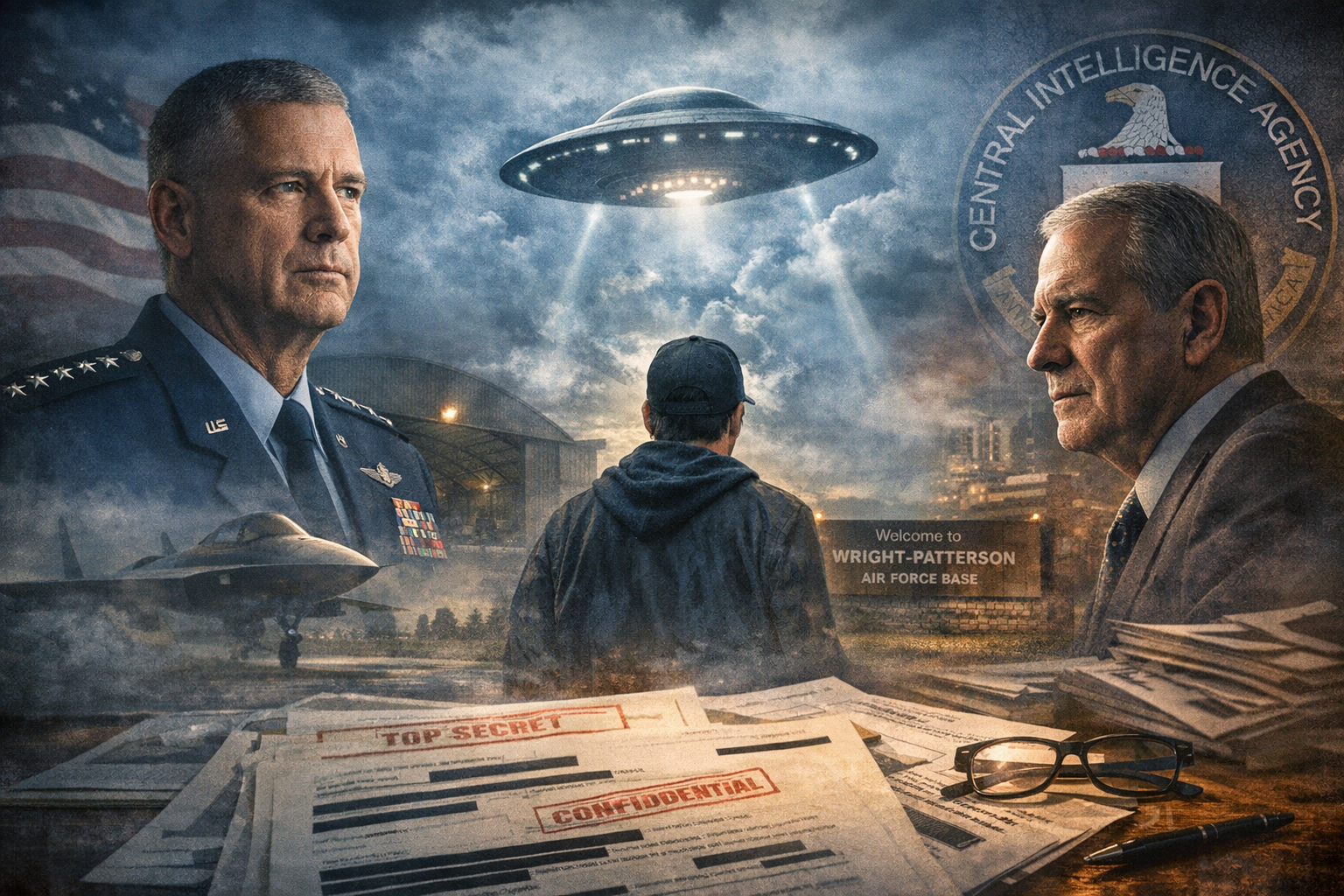
“Where silence is engineered and belief is borrowed, the sky becomes a ledger of competing truths.”
Art and poetry by James Hall