
Russia and the Costs of Pride: A Point of Fracture?
“Pride goes before destruction,
a haughty spirit before a fall.”
— Proverbs 16:18
By James Hall
Coauthor of the popular "The Sword of Damocles: Our Nuclear Age," now on Audible, Kindle and Amazon books.
ameshall042999@gmail.com
The proverb fits Russia’s war trajectory with painful precision, and there is strong analytical evidence to support the idea that the system built by Moscow is approaching a fracturing point, even if it has not yet reached outright collapse.
We can not avoid that old saying from the Bible: “Pride goes before destruction.” It is a warning about overconfidence—about believing too strongly in one’s own power and ignoring limits. For many people watching the war in Ukraine, this saying feels especially relevant to Russia today.
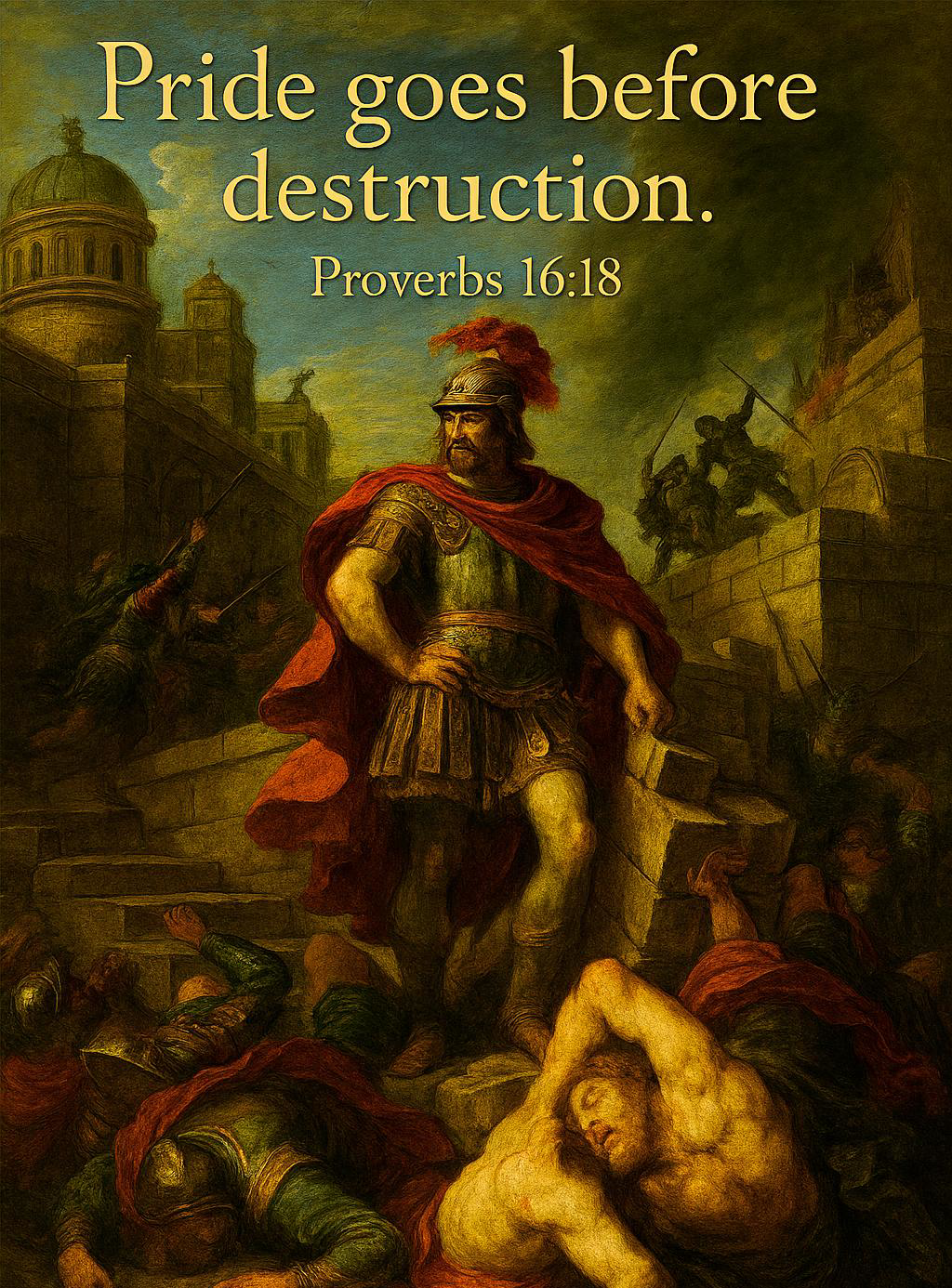
“Pride goes before destruction,
a haughty spirit before a fall.”
— Proverbs 16:18
Art by James Hall.
When Russia launched its invasion of Ukraine, it did so with great confidence. The Russian leadership appeared to believe the war would be short, resistance would collapse, and the world would eventually accept the outcome. None of this happened. Instead, the war dragged on, growing longer, more costly, and more damaging with each passing year.
Today, aerial photographs of the front lines look eerily similar to those of the First World War. What was expected to be a swift campaign has devolved into a stagnant, grinding conflict—an expanding graveyard for soldiers on all sides.
Militarily, Russia has achieved little relative to the scale of its effort. Progress on the battlefield has been slow and expensive. Large numbers of troops and equipment have been lost, and territorial gains are measured in small increments rather than decisive breakthroughs. Supplying the war has become increasingly difficult, requiring constant effort simply to maintain existing positions.
At home, the economic burden of the war continues to grow. Massive spending on weapons, soldiers’ pay, and internal security has propped up the economy on paper, but it has also drained resources from everyday life. Funding once directed toward healthcare, education, housing, and regional development is now increasingly tied to sustaining the war. Prices have risen, public services are strained, and many regions outside major cities are falling further behind.
Russian society itself is being reshaped by the conflict. A small segment of the population—those connected to the military and defense industries—has seen higher wages and benefits. Most others face rising costs and shrinking opportunities. Young people, especially outside Moscow and St. Petersburg, often see only two paths: working in war‑related factories or being sent to fight. This has fostered quiet despair rather than open rebellion, but such hopelessness weakens nations over time.
Russia has therefore not only framed the conflict as a proxy war against the West; it has also bound itself to a war economy to which it now appears addicted.
Perhaps most telling are the signs of stress within Russia’s own power structure. Wealthy business figures, regional leaders, and officials once thought to be protected have been arrested, removed, or stripped of assets. These actions are officially described as anti‑corruption measures, but many observers interpret them as signs of fear and mistrust at the top. Systems confident in themselves do not punish their own elites so aggressively. Compounding this pressure is a government‑controlled central bank enforcing highly restrictive interest rates, pushing many small and mid‑sized businesses toward collapse while consolidating advantage among large corporations.
Politically, the Kremlin remains in control. There is no mass uprising and no organized opposition capable of overturning the government in the near term. Yet control should not be mistaken for stability. Long wars place strain on every part of a state—its economy, its leadership, and its people. Elections this year, though tightly managed, introduce additional risk by forcing regional leaders and elites to perform loyalty amid worsening conditions. Upcoming regional elections this fall may further strain President Putin’s influence.
History shows that powerful states often fracture not through sudden collapse, but under the accumulated weight of their own decisions. Pride delays correction. It makes it harder to admit mistakes, harder to change direction, and harder to end conflicts that no longer serve their original purpose. By the time adjustment comes, the cost is far higher than it needed to be.
Russia today shows many signs of strain: economic distortion, social exhaustion, elite anxiety, and a war that cannot end without acknowledgment of failure. None of this suggests the system will fall tomorrow. But it does indicate that the country may be approaching a point where internal pressures become increasingly difficult to contain.
In that sense, the ancient warning still applies. Pride does not cause destruction overnight. It does, however, set it in motion.