
FACTS ON THE IRANIAN WAR NOT WIDELY REPORTED
By James Hall
Russia and Chinese Assistance?
Russia and China are clearly assisting Iran in various ways. What we actually know is that both countries share military technology, military intelligence, and provide diplomatic support.
Actual military assistance to Iran by Russia is well documented.
This includes the transfer of military technology. In exchange, Iran supplies Russia with Shahed drones for the Ukraine war. In that symbiotic relationship, Russia supplies advanced air‑defense components, guidance systems, electronic warfare technology, and missile and drone design expertise.
Russia also provides satellite coverage over the Middle East, signals intelligence collection from Syria, and a naval presence in the Mediterranean.
It is widely understood that Russia shares situational awareness with Iran, especially regarding US and Israeli movements.
It is no surprise, then, that Iran’s recent missile and drone tactics resemble Russian swarm‑saturation patterns as well as Russian GPS‑spoofing techniques. Iran has also learned Russian air‑defense evasion tactics.
Behind Iran’s battlefield posture lies a quieter but unmistakable pattern of great‑power assistance. Russia, in particular, has spent years feeding Iran pieces of its own military ecosystem. Trainer aircraft, attack helicopters, armored vehicles, and small arms have moved into Iranian hands through formal sales and opaque channels alike. These transfers were never dramatic enough to dominate headlines, but together they formed a steady pipeline of hardware that strengthened Iran’s conventional forces long before the current conflict erupted.
More recently, Russia’s promised sale of Su‑35 fighter jets—long discussed, partially delivered, and still shrouded in ambiguity—signaled a deeper level of military alignment. Even without full delivery, the agreement itself underscored Moscow’s willingness to treat Iran not as a client state but as a strategic partner in a shared confrontation with the West. Russia’s role in joint naval drills with Iran and China further exposed Iranian commanders to foreign platforms, tactics, and command systems, giving Tehran a window into how larger militaries operate at sea.
Chinese assistance to Iran is also significant.
China buys the majority of Iran’s oil through re‑flagged tankers, shadow fleets, and discounted long‑term contracts. This has long given Iran the cash flow to sustain military operations despite sanctions.
China also supplies Iran with microelectronics, industrial robotics, telecommunications, and AI. All of that technology supports Iran’s drone production, missile guidance systems, cyber operations, and surveillance and internal command‑and‑control operations.
China’s support has thus been less about weapons and more about the infrastructure that makes modern militaries function. Beyond the economic lifeline of oil purchases, Beijing has opened the door to its BeiDou‑3 satellite navigation system, giving Iran access to a precision‑guidance backbone outside US control. China’s participation in trilateral naval exercises has also placed its warships alongside Iranian vessels, offering Iran a rare look at Chinese maritime doctrine and communications systems. None of this arrives as headline‑grabbing weapons shipments, but it quietly expands Iran’s strategic toolkit.
Taken together, these forms of assistance—Russian hardware, Chinese navigation and operational exposure, and the shared exercises that bind them—have helped Iran modernize in ways that are easy to overlook. They do not define the war now unfolding, but they shape the capabilities Iran brings into it, and they reveal how deeply the conflict is entangled in the ambitions of larger powers.
Nuclear Power and the Pakistan Question
Although Iran does not appear to have an operational nuclear weapon, most analysts agree that Tehran is now closer to a weapons‑capable threshold than at any point in its history.
Dad and I remember that twenty years ago the news was full of reports claiming Iran was only weeks away from a nuclear weapon, and similar warnings have surfaced regularly ever since. They have had the chance, but have they taken it?
Iran has certainly enriched uranium well beyond civilian levels, accumulated enough material for multiple potential devices, and demonstrated the engineering knowledge needed to assemble a crude nuclear design if the leadership ever chose to cross that threshold. What remains uncertain is the status of weaponization work, the miniaturization, testing, and delivery integration that turn fissile material into a deployable capability.
It’s worth remembering that even the United States and the Soviet Union required nearly a decade in the 1950s to master those steps, particularly the challenge of marrying a nuclear device to a reliable missile. (See Sword of Damocles: Our Nuclear Age, by Michael and James Hall on Audible and Amazon books.)
Many raise the question of outside help. Pakistan has long been viewed as the most plausible source of historical assistance, largely because of the A.Q. Khan proliferation network that sold nuclear technology to multiple states in the early 2000s. While there is no public evidence of current Pakistani support, the legacy of that network means Iran’s early nuclear know‑how did not develop in isolation. Today, the best assessment is that Iran stands at the edge of nuclear capability by its own efforts, with Pakistan’s past proliferation activity forming part of the foundation rather than an active partnership. (Pakistan’s ‘sympathy’ toward Iran is not ideological but strategic—just as its mutual‑defense agreement with Saudi Arabia and its courting of US support are strategic.)
And then there is the North Korea question.
Iran and North Korea maintain a pragmatic, decades‑long partnership rooted in shared hostility toward the United States and a history of missile and military cooperation. Pyongyang supplied Tehran with Scud‑based systems during the Iran–Iraq War and later assisted with solid‑fuel and medium‑range missile development, creating the most substantive technical bridge between the two regimes. While open‑source assessments do not confirm direct nuclear collaboration, analysts widely agree that North Korean advances—from warhead miniaturization to mobile missile deployment—have provided Iran with a valuable model, even as each pursues its program independently. The relationship is best understood as a durable axis of convenience, meaning parallel nuclear trajectories, intermittent weapons‑technology exchanges, and a shared belief that strategic deterrence is essential for regime survival.
What the US and Israel Have Hit
It is well known that the Iranian Supreme Leader, Ali Khamenei, was killed in the opening wave of strikes on March 1st when multiple precision munitions hit his compound. As many as 49 other senior Iranian leaders were also killed in the initial barrage.
What is not so widely known is that Khamenei was first and foremost the Supreme Leader of Iran, holding ultimate authority over the state, the military, and the IRGC. His position also made him one of the most influential Shia clerics in the world. He was not the universally recognized leader of all Shia Muslims, but he was regarded as a central political and symbolic figure by many Shia communities. Iran has no precedent for losing a Supreme Leader to an enemy strike. What will they do now?
Now here is the really important part, Ali Khamenei was, paradoxically, both the architect of Iran’s nuclear program and the main internal brake on building an actual weapon.
For decades he framed nuclear arms as religiously impermissible, a position that blended theology, politics, and strategic caution. His opposition did not stop Iran from enriching uranium or mastering the technical steps toward a bomb, but it did slow the final leap from capability to weaponization. With his death, that restraint becomes far less certain. Iran’s leadership is now fractured, the succession process is contested, and the IRGC—long more hawkish than the clerical establishment has gained disproportionate influence. In such an environment, the old red lines may not hold. The next Supreme Leader, or an empowered military faction, could decide that the strategic value of a nuclear deterrent outweighs the ethical arguments Khamenei once invoked.
In short, the one figure who consistently argued against the bomb on moral grounds is gone, and the system he leaves behind is more volatile, more militarized, and more likely to revisit decisions he once kept off the table.
In the overall war so far US and Israeli forces have since carried out a broad set of coordinated strikes targeting command centers in Tehran, major IRGC facilities, missile bases, air‑defense sites, and locations tied to Iran’s nuclear and aerospace programs. Attacks have also included naval assets, naval bases, and mine‑laying vessels along the Gulf of Oman.
These strikes have left Iran’s navy severely degraded. A US fast‑attack submarine also sank the Iranian warship IRIS Dena in the Indian Ocean, with video of the torpedo strike circulating widely on social media. This marked the first time since World War II that a US submarine sank an enemy warship with a torpedo. Sri Lanka’s navy later recovered 87 bodies and rescued 32 survivors.
In what many analysts are already calling the most consequential day of the war, US B‑1B Lancer bombers (today) entered combat operations for the first time in this crisis, signaling a major shift in the tempo and scale of the American response. The long‑range strike aircraft conducted multiple sorties against Iranian missile and drone infrastructure, hitting launch sites, coastal batteries, and suspected IRGC command nodes tied to today’s attacks on commercial shipping. Their appearance underscores Washington’s decision to move beyond defensive intercepts and into sustained offensive pressure. This is a turning point that has reshaped the character of the conflict in a single afternoon
What Iran Has Hit
Iran is now striking commercial vessels regardless of nationality, escalating its campaign into open attacks on global shipping. Multiple tankers and cargo ships were hit yesterday, March 11, including Thai‑, Japan‑, and Marshall Islands‑flagged vessels — with several struck by missiles or projectiles and at least one tanker set ablaze. Tehran has now claimed responsibility for part of the barrage, while US forces report sinking several Iranian minelaying craft operating near the Strait.
Overnight, the pattern intensified further as three additional oil tankers were struck in separate incidents—two hit near Iraq’s Umm Qasr channel and a third damaged north of the UAE. This means Iran’s targeting now extends well beyond the Strait itself. These attacks involved explosive‑laden remote‑controlled boats and at least one projectile strike, causing fires, casualties, and temporary port shutdowns.
Maritime traffic through the Strait of Hormuz has slowed to a near standstill, with scores of tankers effectively trapped inside the Gulf and insurers warning of a rapidly deteriorating risk environment. The cumulative effect is a de facto closure of the world’s most critical energy chokepoint, driven not by formal declaration but by sustained, indiscriminate attacks on global shipping.
Iran has also launched missiles and drones at US bases across the Middle East, including sites in Qatar, Kuwait, the UAE, and Bahrain. Some missiles reached their targets while others were intercepted. Iran additionally fired missiles toward Israel, with at least one reported impact and several interceptions. Jordan and Saudi Arabia are intercepting Iranian missiles to protect their own airspace.
Overall Picture
The fog of war remains thick. What is clear is that the US and Israel have focused on dismantling Iran’s ability to wage organized, state‑level warfare by targeting leadership, missile systems, and naval assets.
Iran, in turn, is striking back across the region rather than focusing solely on Israel or the United States, attempting to create pressure on multiple fronts.
The result is a fast‑moving, fog‑heavy conflict in which both sides remain capable of action, but Iran’s conventional military power has been significantly weakened.
The economic consequences of this crisis are already radiating far beyond the battlefield. With commercial shipping under fire and the Strait of Hormuz operating at a crawl, global energy markets have been thrown into a state of acute volatility. Even modest disruptions in the Gulf can send shockwaves through Asia and Europe, but the near‑standstill now unfolding threatens to constrict roughly a fifth of the world’s traded oil. China, India, and key European importers are scrambling for alternative supply, while insurers have begun pricing Gulf transits at wartime risk levels. For Iran, the attacks may offer short‑term leverage, but they also risk strangling its own export lifeline and accelerating the economic isolation that has defined the regime’s last decade.
In effect, the conflict is no longer just a regional military confrontation, but it is rapidly becoming a global economic event with consequences that may outlast the fighting.
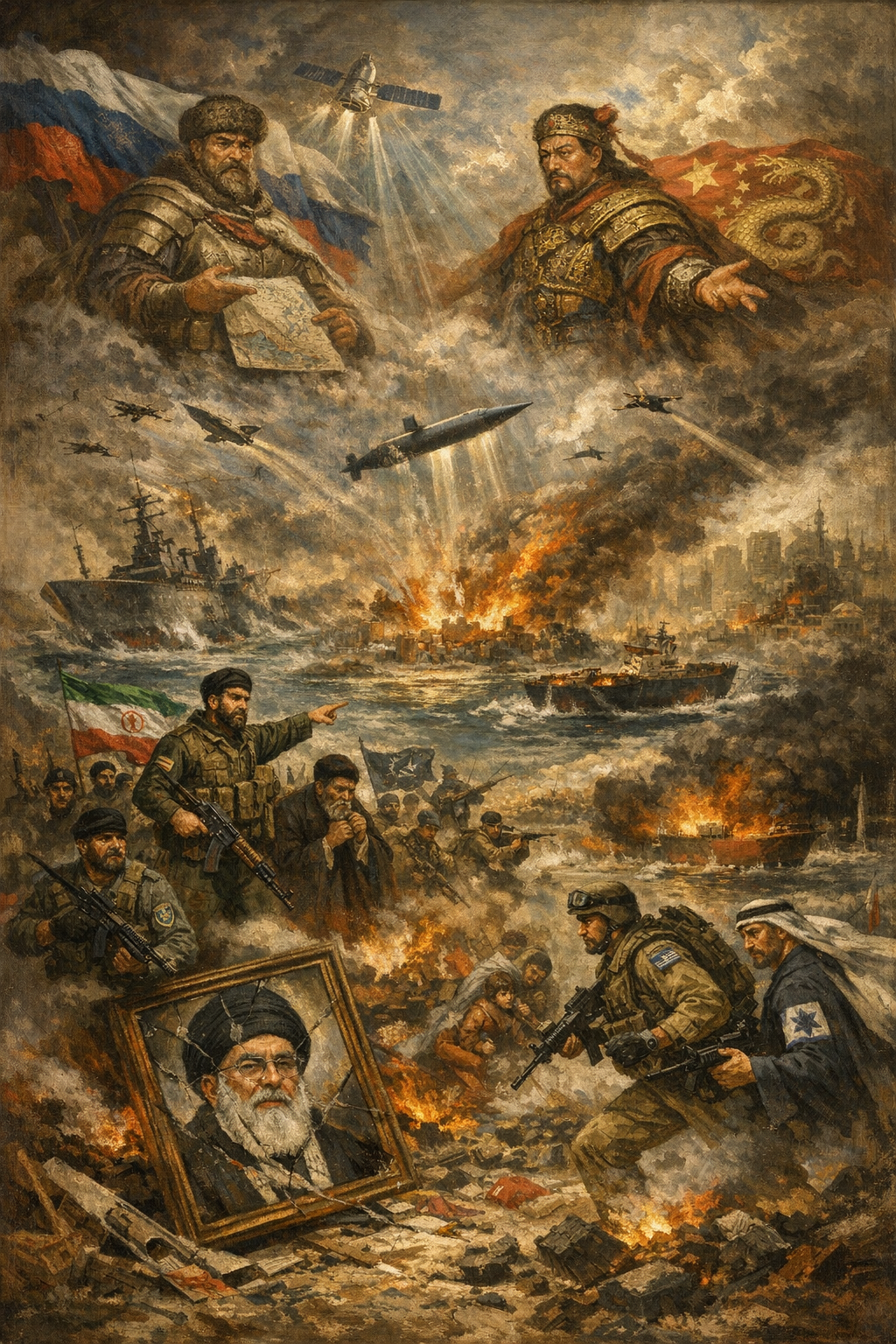
Where fire meets faith, empires stager.
Poetry and art by James Hall