
What’s Really Happening Inside Iran Today?
By James Hall
jameshall042999@gmail.com
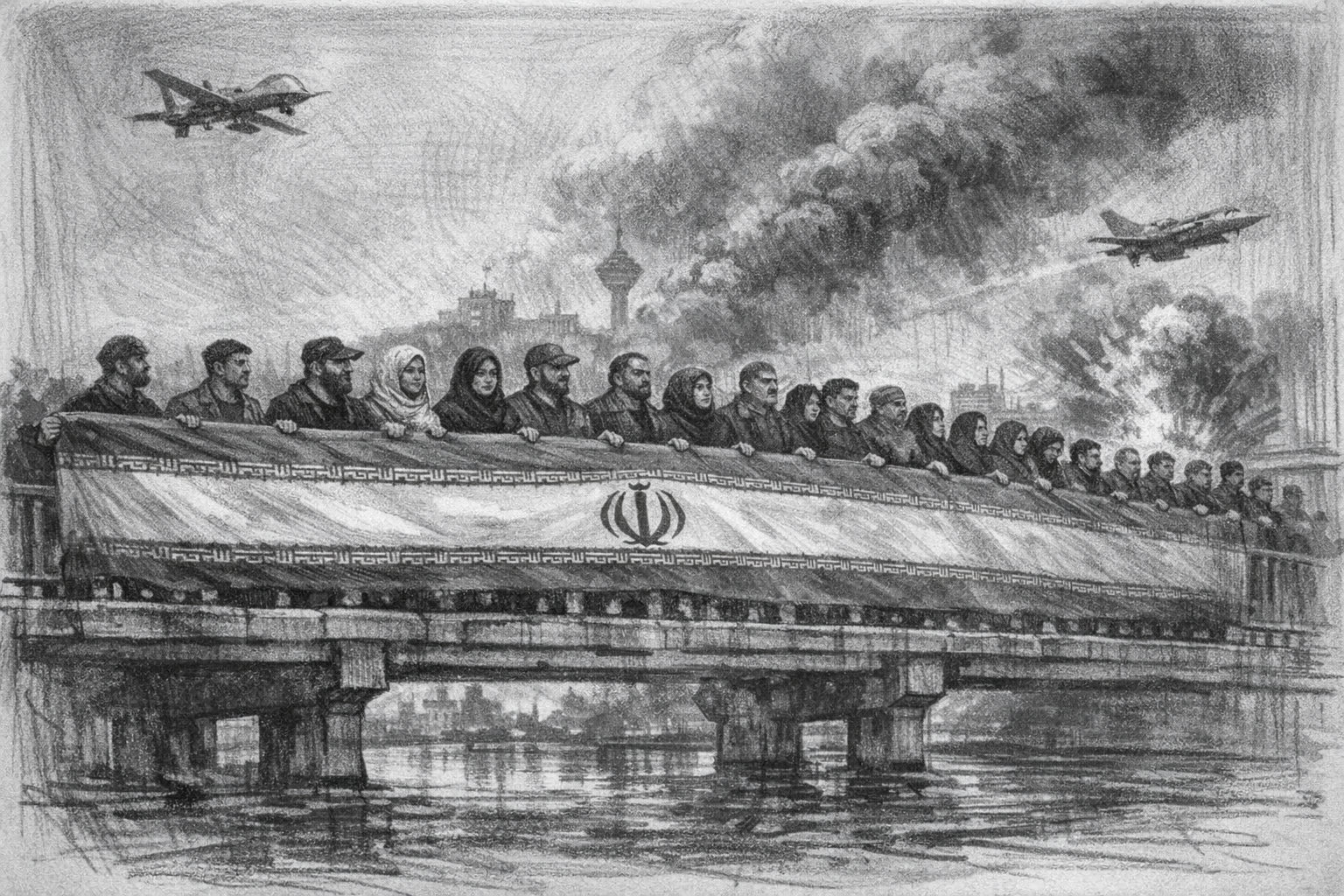
“When power falters, it is the people who are asked to stand in its place.”
Art and poetry by James Hall.
It was all over once Iran started putting civilians on bridges.
At first glance, the recent ceasefire between the US and Iran looks like just another "pause" in a long history of fighting. But if you look closer, Iran is currently facing a massive internal crisis. This crisis explains why they are acting the way they are on the battlefield and in negotiations. Right now, the Iranian government is dealing with three big problems at once: they don't know who is really in charge, their military has been badly damaged, and the rest of the world is turning up the pressure.
The biggest shake-up is at the very top. The long‑time Supreme Leader, Ali Khamenei, was killed in a US attack—a moment that will be etched into Shia memory long after the politics of today have faded. While his son, Mojtaba, has been named as the new leader, he hasn't actually appeared in public yet. This creates a “credibility gap.” The Iranian people just aren't sure who is actually making the rules.
Because of this vacuum, Iran’s military Islamic Revolutionary Guard Corps (IRGC) has stepped in to take control. Instead of one strong leader, Iran is now being run by a divided group of military officials. On the outside, they try to look tough, but on the inside, the system is very shaky. In that light, you might wonder why Iran’s neighbor Pakistan was the one to help the US and Iran reach a deal. This is especially true since Iran is Shia Muslim and Pakistan, by contrast, is a Sunni‑majority.
Actually, while Pakistan has one of the world’s largest Shia populations in absolute numbers, Shias are a minority within the country. In other words, the Pakistani state does not follow Shia religious doctrine. Instead strict Sunni traditions dominate public religious life and institutions.*
Although Iran and Pakistan are both Muslim‑majority countries, they do not share the same approaches or “sympathies” toward terrorism. Iran’s support for militant groups is a deliberate, top‑down state policy, embedded in its post‑1979 revolutionary ideology and carried out largely through the Islamic Revolutionary Guard Corps as a way to project power abroad and confront US and Israeli influence. Pakistan’s situation is fundamentally different. Pakistan has suffered heavily from terrorism itself and continues to face deadly attacks from militant groups operating within and around its borders. While Pakistan has historically been criticized for tolerating or selectively managing certain militants for strategic reasons, this was driven by security calculations and not ideological distractions. Today, Pakistan’s cooperation with Iran is pragmatic and diplomatic, aimed at preventing regional war and chaos, not born of shared extremist beliefs. In short, Iran sponsors militant proxies as foreign policy, whereas Pakistan is largely struggling to contain militancy as a domestic threat.
So, It was clear to Pakistan that Iran doesn't talk directly to the US and they knew that if the fighting kept getting worse, the whole Iranian government might collapse. So Pakistan stepped in because they are neighbors with Iran and don't want a massive war next door. For Iran, accepting the talks in Islamabad was a survival tactic. They needed to buy time to fix their economy and figure out their leadership mess without being distracted by a war.
Thus the ceasefire wasn't caused by a polite agreement; it was caused by rising risks. Just before the deal, Iranian officials told regular citizens to stand near power plants and bridges. They were essentially using people as “human shields” to stop US. bombs. This created a huge legal and humanitarian problem for Washington. The US decided that the risk of accidentally hurting thousands of civilians—and starting a much bigger war—wasn't worth it, especially since they had already hit their main military targets.
Even though Iran talks a big game, their military is much weaker than it used to be. Recent US strikes have essentially wiped out Iran’s main navy, sinking their biggest ships and disabling their best submarines.
However, Iran has changed its strategy. Instead of big ships, they now use “asymmetric” tools such as small, fast attack boats, cheap drones, and hidden sea mines.
They might not have a traditional navy anymore, but they can still cause a lot of trouble in the water. This is where modern technology comes in. The US now uses advanced AI systems—like those developed in Project Maven—to sort through hours of video and data to find these small, hidden threats. It’s a game of "hide and seek" where the stakes are life and death. (You can read about Project Maven at www.authorshall.com/blog/vydpikegfyvb5xmk7p1qyg4mqmha3j.)
The bottom line is that Iran is trying to look strong while hiding the fact that it is very vulnerable. The regime is struggling to stay together and wants to avoid any fight that might show the world how "brittle" their system has become. This ceasefire isn't about peace; it’s a "tactical pause" that gives Iran a chance to breathe while they try to figure out their future.
* Note:
(Iran is overwhelmingly Shia Muslim, specifically Twelver Shia Islam, which is also the official state religion. Roughly 90–95% of Iranians are Shia, and Iran is the world’s largest Shia‑majority country. The religious establishment—including the position of Supreme Leader—is rooted directly in Shia theology and clerical authority. This Shia identity is central to Iran’s political system and foreign policy posture. Pakistan, by contrast, is a Sunni‑majority country. About 85–90% of Pakistani Muslims are Sunni, primarily following the Hanafi school of law, while 10–15% are Shia. Pakistan therefore has one of the world’s largest Shia populations in absolute numbers, but Shias are a minority within the country. The state does not follow Shia religious doctrine, and Sunni traditions dominate public religious life and institutions.)
Michael and James Hall, authors of the popular The Sword of Damocles: Our Nuclear Age, now on Audible, Kindle and Amazon books.