
Investing in AI: Our NEW Economy
STOP FEARING AI & INSTEAD MAKE SOME MONEY OFF OF IT!
By James Hall at www.authorshall.com
jameshall042999@gmail.com
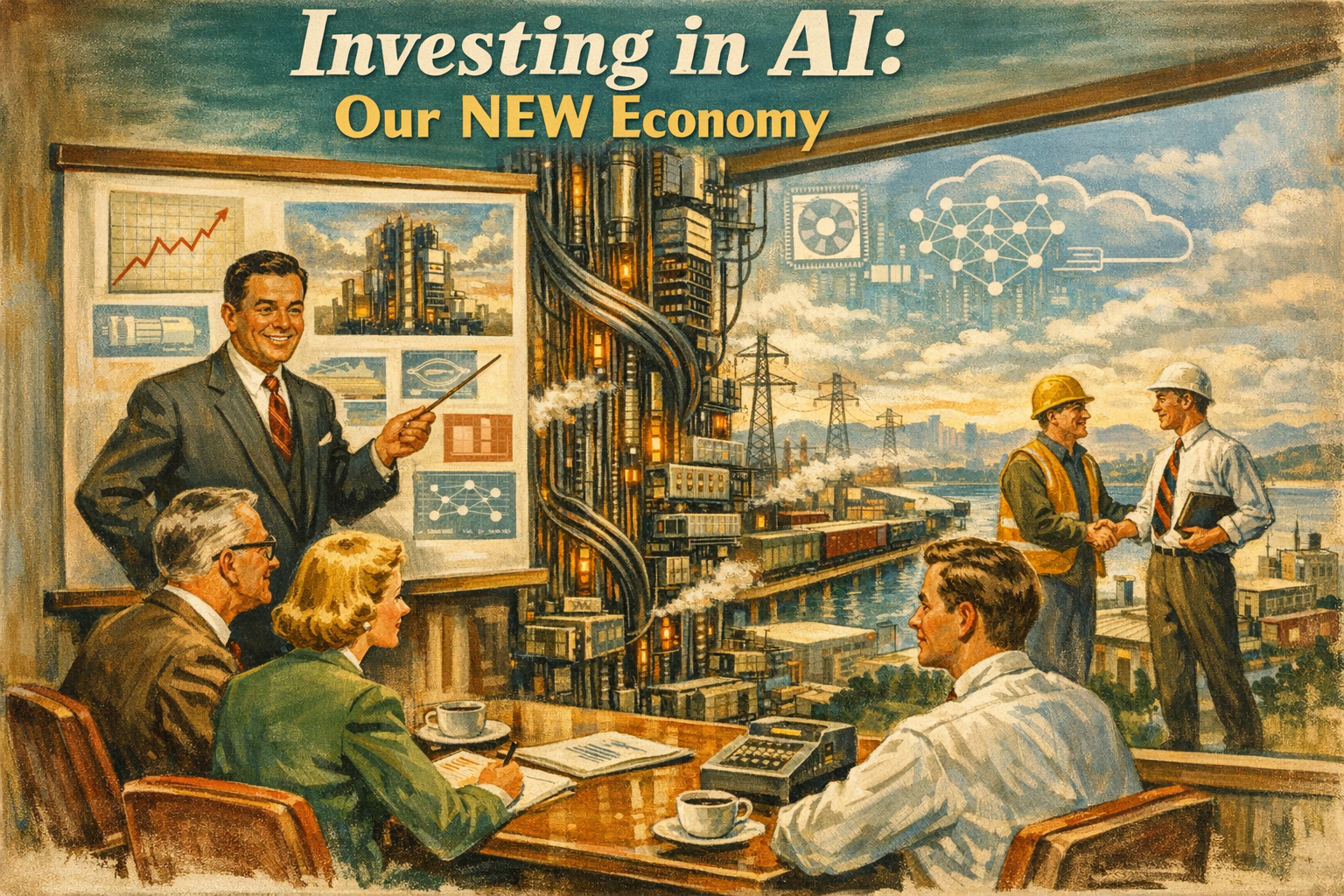
“The future is not built by machines alone, but by people who choose to invest in the systems.”
Art and poetry by James Hall.
Dad and I have spent the past few months in our spare time diving deeply into the world of artificial intelligence—not out of idle curiosity, but as part of our research for a chapter in our upcoming book, Heaven and Earth. The book explores consciousness in all its forms from human to artificial, and to what some call non‑human intelligence. When studying artificial intelligence we found ourselves learning far more than algorithms and headlines. We began tracing the physical, economic, and philosophical machinery behind AI. The deeper we went, the more we realized how profoundly misunderstood this technology truly is.
Many of our followers have been hesitant to engage with our resulting AI posts. Some are wary, some overwhelmed, and some simply don’t want to acknowledge how quickly this new force is reshaping the world. But ignoring AI won’t protect anyone from its impact. In fact, those who refuse to understand it may find themselves severely disadvantaged.
AI is not just another tool—it is an enabling, enriching force that now makes lifelong learning an absolute necessity for all of us, each and every day. And those days are precious. Let’s not waste a single one to learn. And then learn some more!
Because of this, Dad and I decided to do something simple but important. We put our own skin in the game. Not just by studying AI, but by investing in the economic movement being driven by it. We acted carefully, thoughtfully, and with the same curiosity that guides our writing. In short, we knew we had to start playing the game!
Despite market volatility, our AI‑related investments have surprised us. They’ve grown—sometimes dramatically—and, more importantly, they’ve taught us something essential. That is you cannot understand AI’s economic impact and power to uplift unless you understand what makes it possible.
Behind The AI Curtain
Behind the AI curtain lies a vast physical world of power lines, cooling systems, water resources, fiber‑optic cables, data‑center builders, and global logistics networks. This is the digital infrastructure—the logistics—that powers the AI revolution.
This real‑world layer is where we chose to invest.
Our approach mirrors how we previously invested in oil and gas. We didn’t invest in the people pumping the oil or refining it. We invested in the companies that moves and distributes the fuel once it safely reaches port—historically one of the safest and most consistent strategies. The same logic applies to AI. The real opportunity lies not in the hype, but in the infrastructure that makes AI work.
This is the true backbone of the AI revolution. Not the companies that write the models or manufacture the chips, but those that make the entire AI ecosystem physically possible in the first place.
This layer of the AI economy—the logistical, infrastructural, and supply‑chain enablers—is far more interesting and far more overlooked. These firms sit quietly behind NVIDIA, AMD, OpenAI, Microsoft, Amazon, and Google, powering the entire machine.
AI is A Physical Organism
AI is not just algorithms and silicon. It is a vast physical organism—hungry for electricity, cooling, bandwidth, steel, concrete, and global transport. To understand where AI is going, we must understand the companies that power, cool, connect, move, and secure the world’s most advanced computing infrastructure.
AI, after all, is just as fragile as our own mortal bodies and requires the same necessities—from air and water to energy.
Power, The First Bottleneck Of AI
We begin with power generation—the first true bottleneck of the AI age. AI data centers consume electricity at unprecedented rates. These facilities are essentially giant buildings filled with extremely powerful computers running at full speed, nonstop. The heat they generate is immense, requiring massive industrial cooling systems just to keep them operational.
Think of it as thousands of high‑performance engines running continuously. Every watt of computing power produces heat, and every bit of heat must be removed. That nonstop computing, combined with industrial‑scale cooling, requires electricity on the scale of small cities. But electricity is only part of the equation. Much of that heat is ultimately managed through water—used directly in cooling systems or indirectly through the power generation that feeds them—making water availability a quiet but growing constraint on where and how AI can scale. As stated, AI is not that different from human workers. It requires nourishment/energy and water to function.
The companies enabling this surge are not technology firms at all, but utilities such as NextEra Energy (NYSE: NEE), Duke Energy (NYSE: DUK), and Dominion Energy (NYSE: D). NextEra has become a major supplier of renewable power to hyperscale data‑center operators. Duke is expanding grid capacity specifically to meet AI‑driven demand. Dominion is building new transmission corridors to feed growing clusters of data centers.
These companies do not write code or design chips. They do something far more fundamental by ensuring that AI has the energy—and increasingly the water—it needs to stay alive.
Cooling to Keep AI Alive
Cooling itself is its own critical infrastructure layer. Without it, AI hardware would simply fail. The extreme heat generated by dense, nonstop computation must be managed precisely and continuously, or the entire system breaks down.
This essential role is filled by companies such as Vertiv (NYSE: VRT), Trane Technologies (NYSE: TT), and Carrier Global (NYSE: CARR). Vertiv provides the specialized cooling and power‑distribution systems that hyperscale AI facilities depend on. Trane delivers industrial‑scale climate control engineered for massive, power‑dense environments. Carrier supplies precision cooling technologies that keep servers and data‑center operations within narrow operating tolerances.
Without these companies, NVIDIA’s popular chips would quite literally melt. Just as our own bodies require a stable, reasonable climate to remain productive, AI depends on carefully controlled environments to function at all.
Real Estate, Where AI Lives
AI also requires real estate—vast, climate‑controlled, power‑dense campuses designed to house and sustain extreme computational workloads. These facilities are not incidental; they are foundational. In many ways, they are the physical homes of artificial intelligence.
Companies such as Equinix (NASDAQ: EQIX), Digital Realty Trust (NYSE: DLR), and Switch (operating under DigitalBridge) serve as the landlords of the AI revolution. Equinix and Digital Realty operate global portfolios of data‑center campuses that power cloud platforms and AI workloads at scale. Switch focuses on high‑efficiency, AI‑optimized facilities built to support dense compute, advanced cooling, and long‑term reliability.
These firms do not design algorithms or train models. They provide something far more basic—and far more enduring which is the physical space engineered for intelligence to exist. Like humans, AI needs a place to live and work, and these companies supply the environments that make sustained computation possible. Many of the more sensational predictions about AI ‘taking over the world’ overlook this reality. AI’s survival, like our own, is profoundly dependent on material conditions—and therefore inherently fragile.
Mobility
AI hardware is fragile, expensive, and globally distributed. It must be shipped with care, tracked precisely, and secured at every step along the way. This reality brings traditional logistics companies squarely into the AI ecosystem—firms whose expertise long predates the digital age.
Companies such as UPS (NYSE: UPS), FedEx (NYSE: FDX), and Maersk (OTC: AMKBY) quietly perform this essential work. UPS and FedEx move high‑value electronics and server hardware across continents with the speed and security hyperscale operators require. Maersk carries semiconductor equipment, server racks, and data‑center components across oceans, connecting global manufacturing hubs to the physical sites where AI ultimately lives.
AI may be digital, but its supply chain is profoundly physical. Like humans, AI needs a place to live and work—and it depends on real‑world systems to get there safely.
Connectivity, The AI Highway
AI runs on data highways. These companies don’t make chips—they build the roads those chips communicate on. Without vast, high‑capacity networks to move information at the speed and scale AI demands, even the most advanced models are effectively isolated.
This connective layer of the AI economy is enabled by firms such as Corning (NYSE: GLW), Ciena (NYSE: CIEN), and Lumen Technologies (NYSE: LUMN). Corning supplies the fiber‑optic cable that forms the physical backbone of global data transmission. Ciena builds the high‑capacity optical networking systems that light that fiber and push enormous volumes of data across it. Lumen operates long‑haul fiber networks that connect data centers, cloud regions, and AI clusters across continents.
These companies do not compete in the spotlight of AI headlines, but they quietly determine how fast, how far, and how reliably intelligence can travel. Without sufficient bandwidth—without these data highways—AI is not merely slower; it is effectively unusable.
Electrical Infrastructure
Finally, AI requires technical logistics to ensure clean, stable, and uninterrupted power—not just the generation itself, which was covered earlier, but the supporting systems. In this respect, AI is once again much like a human worker who is fragile, demanding, and dependent on proper working conditions. Power must be delivered consistently, converted efficiently, and protected from interruption. Any instability is not a mere inconvenience; it is a point of failure just as if the human heart stops for even a moment.
This critical layer of the AI economy is enabled by companies such as Eaton (NYSE: ETN), Schneider Electric (OTC: SBGSY), and ABB (NYSE: ABB). These firms do not build models or design chips. Instead, they manage the electrical backbone that allows hyperscale data centers to function at all. They provide power management systems, electrical distribution, automation, and industrial‑grade reliability—the invisible safeguards that keep AI running continuously.
Just as the human body cannot function well without a stable climate, AI cannot operate without precisely controlled power conditions. These infrastructure companies ensure that electricity arrives cleanly, remains stable, and never falters—making them indispensable to the AI ecosystem.
This Is The Good Part! the “Head of the Animal”
This brings us to a different kind of AI investment—not a single company, but a category of companies that sit firmly in the infrastructure layer of the AI economy. Firms such as Nokia (NYSE: NOK), Ericsson (NASDAQ: ERIC), and Cisco Systems (NASDAQ: CSCO) serve as useful examples—not because any one of them is unique, but because together they illustrate why infrastructure matters far more than the speculative, headline‑driven world of chipmakers.
Chip manufacturers sit at the head of the animal. They are visible, celebrated, and intensely concentrated. Their fortunes rise and fall with product cycles, competitive breakthroughs, export controls, and hype. They are extraordinary businesses—but they are also narrow, fragile, and brutally competitive. When you invest at the head, you are betting on who wins.
Infrastructure companies are different. They do not need to win the race. They only need the race to continue.
These firms do not build GPUs. They do not train models. They do not compete with NVIDIA, AMD, or OpenAI. Instead, they build and maintain the global nervous system that AI depends on. These are wireless networks, fiber backhaul, routing, switching, and the software that allows trillions of packets of data to move reliably, securely, and at low latency.
AI does not live in the cloud in some abstract sense. It lives on networks.
Every AI query, every model update, every inference request, and every data‑center‑to‑data‑center synchronization depends on telecom and networking infrastructure. As AI scales, so does network demand. This does not happen linearly, but exponentially. More models mean more data. More users mean more traffic. More edge computing means more local processing that must still synchronize with centralized systems.
This is the layer where infrastructure companies operate. They occupy the unglamorous but indispensable middle of the AI economy:
Building 5G and emerging 6G networks that enable AI at the edge.
Providing optical networking that connects hyperscale data centers.
Supplying core network software that manages massive, real‑time data flows.
Operating across governments, carriers, enterprises, and industrial systems.
These are not companies that need consumers to fall in love with a product. They need the world to keep transmitting data. And that is a much safer bet.
Infrastructure vs. Hype
Chipmakers live in a world of rapid obsolescence. One architectural leap, one geopolitical shock, or one competitor’s breakthrough can dramatically alter the landscape. Margins are high—but so is risk.
Infrastructure companies operate on a different timeline. Their systems are deployed for years or decades. Networks are not swapped out overnight. Once installed, they become part of the permanent skeleton of the digital world. Revenues are steadier. Replacement cycles are longer. Demand is structural rather than fashionable.
AI guarantees one thing above all else. It is about more data, moving faster, across more places, all the time. That reality does not favor the head of the animal alone. It favors the spine.
The Spine Always Gets Paid
If chipmakers are the brain, infrastructure companies are the spinal cord. Without them, nothing moves. Nothing connects. Nothing scales.
This class of companies benefits whether AI models are open‑source or proprietary, whether they run in centralized data centers or at the edge, and whether the winning applications come from Silicon Valley, Europe, China, or somewhere unexpected. As long as data must move—and it always will—the infrastructure remains essential.
This is why infrastructure investing feels less like speculation and more like engineering. It rewards patience, attention to detail, and an understanding of how complex systems function in the real world.
It is not a bet on intelligence itself. It is a bet on connection. And connection, unlike hype, does not disappear when the cycle turns.
The Grand Conclusion
In the end, investing in AI is not really about machines at all. It is about people—those who build, maintain, regulate, and live alongside the systems that now shape our economy. AI may be software, but it is sustained by human hands, human judgment, and human choices. Every data center, power line, fiber route, and cooling system exists because someone planned it, financed it, and took responsibility for its operation. The new AI economy, for all its speed and abstraction, remains deeply human at its core.
That is why our approach to AI has been grounded not in fascination with artificial intelligence itself, but in respect for the systems that make it economicly durable. Infrastructure investing requires patience, humility, and an understanding of limits. It demands that we think in reliability rather than novelty. In this way, investing in AI infrastructure looks less like speculation and more like stewardship.
As AI reshapes how we work, learn, and create, it also reminds us of something timeless. That is no intelligence thrives in isolation. Like us, AI depends on stable environments, shared resources, and collective care. Investing in AI is participation—not reaction. And we’re getting pretty good at it!
Michael and James Hall, authors of the popular The Sword of Damocles: Our Nuclear Age, now on Audible, Kindle and Amazon books.