
THE AI REVOLUTION CANNOT BE STOPPED BECAUSE IT HAS ALL HAPPENED BEFORE
By Michael and James Hall
Authors of the popular The Sword of Damocles: Our Nuclear Age, on Audible, Kindle and Amazon books.
Whenever a breakthrough technology emerges, investors rush to crown the next industrial revolution. Today, that focus is artificial intelligence. Every week brings fresh debate over valuations, market bubbles, chip bottlenecks, power grid constraints, and workplace disruption.
Yet, like every major industrial shift before it, this momentum cannot be halted. History has already shown us how this story unfolds.
The AI revolution is now part and parcel of our Conscious Reality—even if the broader consensus has yet to fully appreciate it.
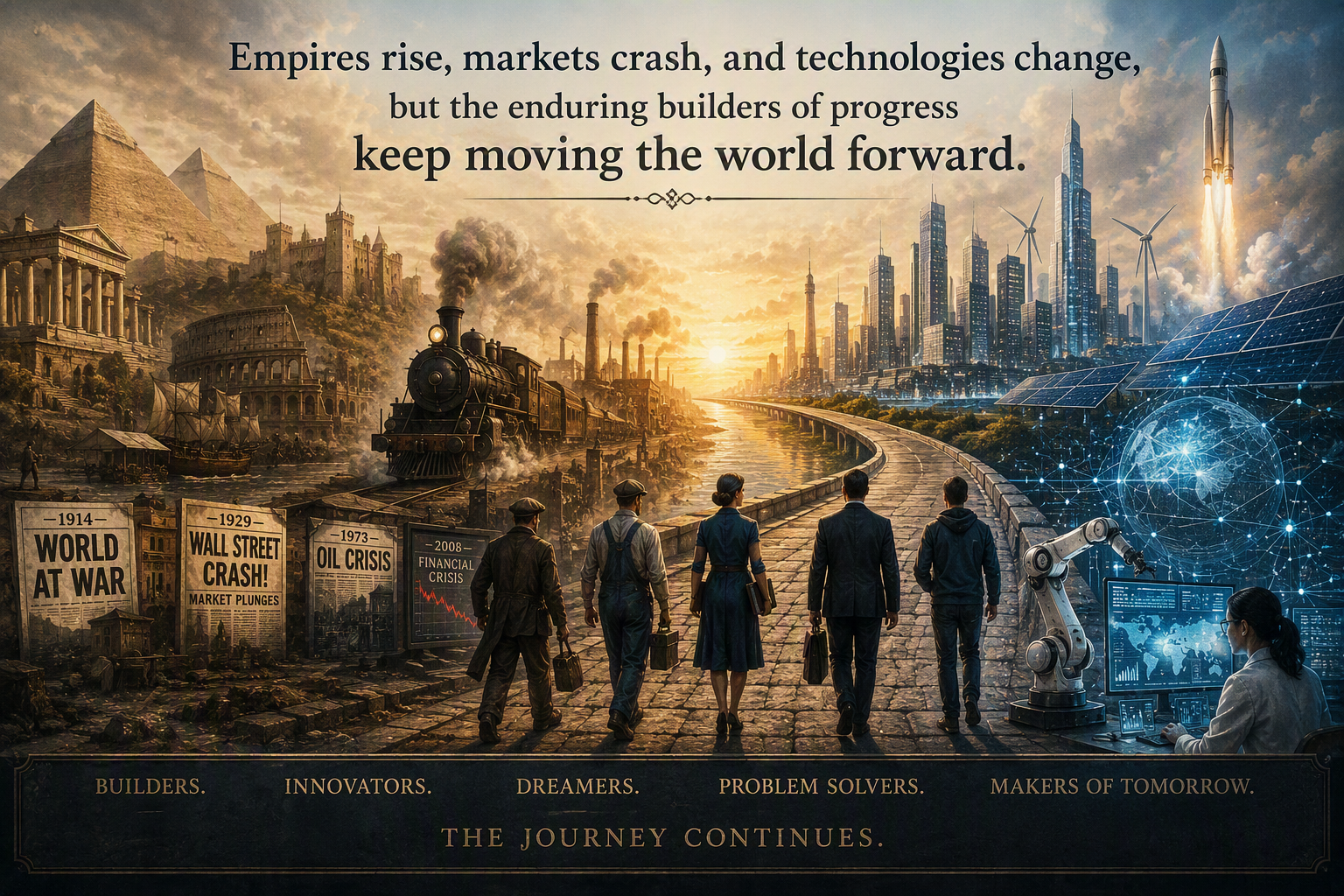
Art and poetry by James Hall.
History offers a powerful lesson. During every major industrial transformation, many companies disappeared, prices fluctuated wildly, and nations experienced wars, economic crises, and political upheaval. Yet the underlying revolution continued.
The story of Ford Motor Company illustrates this principle
.
Ford and the Automobile Revolution
When Henry Ford founded the Ford Motor Company in 1903, automobiles were still competing among steam, electric, and gasoline power and were little more than an expensive curiosity for the wealthy. Most Americans still relied on horses, wagons, and railroads. Ford harnessed the internal combustion engine and combined it with mass production, transforming the automobile from a novelty into the foundation of an industrial revolution.
As automobiles gained mainstream acceptance, entire industries adapted. Wagon makers transitioned to automobile manufacturing, blacksmiths became mechanics, and new commercial ecosystems emerged around paved roads, oil refining, large-scale manufacturing, and consumer financing. A notable example was Studebaker, which evolved from a successful wagon manufacturer into a major automobile company. By leveraging its manufacturing expertise and adapting to changing consumer demand, Studebaker remained a significant force in the automotive industry for decades. While some jobs disappeared, many more opportunities emerged as businesses and workers embraced the new technology.
Yet the automobile revolution was never really about the automobile. At its core was the internal combustion engine, a technology so powerful that it transformed transportation and, in doing so, reshaped daily life. The car provided the body, but the engine provided the force. Today's AI revolution is still embryonic and may follow a similar path. Artificial intelligence is the engine driving change, while robotics could become the body that carries that intelligence into factories, hospitals, homes, and cities. In that sense, this new revolution may not yet be fully defined and could one day be remembered as the robotic revolution.
The decades that followed brought historic upheaval: two devastating world wars, the Great Depression, periods of high inflation, and dramatic shifts in global power. Yet despite these crises, the automobile revolution continued to advance. Its growth was mirrored by the expansion of paved roads and, later, the Interstate Highway System, creating an infrastructure boom that became a transformative economic force in its own right.
Of course, not every automaker survived. Hundreds of early manufacturers either went bankrupt or were absorbed by competitors. Investors who tried to identify every individual winner often lost money. However, those who recognized the broader structural shift, that society was reorganizing around motorized transportation, were ultimately proven right. The greatest opportunities came not from predicting which company would dominate, but from understanding the transformative direction in which the world was moving. That shift proved unstoppable.
The Same Pattern Repeats Throughout History
Consider the railroad and steam age.
As railroads and steam power spread, entire industries were transformed. Canal operators became rail investors, horse-drawn freight carriers evolved into railway companies, and entirely new industries emerged to support steel production, coal mining, locomotive manufacturing, telegraph networks, and large-scale commerce. Employment expanded, productivity surged, and prosperity grew.
Yet the railroad revolution also endured devastating financial crashes throughout the nineteenth century.
The electric power revolution generated speculative booms and painful busts.
The aviation industry weathered bankruptcies, wars, and economic downturns.
The internet fueled one of the largest market bubbles in history during the late 1990s.
Despite these setbacks, no one today questions whether railroads, electricity, aviation, or the internet fundamentally changed civilization.
The lesson is simple:
Revolutionary technologies often experience temporary setbacks on the path to permanent adoption.
Along the way, they make people, businesses, and societies more productive.
These innovations don't diminish human potential, they amplify it.
These inventions and revolutions empower us!
Why AI Appears Different
Artificial intelligence is not merely another software trend.
It is a productivity technology.
Just as electricity amplified human muscle power, AI amplifies human cognitive power.
Businesses are already using AI to write software, analyze data, create content, improve customer service, accelerate research, design products, and enhance medical analysis.
The long-term economic incentives are enormous.
The AI revolution is not just a new invention but a watershed for civilization.
Thus even if investors become temporarily pessimistic, companies will continue searching for ways to lower costs and improve productivity.
That incentive will not disappear.
The Bubble Question
Despite AI's remarkable growth, many observers continue to ask whether it is a bubble.
History suggests the answer may be both yes and no.
As stated, the railroad industry experienced speculative bubbles. The automobile industry did as well. The internet era produced one of the most spectacular bubbles in modern financial history. Yet all three ultimately transformed society and reshaped the global economy.
A bubble can exist within a genuine technological revolution. Excessive speculation does not invalidate the underlying innovation. For investors, the more important challenge is distinguishing between a transformative technology and a company that is merely benefiting from temporary market enthusiasm. Those are not always the same thing.
AI, however, may transcend the characteristics of a typical market bubble. It has become both a critical geopolitical asset and a foundational component of the modern economy. The United States and China are engaged in a technological arms race in which leadership in AI is increasingly tied to economic strength, national security, and global influence. As a result, neither nation can afford to allow the sector to fail, and governments are likely to support critical infrastructure and strategic industry participants during periods of financial stress.
Moreover, AI adoption is now embedded across industries, while demand for computing power continues to exceed available supply. The data centers, semiconductor infrastructure, and intelligence models underpinning the AI ecosystem are becoming deeply integrated into economic activity. Unlike purely speculative assets that disappear when enthusiasm fades, these capabilities increasingly resemble durable, systemically important infrastructure.
Once built, these billion-dollar data centers will not disappear—they will remain in use just like the bridges built decades ago for the automotive revolution. Likewise, over the last century, many automotive companies and rail lines went broke, but the highways and rails remain a systemic part of our modern economy.
Who Are the "Fords" of the AI Age?
No one knows with certainty.
The eventual market leaders are rarely the flashiest consumer-facing applications. During the California Gold Rush, the most reliable fortunes were made not by panning for gold, but by supplying the picks and shovels.
In the AI buildout, the durable foundation lies within essential infrastructure:
Semiconductor fabrication and specialized memory
Data center operators and thermal management systems
High-voltage electrical transmission and grid equipment
Independent power generation and base-load energy providers
Automated warehouse and logistics systems
These backbone providers support the entire ecosystem, regardless of which individual AI software platform ultimately dominates.
James decided to invest in AI in January of this year and has done exceptionally well, seeing 40 to 60 percent gains depending on the stock. Yet, you likely haven't heard of most of his top performers—they aren't household names like the Fords or Googles of the past. Instead, they are the logistics and infrastructure backbone that make the world run, just as in previous industrial revolutions. At James’ age, he is young enough to embrace and master this AI revolution—to truly inherit the wind in a positive sense!
Much has been said about the promise and peril of the AI revolution. Yet throughout history, every industrial breakthrough has brought both positive and negative consequences. Ultimately, it is not the technology that is inherently good or bad, but how humans choose to use it.
The Geopolitical Challenge & PAX SILICA
Every industrial revolution develops alongside geopolitical friction.
Ford had to scale production in two world wars. Rail networks expanded warfare logistics over two centuries. The global internet continues to evolve through decades of international tension.
Today’s modern concerns focus, by necessity, on supply chain bottlenecks. Investors see these linked to US-China competition, Taiwan, North Korea, Russia, tariffs, semiconductor supply shortages, and cyber attacks accelerated via the power of AI.
A recent example illustrates how these geopolitical and infrastructure realities are already influencing investment flows. In 2026, the US-led Pax Silica initiative emerged as a strategic framework aimed at strengthening semiconductor, AI, and advanced manufacturing ecosystems among allied and partner nations. The initiative seeks to reduce dependence on concentrated supply chains, promote technology cooperation, and expand trusted production networks for critical digital infrastructure. At the same time, Taiwan's Foxconn, one of the world's largest electronics manufacturers, became associated with plans for a proposed AI and high-tech manufacturing hub in the Philippines' New Clark City. Supporters view the project as part of a broader effort to build resilient technology infrastructure and diversify critical supply chains beyond traditional centers of production.
Whether or not this particular project ultimately succeeds is almost beside the point. What matters is that governments, manufacturers, and investors are already reorganizing around the long-term demands of artificial intelligence. Just as railroads required steel, automobiles required oil and highways, and the internet required fiber-optic networks and data centers, AI is driving a new generation of investment in power systems, chips, logistics networks, and industrial infrastructure.
These developments reinforce a recurring historical lesson: when a technology revolution reaches the strategic priorities of nations, it has usually progressed far beyond a temporary market trend.
Industrial Revolutions Rewire the Mind
Industrial revolutions do more than transform economies and industries. They reshape how people think.
Every major technological shift alters human cognition, changing how we understand time, distance, work, and even intelligence itself.
Before steam power, daily life moved to the rhythms of nature. Time was measured by seasons, weather, and daylight. The steam age introduced precise schedules and standardized clock time, encouraging a new mindset centered on synchronization, discipline, and efficiency.
Railroads accelerated this shift. To coordinate train movements, societies created unified time zones, turning distance into a predictable calculation of time and speed. People began to think about geography in more abstract terms, experiencing landscapes through a train window rather than as a continuous journey.
The automobile transformed this relationship again. Personal transportation freed individuals from collective timetables and fostered a culture of autonomy. Navigation became less about fixed routes and more about networks, flexibility, and personal choice. The way people perceived mobility, freedom, and geographic space fundamentally changed.
The internet introduced a different cognitive shift. For the first time, access to information became nearly instantaneous and global. Knowledge was no longer defined by what individuals could memorize but by what they could find.
Where books and traditional media encouraged largely linear thinking, leading readers through information in a structured sequence, the internet, and later AI platforms, fosters a more spatial mode of thought.
Search engines, hyperlinks, and digital networks allow people to move freely between ideas, sources, and communities, navigating knowledge as an interconnected landscape rather than a single path. Memory became increasingly externalized as information moved from books and minds into searchable digital systems.
Social media and cellphones accelerated this transformation even further. Human attention became more fragmented, communication became continuous, and information flowed at unprecedented speed. The internet age trained people to navigate abundance rather than scarcity, shifting the challenge from acquiring information to filtering and evaluating it.
While the internet changed how humans access knowledge, AI is changing how knowledge itself is produced, interpreted, and applied. Earlier technologies amplified physical power, and the internet amplified access to information. AI is the first technology to directly augment cognitive work, transforming analysis, reasoning, creativity, and decision-making. In short, AI may be rewiring our brains.
On a personal level, we as authors have personally noticed this shift and feel that the ability to think more spatially rather than linearly has been a tremendous gift. It has allowed us to approach ideas, problems, and connections from a broader and more intuitive perspective. We must master flexible intelligence.
Just as previous generations adapted their thinking to the speed of machines, we are now adapting our thinking to the presence of computational intelligence. Again, the AI revolution is not only changing what we do, but also how we think.
Looking INTO THE Crystal BALL
Nobody can predict even the next six months of the global market.
Nobody can identify every future winner.
What history teaches is something much more important.
The automobile revolution survived wars, depressions, inflation, and countless bankruptcies.
The electrical revolution survived financial panics.
The internet survived the dot-com crash.
Likewise, artificial intelligence will almost certainly experience bubbles, corrections, disappointments, and geopolitical challenges.
Because AI is already a foundational technology, the revolution itself will continue long after today's market debates have been forgotten.
The greatest investment question may not be whether AI survives.
It may be whether we can identify the indispensable infrastructure businesses that will still be standing fifty or one hundred years from now, just as Ford remains standing more than a century after the automobile first transformed the world.
A lot has been said about AI taking over the world. In reality, AI is just as fragile as we are in that it needs two things: energy and water. For that reason, AI may not move as fast as prophesied because it requires decades of infrastructure building, just as all previous industrial revolutions did.
After all, the more things change, the more they stay the same.