
Wings of Smoke and Flame
Warfare of The Future IS HERE
By Michael and James Hall
Authors of the popular The Sword of Damocles: Our Nuclear Age, now on Audible, Kindle and Amazon books.
Since early 2024, Ukraine has conducted a sustained campaign of long-range drone strikes against Russia's oil refineries, fuel depots, export terminals, pumping stations, and petrochemical facilities. The campaign represents one of the most significant attacks on an energy system in modern warfare and has forced Russia to divert resources toward air defense, repairs, and rationing. This is now an existential threat to Russia.
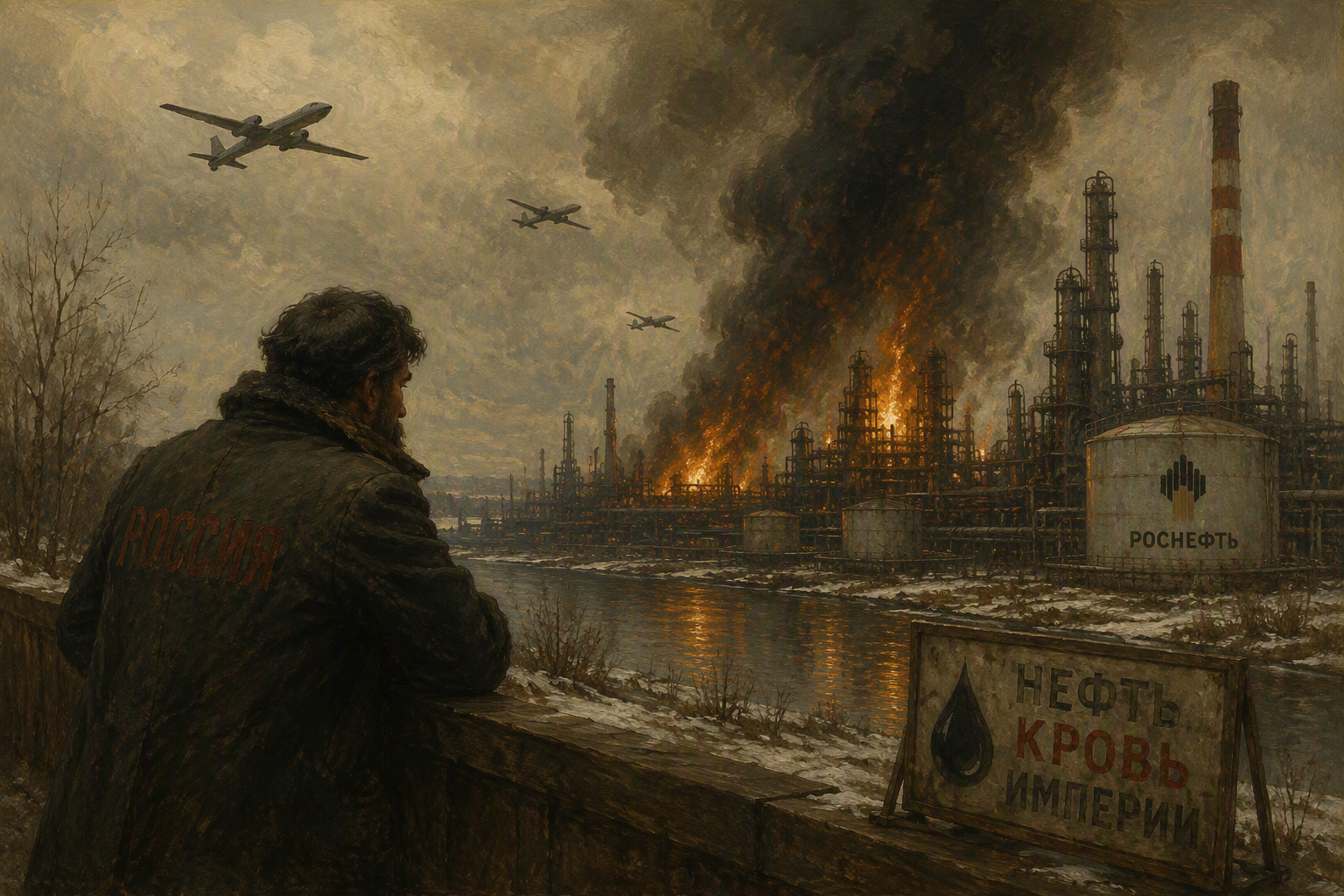
“What armies could not reach, silence and distance delivered on wings of smoke and flame.”
Poetry and Art by James Hall in style of Russian artist Ilya Repin.
If Russia were backing proxy drone strikes from Cuba or Mexico against US Gulf Coast oil infrastructure, Washington would immediately treat it as an existential national security threat. Moscow views Ukraine's refinery strikes through the same lens—yet the analogy collapses on a fundamental point: the United States did not launch an unprovoked invasion of its neighbors, whereas Russia chose to invade in just such a manner against an independent Ukraine.
When Allied interrogators questioned Nazi armaments minister Albert Speer at the end of the Second World War, he remarked that he never understood why the strategic bombing campaign took so long to target synthetic oil refineries rather than broader industrial production. Ukraine appears to have learned that lesson.
Modern industrial warfare runs on fuel. Refineries not only support civilian transportation and exports but also supply diesel, aviation fuel, and other petroleum products essential for military logistics. Every disruption forces difficult trade-offs between domestic consumption, military requirements, and export revenue. Unlike many military targets, energy infrastructure also requires lengthy repairs and continuous maintenance, making it vulnerable to sustained pressure campaigns.
The Scale of the Campaign
The results of Ukraine's long-range strike campaign against Russian energy infrastructure are no longer hypothetical. By March 2025, independent tracking by the Caspian Policy Center had documented 61 Ukrainian attacks on Russian oil refineries since January 2024, affecting 24 separate facilities and causing fires or lasting damage in at least 40 cases.
Since then, the campaign has expanded significantly. By 2026, public assessments indicated that Ukrainian long-range drones had reached dozens of additional energy targets, including refineries, fuel depots, export terminals, storage facilities, and processing plants across western Russia, the Volga region, and even parts of Siberia. Among the most notable targets were the Ryazan, Nizhny Novgorod (NORSI), Tuapse, Moscow, Kirishi, Syzran, Kuibyshev, Afipsky, Ilsky, Slavyansk, and Taneco refineries, along with the strategically important Ust-Luga export terminal. These facilities represent some of Russia's most valuable fuel production and export assets.
By mid-to-late 2026, open-source analyses estimated that well over 150, and possibly close to 200, successful strikes had been carried out against Russian oil and gas infrastructure during the year alone. Damage was reported at a majority of Russia's largest refining complexes. Some assessments suggested that roughly one-quarter of Russia's refining capacity had experienced disruptions at various points, while Ukrainian and independent analysts claimed even higher figures.
Economic and Industrial Impact
Several studies have attempted to quantify the impact of these attacks. While exact estimates vary, most agree that the strikes have imposed substantial repair costs, reduced refining output, and disrupted fuel distribution networks. Analysts have linked the campaign to periodic fuel shortages, regional sales restrictions, higher transportation costs, and declining fuel exports, making Ukraine's deep-strike effort one of the most significant economic pressure campaigns of the war.
According to a July 2026 assessment cited by the Kyiv Post, Ukrainian strikes had disabled approximately 42.7 percent of Russia's projected oil-refining capacity. Another assessment concluded that attacks had temporarily knocked out roughly 25 percent of Russian refining capacity during periods of peak disruption.
The Caspian Policy Center reported that Russian refining volumes fell to their lowest level in twelve years following the attacks. A separate analysis estimated that Russian refineries were processing approximately 1.4 million fewer barrels of crude oil per day than previous annual averages.
The impact extends beyond lost production. Many modern Russian refineries rely on specialized equipment originally sourced from Western manufacturers. Damage to cracking units, distillation towers, and other processing systems can require months of repairs and may necessitate components that are difficult to obtain under existing sanctions regimes.
Strategic Consequences
The campaign has also imposed significant military costs. Russia has been forced to deploy large numbers of air-defense systems around refineries, fuel terminals, industrial hubs, and transportation infrastructure, reducing operational flexibility elsewhere.
More importantly, the strikes have also challenged a long-standing assumption embedded in Russian military thinking: that Russia can project force abroad while keeping the direct costs of war largely distant from everyday life inside Russia itself. Since the collapse of the Soviet Union, Russian military operations in Chechnya, Georgia, Syria, and parts of Ukraine were fought on the periphery or beyond Russia's borders. Casualties occurred, economic costs accumulated, and sanctions imposed burdens, but for most Russian citizens the physical infrastructure of daily life remained untouched. Refineries continued operating, airports functioned normally, railways ran uninterrupted, and major cities experienced little visible evidence that the country was engaged in war.
The Kremlin has historically benefited from this separation between battlefield and homeland. Wars could be presented as limited operations occurring somewhere else, affecting soldiers and distant regions rather than the broader population. This allowed the state to manage public opinion while avoiding the social and political pressures that often emerge when civilians directly experience the consequences of conflict.
Ukraine's long-range drone campaign has begun to erode that separation.
The psychological significance of the strikes extends beyond the physical damage they inflict. When refineries burn hundreds of kilometers from the front, airports temporarily close, commercial flights are disrupted, and air-defense systems appear around major population centers, the war becomes harder to portray as a distant event. Russians may still support, oppose, or remain indifferent to the conflict, but they can no longer assume that geography alone will shield them from its effects.
In this sense, Ukraine's campaign is not simply an effort to destroy fuel production. It is an attempt to alter Russia's strategic calculus by demonstrating that military aggression carries domestic consequences. The objective is to force Moscow to allocate resources to homeland defense, accept economic disruption, and confront the reality that modern precision drones can extend the battlefield far beyond the front line. What was once a war fought primarily in Ukraine increasingly imposes costs inside Russia itself.
This represents a profound shift in modern warfare. For centuries, great powers often relied on geographic depth and distance to insulate their economic centers from attack. Long-range, relatively inexpensive drones are weakening that advantage. Ukraine has shown that even a state lacking a large strategic air force can reach deep into an adversary's territory and threaten critical economic infrastructure. The implication extends beyond Russia and Ukraine: future wars may offer fewer safe rear areas and fewer opportunities for powerful states to separate military operations abroad from the vulnerabilities of their own homeland.
For those who lived through the Cold War, the significance of this shift should not be underestimated. For decades, the idea of regular attacks on Moscow, the surrounding region, or critical infrastructure deep inside Russia would have been almost unthinkable outside the context of a general war between nuclear superpowers.
During the Cold War, strikes against the Soviet heartland were largely discussed only in scenarios involving a catastrophic Third World War.
Today, however, relatively inexpensive drones launched by a neighboring state are reaching targets hundreds and sometimes more than a thousand kilometers inside Russian territory. The psychological significance of that transformation may be as important as the physical damage itself. A strategic sanctuary once protected by geography, distance, and great-power status is no longer entirely immune from attack.
The Proxy War Debate
The refinery campaign also highlights an important distinction often overlooked in political debate.
Of course this is one of the oldest tensions in history and current events: the difference between what happened, what people know happened, and what can be proven happened. Those three categories often overlap, but they are not always identical. That realization is often what separates historical study from real-world experience.
Critics frequently portray the conflict as a NATO proxy war against Russia. The argument rests on an undeniable reality: Ukraine receives substantial military, financial, intelligence, and diplomatic support from NATO member states. Without that assistance, Ukraine's ability to sustain large-scale military operations would be significantly reduced.
Nor should anyone be naïve about how great-power politics works. States pursue their interests through a combination of diplomacy, military aid, intelligence activities, economic pressure, and covert action. Britain, France, the United States, and Russia all possess long traditions of intelligence competition, and few serious observers would argue that intelligence services are passive spectators in a conflict of this magnitude. The history of Anglo-Russian rivalry alone stretches back well beyond the Cold War to the nineteenth century and the Crimean War.
However, acknowledging strategic competition and intelligence cooperation does not automatically transform a conflict into a war directed by outside powers. Throughout modern history, states have supplied weapons, funding, intelligence, training, and political support to partners without exercising direct operational control over their military campaigns. The decisive question is not whether assistance exists, but who makes the strategic and operational decisions.
NATO states provide varying degrees of support, ranging from satellite intelligence and battlefield awareness to training and technical assistance. At the same time, publicly available evidence indicates that Ukraine retains direct responsibility for target selection, mission planning, drone development, and strike execution. Western governments have repeatedly imposed restrictions on the use of their weapon systems inside internationally recognized Russian territory and have often expressed caution regarding deep strikes beyond the battlefield.
This distinction matters. One can reasonably argue that Western intelligence has improved Ukraine's situational awareness or enhanced its ability to plan operations. That is very different from demonstrating that NATO governments personally select targets, approve missions, or direct the refinery campaign. Available evidence suggests a more complex reality: NATO provides significant support, while Ukraine retains ownership of the campaign and its strategic objectives.
The proxy-war narrative can also obscure Ukrainian agency. It implies that Ukraine functions primarily as an instrument of Western policy rather than as a state pursuing its own wartime goals. Yet Kyiv's objective of degrading Russian military and economic capacity would exist regardless of foreign support. The refinery campaign reflects Ukrainian interests first and foremost, even if those interests overlap with those of many Western governments that view Russia as a growing security challenge.
Indeed, the very fact that Ukraine invested heavily in developing indigenous long-range strike drones suggests a desire to preserve operational freedom rather than depend entirely on foreign weapons subject to political restrictions. Support, cooperation, and aligned interests are not necessarily the same thing as control.
Why Ukraine's Drone Program Matters
The nature of the weapons used further reinforces this point. Because Western-supplied cruise missiles such as the British and French Storm Shadow/SCALP-EG have generally been constrained or reserved for military targets, Ukraine has relied overwhelmingly on domestically developed long-range drones to strike Russian energy infrastructure.
Platforms such as the Antonov An-196 Liutyi, the Bober (Beaver), and the rocket-powered Palianytsia were developed specifically to bypass political restrictions while providing the range necessary to reach refining hubs deep inside Russia.
Ukraine's strike portfolio extends well beyond these systems. Reports have referenced platforms such as the Flamingo and a growing family of unmanned aircraft designed for reconnaissance, electronic warfare support, and long-range precision attack. Rather than depending on a single flagship platform, Ukraine has developed a diverse drone ecosystem employing different airframes, propulsion methods, flight profiles, and payloads.
This diversity complicates Russian air-defense planning and increases operational resilience. While Western intelligence and commercial satellite imagery likely support mission planning and battle damage assessment, the platforms, decision-making, and operational execution remain Ukrainian.
A Glimpse of Future Warfare
More broadly, the Russia-Ukraine war is rewriting assumptions about how modern conflicts are fought.
Drones have become one of the most transformative weapons on the battlefield. Both Russia and Ukraine employ thousands of reconnaissance, attack, and first-person-view drones to locate enemy forces, direct artillery, and strike targets at relatively low cost. Increasingly, artificial intelligence and machine-learning systems are being integrated to improve navigation, resist jamming, identify targets, and enable operations in GPS-denied environments.
While fully autonomous systems that independently select targets are not yet widely deployed, both sides are moving toward greater autonomy through AI-assisted targeting, swarm coordination, and increasingly sophisticated guidance systems. Analysts increasingly view the conflict as a testing ground for the future of warfare, where humans remain in the decision loop but AI plays a growing role in surveillance, targeting, and operational planning.
The refinery campaign illustrates this broader transformation. Precision drones have given medium-sized states the ability to threaten strategic infrastructure hundreds or even thousands of kilometers beyond the front line at a fraction of the cost of conventional airpower. Whether measured in lost refining capacity, diverted air-defense resources, disrupted exports, or growing insecurity within Russia itself, Ukraine's strikes demonstrate that economic infrastructure has become a battlefield in its own right.
The campaign may ultimately be remembered as one of the first large-scale demonstrations of how relatively inexpensive autonomous and semi-autonomous systems can impose strategic costs on a much larger adversary.
In an interview on The World with Richard Engel and Yalda Hakim, former Google CEO and former Chairman of the US National Security Commission on Artificial Intelligence, Eric Schmidt delivered a stark warning. Drawing on his firsthand experience advising and observing technological innovation in Ukraine, Schmidt argued that warfare has crossed an irreversible technological threshold. Autonomous systems, rapid software development, and accelerated hardware adaptation are no longer experimental supplements to military power. They are increasingly determining the operational tempo, tactical advantage, and battlefield survival of modern armies.
Schmidt describes a battlefield that would be almost unrecognizable to many military planners of previous generations. The traditional image of ground combat, characterized by artillery duels, maneuver warfare, infantry assaults, and armored breakthroughs, has given way to an environment dominated by persistent surveillance and precision strike capabilities.
The modern front line has become a transparent kill zone.
Soldiers occupying trench networks often face extreme risk the moment they emerge from cover. Reconnaissance drones continually scan the battlefield, identifying movement and relaying targeting coordinates in real time. Strike drones, loitering munitions, and precision-guided artillery can engage targets within minutes, or even seconds, of detection. Movement itself has become one of the greatest vulnerabilities on the battlefield.
The result is a form of technological stalemate in which neither side can easily mass forces or exploit breakthroughs without immediately exposing itself to destruction. What was once "no-man's-land" has evolved into a digitally monitored death zone, observed from above by thousands of airborne sensors operating around the clock.
Perhaps the most significant lesson emerging from the war in Ukraine is the extraordinary speed of battlefield innovation.
Military supremacy is no longer measured solely by billion-dollar procurement programs that take decades to develop. Increasingly, it is measured by who can iterate designs, update software, and deploy new systems within weeks.
Schmidt notes that Ukrainian and Western-designed interceptor drones had initially achieved remarkable success against Russia's slow-moving one-way attack drones, including Iranian-designed Shahed variants. Many defensive systems successfully neutralized a large percentage of incoming threats using relatively low-cost interceptors.
Russian engineers responded by modifying existing Shahed designs with commercially available jet engines, dramatically increasing their speed and reducing the effectiveness of previously successful defensive systems. Suddenly, interceptors optimized for slower targets found themselves confronting a completely different threat profile.
The lesson is profound. Modern warfare increasingly resembles a continuous technological arms race where innovations measured in months or even weeks can overturn battlefield assumptions. Success belongs not to the force possessing the most sophisticated technology at any given moment, but to the force capable of adapting faster than its adversary.
The battlefield has become a live engineering competition. Schmidt argues that the next revolution is not simply faster drones. It is autonomy. Historically, drones relied on centralized control links that were vulnerable to jamming, interception, and electronic warfare. Modern systems are increasingly transitioning toward decentralized architectures in which drones communicate directly with one another through mesh networks, dynamically sharing information and routing commands across multiple nodes.
In such a network, the loss of individual drones does not cripple the larger system. Information continues to flow through alternative pathways, creating a resilient airborne communications architecture that is difficult to disrupt.
This evolution represents the foundation for machine-coordinated warfare.
Human operators possess inherent cognitive limitations. A person can effectively monitor only a limited number of screens, sensors, and drones simultaneously. Artificial intelligence faces no such restrictions. Future battlefield systems may allow hundreds or thousands of autonomous platforms to coordinate reconnaissance, electronic warfare, target identification, and strike operations at machine speed.
Rather than controlling individual drones, human commanders may increasingly supervise entire autonomous ecosystems that function as a single distributed intelligence.
What is emerging is not merely a new weapon. It is a new form of military organization. During the early stages of the war, Ukraine demonstrated the advantages of decentralized innovation. Small teams of engineers, software developers, and frontline soldiers rapidly modified commercial technologies and fielded solutions far faster than traditional military procurement systems could respond.
This agility allowed Ukraine to punch far above its weight in several phases of the conflict. Schmidt now warns that the balance is shifting. Russia has increasingly aligned state resources, industrial production capacity, and military requirements behind large-scale drone manufacturing programs. As production scales into the tens of thousands of systems, quantity itself becomes a strategic advantage. Even highly effective defenses can become saturated when confronted with overwhelming numbers of autonomous or semi-autonomous platforms.
The danger for Western militaries extends far beyond Ukraine. For decades, military superiority has depended heavily on expensive platforms such as fighter aircraft, tanks, aircraft carriers, and precision-guided munitions. The Ukraine war suggests that relatively inexpensive autonomous systems may increasingly challenge these traditional assumptions.
A drone costing a few thousand dollars can threaten equipment worth millions. A network of autonomous systems can contest airspace without requiring a pilot. A software update can alter battlefield effectiveness faster than a multi-year weapons procurement cycle. These developments point toward a future in which industrial capacity, software innovation, artificial intelligence, and autonomous manufacturing become as strategically important as traditional military power.
The war in Ukraine is not simply a regional conflict. It has become the world's first large-scale laboratory for AI-enabled warfare, autonomous systems, electronic warfare, and rapid technological adaptation.
Every lesson learned on the front lines today will shape military doctrine for decades to come. The central message from Schmidt's observations is clear: future wars will not be won solely by the nation with the largest military budget or the most advanced weapons. They will be won by the nation capable of innovating, adapting, and deploying new technologies faster than its opponent. For military strategists, defense planners, and policymakers, Ukraine is offering a glimpse into the battlefield of the future. The rest of the world would be wise to pay attention.
Conclusion
Ukraine's campaign against Russian oil infrastructure is about far more than damaged refineries and lost production. It represents a deliberate effort to impose economic, military, and political costs on a state that initiated a large-scale war while expecting much of its own territory to remain insulated from its consequences.
The debate surrounding the campaign often becomes entangled in broader arguments about NATO involvement, intelligence cooperation, and great-power competition. There is little doubt that Ukraine benefits from substantial Western support and that Western governments have a significant strategic interest in Russia's military performance. Yet support and direction are not the same thing. Based on publicly available evidence, the refinery campaign remains fundamentally a Ukrainian operation pursued in furtherance of Ukrainian objectives.
More broadly, the strikes reveal how rapidly the character of warfare is changing. For generations, the ability to reach deep into a major power's economic heartland was largely reserved for states possessing large strategic air forces, long-range missile arsenals, or nuclear weapons. Ukraine has demonstrated that increasingly sophisticated and relatively inexpensive drones can now achieve effects once associated only with the military capabilities of great powers.
For those who remember the Cold War, perhaps that is the most striking lesson of all. There was a time when regular attacks against Moscow's region and critical infrastructure deep inside Russia would have been considered conceivable only in the opening stages of a global conflict between nuclear superpowers. Today, such attacks are occurring as part of a regional war fought by a country without a strategic bomber fleet, using domestically produced unmanned systems.
Whether one views the refinery campaign as justified, escalatory, or strategically necessary, its significance is difficult to ignore. Ukraine has shown that economic infrastructure can be a battlefield, that geographic depth no longer guarantees security, and that relatively modest technologies can impose meaningful costs on far larger adversaries. In doing so, it has offered an early glimpse of what twenty-first-century strategic warfare may increasingly look like.
And now we have to see just how long Russia will stand for all of this.
Note on inspired art:
Ilya Yefimovich Repin (1844-1930) was one of the most celebrated painters of the Russian realist movement. Born in Chuhuiv, then part of the Russian Empire (now Ukraine), Repin became famous for his powerful portrayals of Russian society, history, and everyday life. After studying at the Imperial Academy of Arts in St. Petersburg, he gained international recognition with works such as Barge Haulers on the Volga (1870-73), Ivan the Terrible and His Son Ivan (1885), and Reply of the Zaporozhian Cossacks (1880-91). Repin was known for his remarkable ability to capture emotion, psychological depth, and social issues, and he also painted memorable portraits of leading cultural figures including Leo Tolstoy and Modest Mussorgsky. Today, he is regarded as one of the greatest artists of the Russian realist tradition.