By Michael and James Hall—authors of the popular The Sword of Damocles: Our Nuclear Age, on Audible, Kindle and Amazon books.
We are currently finalizing the draft of our book, Heaven and Earth: Conscious Reality. The work explores human, artificial, and non-human intelligence as they relate to conscious behavior, and includes six chapters dedicated to NHI and UAP. This is an updated draft of Chapter 18—previously previewed on this blog—now revised to incorporate recent revelations, including insights from Jay Stratton’s new book.
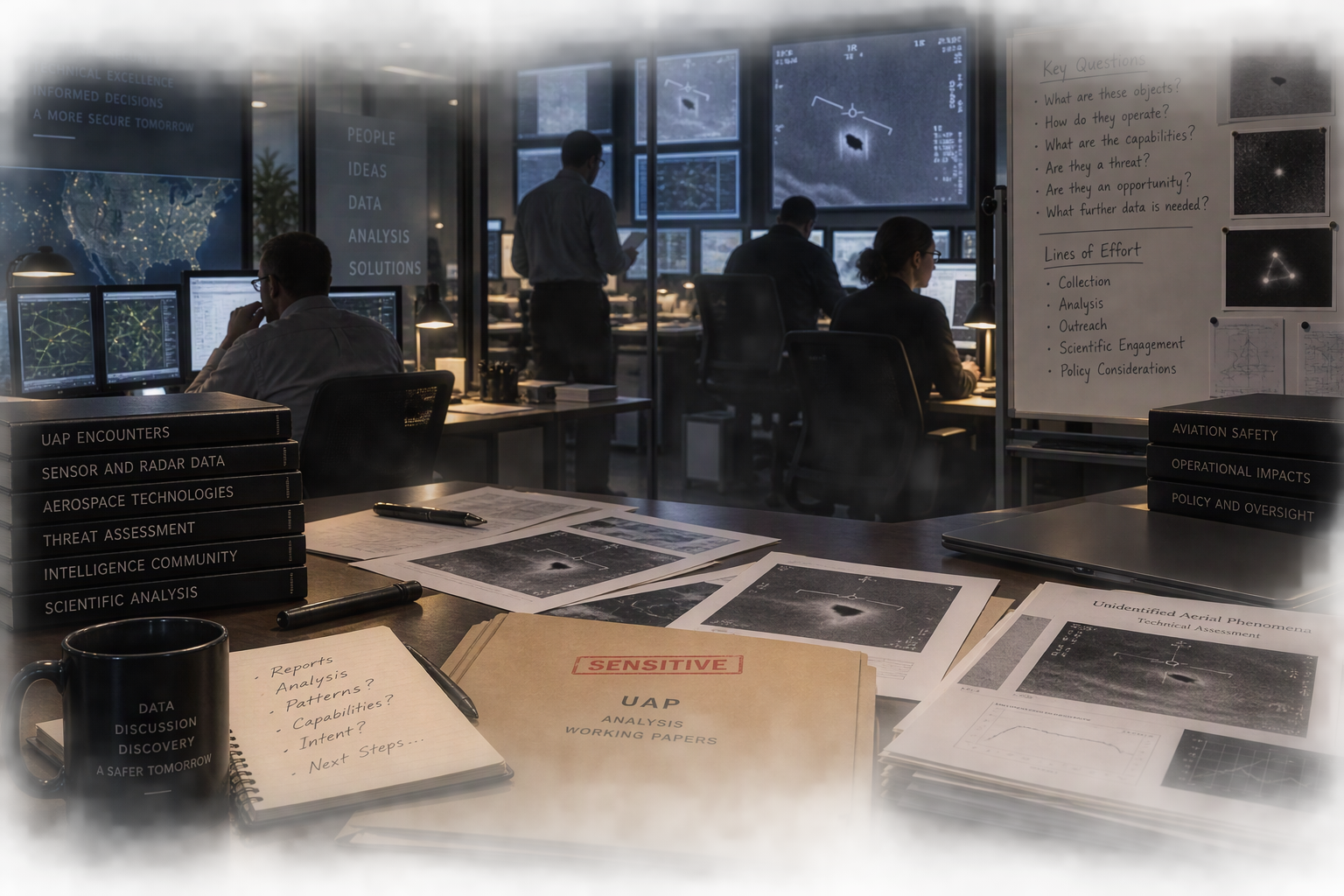
Imagined illustration. AATIP was less a formal program than a handful of dedicated analysts working around the edges of their regular duties.
—Luis Elizondo, former key member of the Pentagon’s Advanced Aerospace Threat Identification Program (AATIP): “There are things that we have seen, that defy our understanding, that appear to be highly advanced, that demonstrate capabilities that we currently do not possess. And whatever this is, it is in our skies, and it is real.”
In a later interview, Drs. James Lacatski and Colm Kelleher framed the assessment of UAP threats around two ideas: capacity and intent. Both agreed that UAP have the capacity to pose a national security risk; neither had found conclusive evidence of hostile intent—though both stressed the phenomenon’s apparent ability to manipulate human perception. It was by focusing on capacity, rather than chasing intent, that AATIP carried the threat question forward after AAWSAP ended.
This chapter covers roughly 2010 to the end of 2017. It is the most confusing period in the story, for a simple reason: AATIP had no dedicated budget, no full-time staff, and few official records, and its very name had first been used for a different program. What we know comes mostly from the people involved, and their accounts do not always agree.
Timeline at a Glance: Chapter Eighteen
Date
Event
June 2009
Senator Reid uses “AATIP” as a cover name for AAWSAP
2010–2012
AAWSAP’s funding ends; AATIP continues as a part-time Pentagon effort
2012
The Pentagon later says AATIP ended with its funding this year; Elizondo says the work continued
April 25, 2013
Aguadilla, Puerto Rico, “transmedium” sighting
January 2015
Navy jets off the East Coast record the “Gimbal” and “Go Fast” videos
2015–2016
Edgar Mitchell and Tom DeLonge email John Podesta about UFOs
Late 2016
A plan to use a Navy ship as “bait” to observe UAP is rejected
August 24, 2017
Three Navy videos cleared for “unlimited distribution”
September 2017
Pentagon begins consolidating UAP oversight
October 4, 2017
Elizondo resigns; To The Stars Academy is launched the same month
December 16, 2017
The New York Times reveals AATIP to the world
Key People in This Chapter
• Luis Elizondo – Pentagon counterintelligence officer; says he directed AATIP until 2017
• Jay Stratton – Office of Naval Intelligence; the thread linking AAWSAP, AATIP, and the later Task Force
• Christopher Mellon – Former Deputy Assistant Secretary of Defense for Intelligence; key ally in releasing the Navy videos
• Dr. Hal Puthoff, Dr. Eric Davis, Dr. Kit Green – Scientific consultants carried over from AAWSAP
• Dr. Garry Nolan – Stanford immunologist; consulted on medical cases
• Garry Reid – Elizondo’s superior at the Pentagon (no relation to Senator Harry Reid)
• Tom DeLonge – Musician; cofounder of To The Stars Academy
As we saw in the previous chapter, AAWSAP began in 2008 under the Defense Intelligence Agency with about $22 million in funding. Its mission split into two tracks—one studying how UAP fly, the other their effects on human thinking and health. That broad mandate took in paranormal phenomena, and by 2010 senior defense officials had grown wary of the human-effects work. As AAWSAP’s budget disappeared, the name Senator Reid had used for it in his 2009 letter—the Advanced Aerospace Threat Identification Program—offered a lifeline.
Out of this shifting landscape came AATIP. It inherited some advisors and case files from AAWSAP but narrowed its focus to threat analysis and defense, in response to encounters reported by military pilots. Associated at first with the DIA and later overseen within the Office of the Under Secretary of Defense for Intelligence, AATIP concentrated on unexplained phenomena reported by service members. Guided by Jay Stratton—a veteran of both programs, by then back at the Office of Naval Intelligence—and counterintelligence specialist Luis Elizondo, it focused on identifying “disruptive technologies” and real aerospace threats.
Even the nature of AATIP’s birth is debated, and because the confusion has dogged every account since 2017, it is worth settling the record in one place:
• The name came first, as a cover. “AATIP” began as an informal nickname for AAWSAP. Reid’s June 2009 letter to Deputy Secretary of Defense William Lynn used it as an unclassified label for AAWSAP, unintentionally blending the two efforts.
• The program came later. Elizondo has emphasized that AATIP, as he led it, took shape only after AAWSAP’s funding ended. It inherited key people and case files but operated as a separate, defense-focused effort. The Pentagon has said AATIP ended with its funding in 2012; Elizondo and others say the work continued informally under other structures.
• The public record blurred them. The December 2017 New York Times article revealed the Pentagon’s UAP effort under the name “AATIP,” implying that it was funded by Reid’s $22 million. In fact that money funded AAWSAP. Reid’s later statements—including 2019 remarks and an April 2021 letter affirming that Elizondo had led AATIP—repeated the original funding figure and so reinforced the mistaken idea that the two programs were one and the same.[1]
• The Pentagon disputed Elizondo’s role. After Elizondo went public, Pentagon spokesman Christopher Sherwood said Elizondo “had no responsibilities with regard to the AATIP program” while at OUSD(I), although an earlier spokesperson, Dana White, had acknowledged him as its director. Reid’s 2021 letter was written specifically to correct that record.
Lacatski and Kelleher say AATIP’s origins were never fully shared with them, though they agree the term began as a cover name for AAWSAP. Some former participants describe AATIP as essentially a renaming; others, including Elizondo, describe a deliberate change of strategy that used an “advanced aerospace threat” banner to regain political support. The available documents cannot settle the matter. Stratton’s 2026 memoir, which might have been expected to resolve it, says surprisingly little about AATIP or Elizondo.[2]
The AATIP Team
AATIP survived less because of any official mandate than because of the dedication of a few people. Elizondo and Stratton steered it through tight resources and Pentagon bureaucracy, focusing on pilot safety and possible incursions into US airspace. Dr. Eric Davis continued as a consultant on breakthrough physics and advanced propulsion, including warp-drive theory and quantum vacuum energy; he and Dr. Hal Puthoff also studied exotic materials. Dr. Kit Green continued as senior scientific consultant on the physical, neurological, and perceptual effects of encounters—interpreting pilot reports of disorientation or injury and evaluating whatever medical data existed. AATIP also drew on biomedical experts, including Stanford immunologist Dr. Garry P. Nolan.[3] And Christopher Mellon, a former Deputy Assistant Secretary of Defense for Intelligence, became a strong supporter.
The move from AAWSAP to AATIP was far from tidy, but the two shared methods, people, and a drive to understand unexplained aerial phenomena. In the end it was the persistence of these individuals—more than any formal policy—that kept UAP threat analysis alive inside the Department of Defense.
The Five Observables
Elizondo worked with Puthoff, Davis, and Stratton on a framework for describing what UAP do. During this period the group identified five characteristics commonly associated with UAP. They have since become a standard reference in the field:
1. Instantaneous acceleration. UAP appear to reach extreme speeds with no gradual buildup, defying conventional aerospace mechanics.
2. Hypersonic velocity without signatures. UAP can travel at more than five times the speed of sound without producing sonic booms or detectable heat.
3. Low observability. UAP are often hard to see or track; they may appear transparent or distorted or suddenly disappear, possibly because of active camouflage or the bending of light.
4. Transmedium travel. UAP can move between air, water, and even space without losing speed or showing signs of propulsion.
5. Positive lift without obvious means. UAP fly without wings, control surfaces, exhaust, or visible engines.
These observables—transmedium travel being the most discussed today—suggest propulsion and flight technologies far beyond known human capabilities. A good example of transmedium behavior comes from a case that remains unexplained.
2013, April 25: Aguadilla, Puerto Rico
At about 9:20 p.m. on April 25, 2013, a US Customs and Border Protection aircraft took off from Rafael Hernández Airport in Aguadilla, Puerto Rico, on a routine surveillance mission. Shortly after departure the crew saw a reddish-pink light moving rapidly over the ocean toward the airport. Air traffic control confirmed seeing it but could not identify it. The crew switched to infrared, using a WESCAM MX-15 thermal camera, and tracked the object as it flew low across the airport and headed back toward the sea.
What followed was extraordinary. The object appeared to enter the water without slowing or making a normal splash, came back out moments later, and seemed to split into two objects that kept moving horizontally before vanishing. Analysts estimated its speed at 80 to 120 miles per hour, with no visible propulsion or wings. The Scientific Coalition for UAP Studies (SCU) concluded that the object defied conventional explanation, making it one of the most compelling cases of the AATIP era.[4]
Bending Light, Bending Space
AATIP was intensely interested in how UAP might work, including the possibility that they use something like gravitational lensing to move or to hide. Gravitational lensing occurs when a massive object, such as a black hole or a galaxy, warps space-time and bends light around it, magnifying or distorting whatever lies behind. In the UAP context, Puthoff and Elizondo have speculated that:
• UAP may create local distortions in space-time, allowing them to seem to “blink” in and out of view.
• Light bending around UAP could explain why they sometimes look shimmering or translucent.
• Extreme acceleration without conventional propulsion might be possible if UAP manipulate gravitational fields rather than relying on aerodynamics.
Puthoff has long suggested that UAP might draw on zero-point energy or on “metric engineering”—reshaping space-time itself—ideas he explored at EarthTech in the 1980s and 1990s. Elizondo connected these ideas to actual encounters: sudden disappearances and reappearances, extreme acceleration without sonic booms, and visual distortions around the objects. Stratton, in his 2026 memoir, likewise discusses whether UAP propulsion might involve a “warp bubble” that separates a craft from its surroundings.[5] While speculative, these ideas would later be carried by Elizondo into mainstream defense discussions and congressional hearings.
The Mystery of “Slide 9”
Several sources suggest that AATIP’s associates put together briefing materials meant to persuade Defense Department leaders that UAP posed a serious national security concern and deserved formal recognition and funding. This is the likely setting for the mysterious “Slide 9,” a controversial item that comes from leaked materials of uncertain origin. The slide is said to outline unusual capabilities or threats beyond the five observables:
• A threat scenario. It reportedly lists capabilities an adversary might have, from manipulating physical surroundings and human thinking to what are sometimes called “psychotronic” effects.
• Specific capabilities. These include the ability to penetrate US facilities, influence decision-makers, and compromise national security through technologies or phenomena that affect the mind and body—including “instantaneous sensor disassembly” and anomalies involving space and time.
• Underlying implications. The language hints at a parallel with Eastern traditions—ideas loosely similar to siddhis, special abilities said to be gained through intense mental discipline—implying that what was once science fiction might have a basis in new physics or secret experimental programs.
Investigative journalist Ross Coulthart has been a leading voice on Slide 9 in his book and lectures. On a NewsNation Reality Check broadcast on June 15, 2025, he said the slide came from leaked documents tied to Christopher Mellon—part of a briefing assembled by Elizondo’s AATIP team for then–Under Secretary of the Navy Thomas B. Modly.[6] Dr. Garry Nolan has also referred to the slide in interviews, describing it as an outline of a “DoD threat scenario” in which an adversary could manipulate not only physical surroundings but human perception. He acknowledges that such ideas straddle hard strategic concern and what some dismiss as the “woo” side of the subject, and he has recounted pushback from officials when he mentioned it—yet he argues the concepts deserve serious scientific and security discussion.
Many believe Slide 9 was written to catch the attention of those who controlled funding; its language seems designed more to alarm than to explain. Others suspect deliberate disinformation, and still others see it as a valuable clue. Its contents have not been confirmed by any public record. To us as authors, Slide 9 illustrates why the UAP/NHI phenomenon so often attracts paranormal or metaphysical labels. On the surface, these incidents can look like simple “nuts-and-bolts” craft—but there is a deeper dimension at work. When guided by non-human intelligence, UAP seem capable of altering how we perceive the physical world and even of influencing consciousness. Decades of consistent reports attest to that effect.
Headwinds: Legacy Programs and the “Collins Elite”
Unlike AAWSAP, AATIP had no dedicated funding or full-time staff. Elizondo and Stratton, with a handful of consultants, kept it going largely on their own initiative, alongside their other official duties. By 2017 morale had clearly declined. Long-standing special access programs inside the Pentagon, some going back decades, appeared to resist any deeper inquiry. At the same time, a small group of senior military and intelligence officials—whom Elizondo calls the “Collins Elite”—viewed UAP through a religious lens, as demonic or deliberately deceptive beings. According to Elizondo, one intelligence official told him, “There is no reason we should be looking into this. We already know what they are and where they come from. They are deceivers. Demons.”[7]
AATIP’s answer was to emphasize aviation safety, threat detection, and national security—language meant to get past religious objections and bureaucratic inertia. To build credibility, it drew on technical studies from respected academics and defense analysts, held small classified briefings for Defense Department officials, and kept quiet ties with journalists and selected think tanks. That two-part strategy—quiet classified work paired with careful outreach—kept AATIP alive until it was exposed in late 2017.
A plan to set “bait.” One frustration of these years was the lack of any way to collect good data on demand. Elizondo’s memoir describes a proposal to station a Navy ship where UAP were frequently reported and record what appeared; it was rejected by late 2016. Stratton’s memoir describes a similar plan, code-named Interloper, that would have used a nuclear submarine as “bait” to draw a UAP close enough to monitor, track, and possibly recover. It stalled at the Joint Staff.[8] Stratton would revive the idea in a smaller form during the Task Force years, as described in Chapter Nineteen.
2017: The Breaking Point
August 24. Just weeks before Elizondo left government, he and Christopher Mellon secured approval from the Defense Office of Prepublication and Security Review (DOPSR) for the “unlimited distribution” of three Navy infrared videos: the 2004 “FLIR1” Tic Tac footage and two January 2015 clips, “Gimbal” and “Go Fast.” The Navy would officially release them on April 27, 2020.[9]
September. Internal efforts to consolidate UAP oversight began under Neill T. Tipton, then Director for Defense Intelligence (Collection and Special Programs). Elizondo, who had worked with Tipton since 2013, welcomed the change. But he remained deeply frustrated with his superior, Garry Reid, Director for Defense Intelligence (Intelligence and Security) in OUSD(I). (Again, no relation to Senator Harry Reid.) Elizondo has publicly accused Garry Reid of obstructing UAP work and misleading the public about AATIP. In May 2021 he filed a sixty-four-page complaint with the Defense Department’s Inspector General alleging that Reid had tried to discredit him. Reid was later removed from his post following Inspector General inquiries into personnel misconduct; interference with UAP work was not cited as a cause, though it was central to Elizondo’s complaint and to later reporting.
2017, October 4: Elizondo Resigns
Elizondo resigned effective October 4, 2017, citing deep frustration with the Defense Department’s unwillingness to treat UAP as a real national security concern. He maintained that military encounters had produced compelling evidence of advanced, unexplained craft—evidence he believed was being systematically ignored. He has said he also delivered a letter to Secretary of Defense Jim Mattis warning that officials were obstructing proper investigation; whether the letter reached Mattis is disputed, and Pentagon officials have denied that it did. Elizondo has described his resignation as a deliberate move to bring the issue to public attention rather than simply walking away.[10]
Dr. Garry Nolan has said that around the time of the resignation he sat with Elizondo in a pub overlooking the Pentagon, where Elizondo described the Tic Tac encounter in detail.[11] During the AATIP period Nolan had become an occasional government consultant on classified medical matters, some of them related to UAP. He remains a friend of Elizondo and an active voice for serious research.
Elizondo’s departure, coming weeks after Tipton’s consolidation effort, marked a turning point. AATIP lost its separate identity, but UAP work did not end. It was absorbed into the Pentagon’s broader intelligence structure, where Jay Stratton would carry it forward.
Looking Back, 2015–2017: Rock Stars, Astronauts, and the Road to Disclosure
Before we reach December 2017, one side story is worth a brief detour, because it explains who was waiting outside government when Elizondo walked out.
Mitchell and Podesta. In January 2015, Apollo 14 astronaut Edgar Mitchell, through a colleague, Terri Mansfield, emailed John Podesta—then counselor to President Obama—asking for an urgent meeting “to discuss Disclosure and zero-point energy.” Mitchell referred to Vatican-hosted seminars on extraterrestrial intelligence and said he believed that non-violent beings “from a contiguous universe” wished to help humanity develop zero-point energy. An August 2015 follow-up said such beings would not tolerate military violence on Earth or in space. Both emails became public in 2016 when WikiLeaks published Podesta’s inbox, and outlets from Rolling Stone to NBC and VICE highlighted the unusual meeting of a moonwalker, a senior political figure, and claims about UFO energy.
DeLonge and Podesta. The same cache included emails from Tom DeLonge, best known as the guitarist for Blink-182, who had become deeply involved in UFO research in the mid-2010s. In October 2015 DeLonge proposed a Washington meeting with “two very important people” who had led classified science and defense projects. In January 2016 he followed up with an email titled “General McCasland,” referring to retired Major General William McCasland, former commander of the Air Force Research Laboratory at Wright-Patterson Air Force Base. DeLonge claimed—his words, not established fact—that McCasland had been in charge of a lab that decades earlier allegedly received material from the 1947 Roswell incident, and that he was “very, very aware” of ongoing UAP investigations. In the last months of the 2016 campaign, this mix of pop-culture figures, military insiders, and political operatives briefly pulled UFOs into mainstream political coverage, laying cultural groundwork for the congressional inquiries that followed.
To The Stars Academy. Although DeLonge played no role in AAWSAP or AATIP, in October 2017 he cofounded To The Stars Academy of Arts & Science (TTSA) with former CIA senior intelligence officer Jim Semivan and Dr. Hal Puthoff. Steve Justice, recently retired from Lockheed Martin’s Skunk Works, joined as director of aerospace. Shortly after leaving government, Elizondo joined TTSA publicly, as did Christopher Mellon. Their presence tied the organization to the government’s UAP work and gave it credibility unusual for a public UFO venture.
Some observers speculated that DeLonge’s fame, wealth, and outspoken interest made him an attractive partner for defense-connected insiders—whether to advance genuine transparency, to shape public opinion, or both. DeLonge’s own accounts describe being introduced to a series of senior intelligence and aerospace veterans in what he framed as a coordinated outreach. DeLonge gained their credibility; they gained his media reach. TTSA’s early work—helping bring the Navy videos into public view and encouraging updated reporting rules for pilots—had real impact. After key departures around 2020, however, the company turned toward entertainment, producing the History Channel series Unidentified and expanding into books and merchandise. By 2022 it had become To The Stars Inc., its investigative mission largely overshadowed.
2017, December 16: The New York Times
After leaving government, Elizondo joined Christopher Mellon and Hal Puthoff in bringing key UAP information to light, while Jay Stratton—still in government—kept the investigative thread alive inside the Pentagon. To make sure the story would be taken seriously, they worked with journalists Leslie Kean and Ralph Blumenthal, both known for handling sensitive material carefully. Blumenthal, a longtime New York Times reporter, cowrote the article with Kean and Helene Cooper.
Published on December 16, 2017, “Glowing Auras and ‘Black Money’: The Pentagon’s Mysterious U.F.O. Program” tore open the secrecy surrounding the Pentagon’s UAP effort.[12] AATIP had been unknown to the public until that day. The article and its accompanying Navy videos gave the subject mainstream legitimacy and set off public pressure that soon reached Congress. What followed was a cultural shift in which UAP were treated not as fringe curiosities but as a credible national security concern. Cable news debated it, major newspapers followed, and congressional offices were flooded with questions from constituents—exactly the groundswell Elizondo, Mellon, Puthoff, and Kean had hoped for.[13]
Looking Ahead, 2025: The Team Reunites—Briefly
Years later, several members of AATIP’s original circle came together again under the UAP Disclosure Fund, a nonprofit promoting transparency, scientific inquiry, and legislative reform. Christopher Mellon chaired its board, and Luis Elizondo and Dr. Garry Nolan were early board members. Dr. Eric Davis and others from the program’s lineage joined the Fund’s May 1, 2025, briefing for members of Congress (described in Chapter Nineteen). The reunion was short-lived. Within days of that briefing, the Fund announced that Elizondo and Nolan had left, along with podcaster and advocate Matt Ford, and each has since pursued disclosure through his own channels.[14]
In Review: A Mosaic of Insiders
Over the past fifteen years, a group of scientists, intelligence officers, and defense insiders has gradually stepped forward to reveal pieces of a much larger and more complicated story. The order in which they spoke is part of what makes the story hard to follow, so it is worth summarizing.
The AAWSAP scientists spoke first. Hal Puthoff and Eric Davis were central figures in the DIA’s program, producing technical studies and interviewing people who claimed involvement in legacy crash-retrieval programs. Their early accounts were cautious and fragmentary, shaped by secrecy rules. As they began speaking publicly, it became clear that even they were unsure where AAWSAP ended and AATIP began—a confusion that mirrored the Pentagon’s own inconsistent descriptions.
Elizondo became the public face. As the former head of AATIP, he described it as a focused effort to analyze military encounters, distinct from AAWSAP’s broader paranormal scope. His resignation and media appearances brought unprecedented attention to the issue but also intensified debate over how the programs overlapped. His advocacy lent weight to Puthoff’s and Davis’s earlier, quieter claims—yet it also showed how isolated from one another these efforts had been.
Stratton provided continuity—and, eventually, the most senior testimony. One of the few officials who worked across AAWSAP, AATIP, and the UAP Task Force, Stratton showed that the government’s interest in UAP never disappeared, even after AAWSAP’s money ran out. He later brought physicist Dr. Travis Taylor into the Task Force as its chief scientist, even while Taylor was appearing on television. For years Stratton said little in public. His 2026 memoir changed that, filling in the early DIA years and adding claims—such as the blocked Lockheed offer—that none of the others had made.
Green and Nolan came from the medical side. Green had quietly studied unusual physical effects for decades; Nolan became involved after being asked to analyze medical cases linked to UAP encounters. Their work focused not on craft or materials but on what close encounters do to people, and suggested that the government had been tracking such cases far longer than most realized.
Taken together, these figures form a mosaic of overlapping experiences, partial insights, and gradual disclosures. None saw the whole picture, and each came forward at a different moment—prompted by declassification, whistleblower protections, or shifting politics. The confusion between AAWSAP and AATIP is understandable in that light: the programs overlapped in time, people, and subject matter, and even the agencies running them struggled to define their boundaries. Their gradual emergence turned UAP from fringe speculation into a legitimate national security conversation—one that, as the next chapter shows, would soon move from Pentagon back offices to the floor of Congress and, eventually, to the President’s desk.
[1] V. J. Ballester-Olmos and Luis Cayetano, “Pentagon’s UFO Program Confusion and How the New York Times Got It Wrong,” republished at Inter Space Sky Way, April 30, 2025, https://interspaceskyway.com/2025/04/30/pentagons-ufo-program-confusion-and-the-way-the-new-york-instances-acquired-it-mistaken/. Lacatski, AAWSAP’s DIA program manager, confirmed the distinction in Colm A. Kelleher, James T. Lacatski, and George Knapp, Skinwalkers at the Pentagon: An Insiders’ Account of the Secret Government UFO Program (Henderson, NV: RTMA, 2021).
[2] Jay Stratton, Out of the Shadows: Revealing the Truth About Non-Human Intelligent Life (New York: William Morrow, 2026). Reviewers have noted that Elizondo’s memoir refers to Stratton many times while Stratton’s refers to Elizondo only a few times; see R. M. McLaren, “Jay Stratton Says Lockheed Had 12 Nonhuman Craft—and a CIA Official Blocked His Team from Getting One,” R. M. McLaren (Substack), October 2026, https://rmmclaren.substack.com/p/jay-stratton-says-lockheed-had-12.
[3] Nolan holds the Rachford and Carlota A. Harris Professorship in the Department of Pathology at the Stanford University School of Medicine. He has made major contributions to immunology and has founded several biotechnology companies. In recent years his public statements on UAP have made him a prominent, and sometimes controversial, figure in the field.
[4] Scientific Coalition for Ufology (now the Scientific Coalition for UAP Studies), 2013 Aguadilla Puerto Rico UAP Report (2015).
[5] Dick Russell, “Out of the Shadows: A Review,” Dick Russell’s Substack, October 2026, https://dickrussell.substack.com/p/out-of-the-shadows-a-review.
[6] Ross Coulthart, Reality Check, NewsNation, June 15, 2025, YouTube video, https://www.youtube.com/watch?v=2aWmclpm4w4.
[7] Luis Elizondo, Imminent: Inside the Pentagon’s Hunt for UFOs (New York: William Morrow, 2024), 205. The origin of the “Collins Elite” nickname is itself anecdotal; Nick Redfern popularized the term in Final Events and the Secret Government Group on Demonic UFOs and the Afterlife (San Antonio, TX: Anomalist Books, 2010). No formal records confirm the group’s existence.
[8] Stratton, Out of the Shadows; Elizondo, Imminent. Both accounts are summarized in McLaren, “Jay Stratton Says Lockheed Had 12 Nonhuman Craft.”
[9] US Department of Defense, “Statement by the Department of Defense on the Release of Historical Navy Videos,” press release, April 27, 2020, https://www.defense.gov/News/Releases/Release/Article/2165713/. The videos are available at “Official UAP Imagery,” All-domain Anomaly Resolution Office, https://www.aaro.mil/UAP-Cases/Official-UAP-Imagery/.
[10] Accounts of AATIP’s timeline remain inconsistent. The Pentagon has said AATIP ended in 2012, yet several sources, including Elizondo, say UAP work continued under other structures. Elizondo has also said that certain officials actively obstructed investigations, whether from skepticism or religious conviction. See Elizondo, Imminent.
[11] Garry Nolan, interview by Robinson Erhardt, Robinson’s Podcast, March 2025, YouTube video, at 2:37:45, https://www.youtube.com/watch?v=QpJebYW_vb4&t=9465s.
[12] Helene Cooper, Ralph Blumenthal, and Leslie Kean, “Glowing Auras and ‘Black Money’: The Pentagon’s Mysterious U.F.O. Program,” New York Times, December 16, 2017.
[13] “Full Special: Confessions of a UFO Hunter,” NewsNation, August 26, 2024, https://www.newsnationnow.com/space/ufo/special-report-confessions-of-a-ufo-hunter/.
[14] UAP Disclosure Fund, post on X, May 8, 2025. Other figures from the program’s lineage, including Jim Semivan, Dr. James Lacatski, Jay Stratton, and Dr. Travis Taylor, have appeared from time to time alongside these groups. Elizondo’s second book, Reckoning: The Unspoken Truth About UFOs and the Urgency of Now, has been announced by HarperCollins.