
By Michael and James Hall—authors of the popular The Sword of Damocles: Our Nuclear Age, on Audible, Kindle and Amazon books.
We are currently finalizing the draft of our book, Heaven and Earth: Conscious Reality. The work explores human, artificial, and non-human intelligence as they relate to conscious behavior, and includes six chapters dedicated to NHI and UAP. This is an updated draft of Chapter 17—previously previewed on this blog—now revised to incorporate recent revelations, including insights from Jay Stratton’s new book.
—Dr. Colm Kelleher, Deputy Administrator,
Advanced Aerospace Weapon System Applications Program (AAWSAP) :
“AAWSAP was never just about lights in the sky. It was about the full spectrum of the unknown—from the measurable to the inexplicable—and the impact these encounters have on the human mind and body. We were tasked with following the evidence, no matter how strange the trail became.”
The modern era of UFOs—at least in terms of widespread media attention—began with Kenneth Arnold’s famous sighting on June 24, 1947. Reports of unexplained aerial phenomena long predate that day, but Arnold’s account of nine disk-shaped objects speeding past Mount Rainier in Washington State seized the public imagination and put the phrase “flying saucer” into the language. In time, flying saucers became UFOs (unidentified flying objects).
A new phase—a “new modern era”—began quietly, and at first unwittingly, on November 14, 2004. That day an extraordinary encounter off the coast of California set in motion a chain of events which, over the next two decades, would see UFOs renamed UAP (unidentified anomalous phenomena) and, more recently, discussed in terms of NHI (non-human intelligence). We are now living in that new modern era—one defined by greater transparency, direct government engagement, and a growing scientific effort to study the phenomenon. By 2026 a sitting president had ordered the release of the government’s UFO files, and the first director of the Pentagon’s UAP Task Force had published a memoir stating that he had seen non-human craft and non-human beings with his own eyes.
This is not a story that unfolds neatly in a straight line. Three government efforts followed one another, but they overlapped in time, shared many of the same people, and were often confused with one another—sometimes by the officials who ran them. Much of what we now know about the early years was revealed only much later, in books, interviews, and document releases between 2017 and 2026. To keep the thread clear, we have organized these chapters as follows:
• Chapter Seventeen covers AAWSAP (2008–2010), a Defense Intelligence Agency (DIA) program run through a private contractor in Las Vegas, and the people and events that led to it.
• Chapter Eighteen covers AATIP (roughly 2010–2017), a smaller, part-time Pentagon effort that chronologically followed AAWSAP and became public in December 2017.
• Chapter Nineteen covers the UAP Task Force (2020–2021) and its successors, AOIMSG (2021–2022) and AARO (2022 to the present), along with the congressional hearings, whistleblowers, and file releases of 2017–2026.
Section headings carry dates so that readers can keep their bearings. When we must step back in time to explain where something came from, the heading says Looking Back; when we jump ahead to describe what was revealed later, it says Looking Ahead. Each chapter opens with a short timeline and a list of the key people.
Timeline at a Glance: Chapter Seventeen
Date
Event
1995–1996
Robert Bigelow founds NIDS and buys Skinwalker Ranch in Utah
October 2004
NIDS winds down
November 14, 2004
Navy pilots encounter the “Tic Tac” off Southern California
Autumn 2005
DIA analyst James Lacatski shows Jay Stratton imagery of a black triangular craft near a nuclear weapons site
2007
Lacatski visits Skinwalker Ranch; Senator Harry Reid is brought in
August 2008
DIA issues a solicitation; only Bigelow’s BAASS bids
September 22, 2008
AAWSAP begins under a two-year, $22 million contract
Early 2009
According to Stratton, a Lockheed Martin executive offers to transfer a recovered craft to AAWSAP; a CIA official blocks it
June 2009
Reid asks that the program be made a special access program and calls it “AATIP”; the request is denied
2009
Luis Elizondo begins working with the AAWSAP circle
2010
AAWSAP’s funding ends; final report delivered in December
2011
“Kona Blue” proposal rejected by Homeland Security
2012
Last efforts to renew funding fail
Key People in This Chapter
• Robert Bigelow – Las Vegas aerospace entrepreneur; founder of NIDS and of BAASS, the AAWSAP contractor
• Dr. James T. Lacatski – DIA nuclear engineer and missile analyst; AAWSAP’s government program manager
• Jay Stratton – Naval and defense intelligence officer; helped conceive AAWSAP; later first director of the UAP Task Force
• Dr. Colm Kelleher – Biochemist; led NIDS fieldwork at Skinwalker Ranch; deputy administrator of BAASS
• Senator Harry Reid (Nevada) – Senate Majority Leader who secured AAWSAP’s funding, with Senators Ted Stevens and Daniel Inouye
• Dr. Hal Puthoff and Dr. Eric Davis – Physicists at EarthTech International in Austin; AAWSAP consultants
• Dr. Christopher “Kit” Green – Former CIA analyst and physician; AAWSAP’s medical and neuroscience consultant
• Luis Elizondo – Pentagon counterintelligence officer; drawn into the circle in 2009; much later the public face of AATIP
2004, November 14: The Nimitz “Tic Tac”
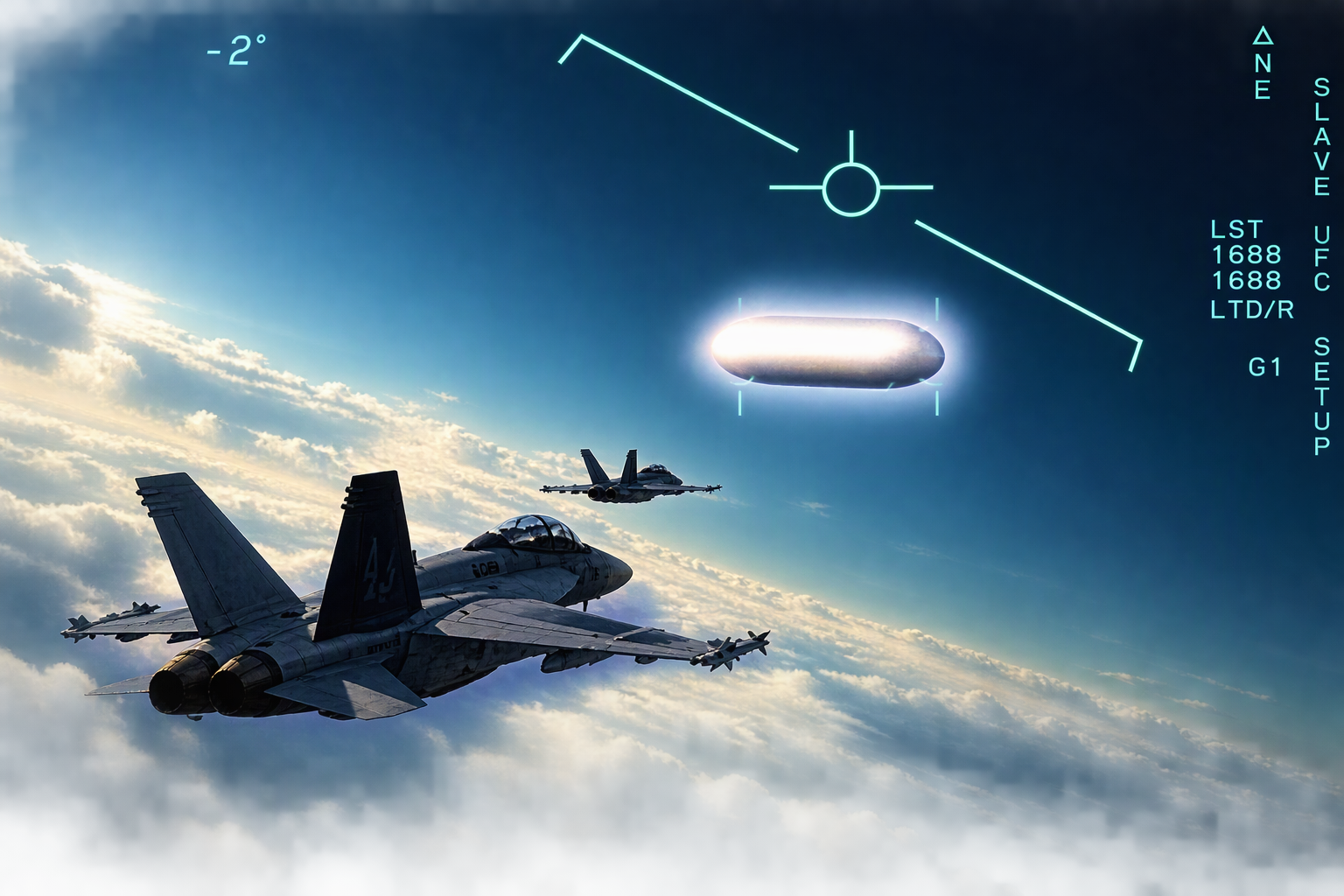
Although the public would not learn of it until 2017, the USS Nimitz “Tic Tac” encounter—corroborated by radar, advanced sensors, and experienced aviators—became a touchstone for modern UAP studies.[1] Off the coast of Southern California, the guided-missile cruiser USS Princeton had for days tracked unknown radar returns dropping from very high altitude toward the sea. Navy aviators sent to investigate—Commander David Fravor and Lieutenant Commander Alex Dietrich among them—saw a smooth, white, Tic Tac-shaped object, perhaps forty feet long, with no wings, exhaust, or control surfaces. It mirrored Fravor’s maneuvers, then accelerated out of sight. A later flight recorded the object with the F/A-18’s Advanced Targeting Forward-Looking Infrared (ATFLIR) pod.[2] The sighting, backed by radar data, sensor video, and pilot testimony, eventually set in motion government investigations and public inquiries that continue today.[3]
At the time, however, almost no one outside the Navy knew it had happened. The case would not be formally studied until 2008–2009, when the program described in this chapter took it up. To understand how that program came to exist, we must step back nearly a decade and travel to a ranch in Utah.
Looking Back, 1995–2004: NIDS and Skinwalker Ranch
In 1995 aerospace entrepreneur Robert Bigelow founded the National Institute for Discovery Science (NIDS), a privately funded organization that studied UFOs, paranormal phenomena, and consciousness. The following year Bigelow bought Skinwalker Ranch in Utah’s Uinta Basin, a property already known for reports of metallic craft, strange animal-like creatures, electromagnetic disturbances, and glowing aerial “portals.” The lore surrounding the ranch is tangled with conflicting accounts and sensational stories, but it also has a long-documented history of unexplained aerial phenomena—some so disorienting that they seem to blur the line between perception and reality.
NIDS investigated the ranch extensively. Several people who would later move into the government’s effort were part of it: Bigelow himself; biochemist Dr. Colm Kelleher, who led the fieldwork; physicist Dr. Eric Davis; Dr. Jacques Vallée; and Dr. John B. Alexander, a retired US Army colonel and non-lethal weapons expert. NIDS wound down in October 2004—just weeks before the Nimitz encounter—citing a lull in activity. Kelleher and Las Vegas journalist George Knapp described the NIDS years in Hunt for the Skinwalker (2005), a book that would soon find an unexpected readership inside the Pentagon.[4]
For decades many UFO researchers had focused only on “nuts and bolts” cases—solid craft, measurable traces, physical evidence. The picture emerging from the ranch suggested something more complicated: a phenomenon that may be bound up with the nature of consciousness itself. This, we believe as authors, is the key to understanding the subject as a whole.
2005: Two Intelligence Officers and an Empty Archive
The government’s side of the story begins with two men at the Defense Intelligence Agency.
The first was Dr. James T. Lacatski, a nuclear engineer by training. In 1985 he completed a master’s degree in nuclear engineering at the University of Tennessee with a thesis titled “Plasma Engineering Analysis of a Small Torsatron Reactor,” and he went on to earn a doctorate in engineering (D.Eng.) in the same field. His early work centered on fusion plasmas, and his expertise later extended to directed-energy weapons, including lasers.[5] By the late 1990s he had joined the DIA, where he spent years analyzing foreign missile and space threats. Colleagues called him a “rocket scientist,” a description that captured both his manner and his rigor.
The second was John “Jay” Stratton, whose 2026 memoir, Out of the Shadows, has filled in much of this early history. Because Stratton appears throughout all three chapters, a brief outline of his career will help. After leaving the military he began in a civilian role as an aerospace engineer with the Naval Air Systems Command, joined the Office of Naval Intelligence (ONI) in 2001 to study foreign aerospace technologies, and survived the September 11 attack on the Pentagon. In 2005 he moved to the DIA as Chief of Air and Space Warfare in the Defense Warning Office, where he focused on “air and space threats from active and developmental technology threat systems controlled by near-peer competitors such as China and Russia.”[6] He returned to ONI in 2008, became its Director of Air Warfare in 2013, entered the Senior Executive Service in 2018, led the UAP Task Force from 2020, and retired in early 2022 after more than thirty-two years of combined military and federal service.[7] Readers of Skinwalkers at the Pentagon (2021) will know him under the pseudonym “Jonathan Axelrod,” which that book used to protect his identity.
The two men met at the DIA. In the autumn of 2005, by Stratton’s account, Lacatski—then the agency’s senior analyst for missile defense—showed him classified imagery of a silent black triangular craft near a sensitive nuclear weapons facility.[8] Stratton found the object beyond comprehension and dates his own interest in the subject to that moment. Both men saw it as a potentially serious national security issue and set out to find the office in the government responsible for analyzing such reports. “As we tried to find that office, we found nothing,” Stratton later recalled.[9] When he asked colleagues, he learned that his own office had once routinely collected UAP reports and evidence. What had become of them was another matter:
There had been a lot of UAP records at DIA, they said, as unexplainable as the report and video we were focused on, “but several years earlier, a mysterious group of men in suits had swept through the office with authority and taken everything: every historical UAP-related document, down to the last scrap of paper and most secure electronic file.”[10]
That discovery—an empty archive where decades of institutional knowledge should have been—is the backdrop to everything that followed. It also explains a problem that will recur in all three chapters: each new government effort had to start almost from scratch.
2007: A Rocket Scientist Visits the Ranch
With no government record to draw on, Lacatski and Stratton turned to the most detailed account available: Hunt for the Skinwalker, which both men had read. In 2007 Lacatski wrote to Robert Bigelow asking to visit the ranch. Bigelow agreed and escorted him there himself. In the same observation trailer that NIDS researchers had used years earlier, Lacatski reportedly had a remarkable anomalous experience.[11]
What Lacatski saw at the ranch, combined with what he and Stratton had already seen in the DIA’s own reporting, convinced him that the United States needed a formal, well-funded inquiry into advanced aerospace threats, with UAP squarely within its scope. That year the two men proposed a secret investigation that would use Skinwalker Ranch as a “living laboratory.” Lacatski proposed, designed, and managed the program that resulted; Stratton, by his own account, helped develop it.[12] Neither man had been part of NIDS, but they were clearly building on its foundation—its data, its facilities, and its investigative methods. Stratton himself would later spend time at the ranch, an experience he describes in his memoir and to which we return in Chapter Nineteen.
2007–2008: From the Ranch to the Senate
How did two DIA intelligence officers reach the Senate Majority Leader? The path ran through Robert Bigelow. Lacatski understood that Pentagon leadership would never approve a study of a “haunted ranch”; any program would have to be framed as research into advanced aerospace weapons. Bigelow had known Senator Harry Reid of Nevada for decades. Reid had once represented him as an attorney and had followed NIDS’s work since the 1990s, after George Knapp told him about it. Bigelow told Reid about the DIA scientist who shared their interest and connected the two men. Stratton writes that he himself began briefing members of Congress on the subject in 2007.[13]
Reid did not need much persuading. He brought in two senior colleagues on the Senate Appropriations Committee’s defense subcommittee, Ted Stevens of Alaska and Daniel Inouye of Hawaii, both of whom were acutely aware of the potential national security stakes. (Stevens had even reported encountering a “foo fighter” as a pilot during World War II.) Reid—like congressional figures as far back as John Glenn and Barry Goldwater—believed that the military and intelligence services held important information that even senior lawmakers could not reach. His openness to the subject may also have been quietly informed by his Latter-day Saint faith, though he rarely spoke publicly about it; LDS theology embraces the idea that God created many worlds and that intelligent life may exist beyond Earth.
Together the three senators secured funding for a classified DIA program. The solicitation was written to speak only of propulsion, lift, power generation, and other aerospace technologies. UFOs were never mentioned.[14] The DIA issued it in August 2008. Only one company bid: Bigelow’s newly created Bigelow Aerospace Advanced Space Studies (BAASS). Its proposal stated openly that the work would include Skinwalker Ranch. In this sense AAWSAP was built from the start around the ranch that had inspired it.
As authors, drawing on personal conversations with Senator Reid and his congressional aide, we can attest to his longstanding concern about the defense implications of UAP. We never heard talk of “aliens,” but we did hear pointed analyses of incidents like the Nimitz case: “This is precisely the kind of operational reconnaissance the Chinese or Russians would conduct—if they had the capability.” It was doubted that they did, yet the threat could not be dismissed. The question was raised: how many times in eighty years must UAP fly over nuclear or military assets to satisfy their curiosity? As one observer put it, “These things are not just doing routine reconnaissance. They are flying training sorties! Yet—who and what are they?”[15] In other words, these were not idle fly-bys but deliberate drills—testing our defenses and mapping how we react.
2008, September 22: AAWSAP Is Launched
These concerns came to a head on September 22, 2008, with the launch of the Advanced Aerospace Weapon System Applications Program (AAWSAP). It was a DIA program effectively sole-sourced to BAASS under a two-year, $22 million contract (HHM402-08-C-0072): roughly $10 million in the first year and $12 million in the second.
Lacatski served as the DIA’s program manager, while Kelleher ran daily operations as deputy administrator at BAASS, headquartered in Las Vegas—Harry Reid’s home turf. Their partnership, later described in Skinwalkers at the Pentagon, combined intelligence oversight with scientific inquiry. In a later interview, Lacatski and Kelleher summarized the mission: it pursued two parallel goals—studying how UAP fly and studying their effects on human beings. Described as “a closed program “operating” as an SAP, or special access program,” AAWSAP remains one of the most intriguing defense studies of the twenty-first century.[16]
(Note, AAWSAP was not a true SAP. On June 24, 2009, Senator Harry Reid wrote to Deputy Secretary of Defense William Lynn asking for “restricted special access program” status for the effort. The Pentagon did not approve it. AARO’s Report on the Historical Record of U.S. Government Involvement with UAP, Vol. I (March 2024) says the request was denied. That request would have been unnecessary if the program already was a SAP.)
In their 2023 book, Lacatski and Kelleher wrote that “AAWSAP was conceived as a program to evaluate the threat potential of UAP. BAASS was an organization specifically created to execute the AAWSAP contract in order to evaluate the threat potential of UAP.”[17] As far as they were concerned, that “meant that if paranormal phenomenon were known to collate with, and overlap temporally with, UAP, then paranormal phenomenon would also be studied.” That decision is the main reason AAWSAP has remained controversial to this day.[18]
The goals were ambitious: “Identify and map potentially disruptive technologies; analyze aerial incursions and performance characteristics; evaluate air-safety risks; document physiological and psychological effects on witnesses; and, where feasible, conduct testing on anomalous materials.” This mix of technical intelligence, human-effects research, and “edge-of-science” inquiry drew early skepticism, but it reflected what investigators were actually finding in the field.[19] The contract’s work fell into twelve areas:
1. Lift
2. Propulsion
3. Control
4. Power generation
5. Spatial/temporal translation
6. Materials
7. Configuration/structure
8. Signature reduction (optical, infrared, radio-frequency, acoustic)
9. Human interface
10. Human effects
11. Armament (radio-frequency and directed-energy weapons)
12. Other areas in support of items 1–11
These categories show an attempt to study UAP not just as lights in the sky but as complete technological systems with effects on people and the environment. The inclusion of “human interface” and “human effects” is especially notable: AAWSAP was not merely asking whether someone could reverse-engineer a craft, as the media often suggests, but was also probing what witnesses experience and how their minds and bodies are affected. The “spatial/temporal translation” and “armament” areas, in particular, signal a more speculative and defense-oriented program than early public summaries suggested.[20]
2008–2010: Into the Field
From the moment the contract was signed, Skinwalker Ranch became more than a backdrop—it was the first testing ground for AAWSAP’s methods. The site offered a concentrated mix of phenomena: objects in the air performing beyond known aeronautical limits, electromagnetic surges that interfered with equipment, and incidents that left physical or psychological effects on witnesses. Even so, Kelleher has emphasized that the ranch was only a small part of the overall program.
In the first months it became clear that the same blend of “hard” technical signatures and “soft” human-effects data seen at the ranch was turning up elsewhere. This confirmed a central AAWSAP premise: to understand UAP, one had to track both their physical performance and their effects on human perception, thinking, and health.
BAASS teams fanned out across the United States and, when possible, overseas. Field units gathered everything from radar tracks and ground traces to medical baselines and post-encounter health assessments. Case files from rural airstrips, military training ranges, and civilian air corridors flowed back to Las Vegas, where analysts worked with aerospace engineers and medical specialists to look for patterns. Lacatski and Kelleher have said they paid close attention to military and civilian cases from the 1940s and 1950s, treating that period as a kind of control sample because it came before modern avionics. They also consulted the respected civilian researcher Brad Sparks. Among the foreign cases studied was the 1977 Colares episode in Brazil.
Among AAWSAP’s earliest and most important inquiries, its investigators were the first to formally examine the 2004 Nimitz incident. With the involvement of Jay Stratton and Commander David Fravor, the program treated the case as a matter of national defense—analyzing the object’s flight performance, the data from multiple sensors, and the possible technological implications. According to Kelleher, BAASS specifically hired Kevin Day, a retired Navy senior chief who had been a key radar operator aboard the USS Princeton in 2004. At the time, Day’s connection to the case was not widely known, even within the intelligence community.[21] According to Kelleher, AAWSAP’s report on the Nimitz case was delivered to the DIA in July 2009.
The scale of the effort was considerable. Lacatski and Kelleher have said more than fifty people worked at the core of the BAASS contract; in their 2023 book they state that eventually seventy-five contract personnel “performing exotic aerospace research” were used, along with several hundred part-time personnel doing fieldwork.[22]
The People of AAWSAP
Dr. Jacques Vallée, a veteran researcher and early protégé of Project Blue Book’s scientific consultant J. Allen Hynek, advised on materials analysis and database development. Vallée was also a partial inspiration for the character Claude Lacombe in Steven Spielberg’s Close Encounters of the Third Kind. (While Project Blue Book was never a highly classified effort, AAWSAP—and later AATIP—operated under much tighter restrictions.)
Dr. Hal Puthoff, a physicist known for his work on quantum vacuum energy and advanced propulsion, consulted on AAWSAP’s theoretical work. Puthoff is the founder, president, and CEO of EarthTech International in Austin, Texas, and director of the affiliated Institute for Advanced Studies at Austin, which focuses on frontier physics, energy generation, and space propulsion.[23] EarthTech helped write reports for AAWSAP. Puthoff’s career runs from laser physics and remote-viewing research at the Stanford Research Institute (SRI) to AAWSAP and its successor, AATIP.[24] He has said that the AAWSAP projects he supported had no direct access to the recovered materials that are now often alleged to exist, limiting his role, as he puts it, to modeling and developing hypotheses.
Dr. Eric W. Davis, a physicist who worked closely with Puthoff at EarthTech for many years, contributed to propulsion studies and high-level briefings. Whether he worked directly for the DIA or through BAASS is unclear, but his influence on the program was substantial.[25] Davis, as we will see, would become one of the most outspoken insiders of all.
Dr. Christopher “Kit” Green, a former senior CIA analyst with a medical degree and a PhD in neuroscience, had overseen studies of anomalous phenomena at CIA headquarters and became a principal scientific consultant to AAWSAP. By 2008 he was an independent contractor, bringing expertise in the neurological effects of UAP encounters—pilot stress and disturbances in thinking and perception—as well as experience dating back to his work as the CIA’s monitor for Puthoff’s remote-viewing studies.[26] Lacatski and Kelleher enlisted Green to help combine radar, infrared, and medical data into coherent case studies. His contributions rarely appeared in public documents, but they shaped AAWSAP’s technical work and later informed AATIP.[27]
John Schuessler served as a senior analyst at BAASS early in the contract. An aerospace engineer with more than thirty-six years at McDonnell Douglas and Boeing, he contributed to NASA’s Gemini, Apollo, and Space Shuttle programs. He was also a founding member and later International Director of the Mutual UFO Network (MUFON), which became a key partner in AAWSAP’s data collection.
Juliet Whitt is briefly mentioned in Skinwalkers at the Pentagon as a Department of the Interior asset who reportedly helped BAASS investigators gain access to federal lands and protected areas. She has not spoken publicly about her role, but her inclusion shows how AAWSAP’s reach extended beyond defense and intelligence circles.
Jay Stratton, whose early career is outlined above, had returned to the Office of Naval Intelligence by the time AAWSAP began, but he remained closely tied to the program. Las Vegas reporting has described him as one of its cofounders, and he worked alongside Puthoff and Davis, including at Skinwalker Ranch. Stratton has emphasized that AAWSAP’s purpose was to identify “disruptive aerospace capabilities,” a phrase that captures its strategic intent. Like other defense intelligence officials, he and Lacatski routinely came across accounts of unidentified craft close to nuclear and military sites. Over a span of some sixteen years, Stratton would become one of the few officials to work across AAWSAP, AATIP, and the UAP Task Force.[28]
2009: Luis Elizondo Enters the Story
In 2009 another key figure appeared: Luis Elizondo. Working from a separate Pentagon office—later under the Office of the Under Secretary of Defense for Intelligence, or OUSD(I)—Elizondo was not formally part of the DIA’s AAWSAP or its BAASS contract. According to his own accounts, in interviews and in his memoir, he was interviewed by Lacatski in a Washington office outside the Pentagon and, because of his background in counterintelligence and security, was chosen to support AAWSAP’s investigations from a military perspective.
Around the same time, Elizondo attended a private dinner in Washington described in Skinwalkers at the Pentagon. Present were Elizondo, Juliet Whitt, Hal Puthoff, Jay Stratton, Kit Green, and presumably Lacatski. The book portrays the gathering as a turning point—a meeting of minds from different agencies and disciplines that laid the groundwork for a multi-agency investigation of UAP and related phenomena.[29]
Elizondo continued his regular security work, but he also began analyzing UAP reports and military footage—a role he would formally take on under AATIP. In short, his UAP work began in 2009, though it was never part of AAWSAP’s formal paperwork or its $22 million budget. It is worth noting that the two men’s books tell the story very differently: Elizondo’s memoir mentions Stratton often, while Stratton’s mentions Elizondo only in passing. Readers should keep in mind that each insider saw only part of the picture.
(Who directed the later AATIP initiative, and under whose authority, remains among the most contested questions of the era. Luis Elizondo has consistently described himself as the program’s director from 2010 until his 2017 resignation. Pentagon spokespersons have at different times both acknowledged and disputed that role. Jay Stratton, the intelligence officer later tapped to lead the UAP Task Force, appears in several accounts as a central figure in the same circle, and some observers believe Elizondo worked under his direction. The documentary record does not settle the question. Journalist Ross Coulthart has gone further, suggesting that Elizondo may have had contact with, or knowledge of, a deeper “legacy” program concerned with recovered non-human craft. That claim remains unverified, and Elizondo himself has been careful about what he will say on the subject. What can be said with confidence is narrower: a small group of officials inside the Department of Defense pursued the UAP question after AAWSAP’s funding ended, with little formal paperwork and contested lines of authority. That ambiguity is itself part of the story.)
Early 2009: The Lockheed Offer
Stratton’s memoir adds an episode from this period that, if accurate, changes how we should read several other parts of the story. In early 2009, he writes, Puthoff and Davis introduced him to Dr. James “Jim” Ryder, then vice president and general manager of Lockheed Martin’s Advanced Technology Center. Ryder, by Stratton’s account, told him that since the 1940s parts of the US government had recovered non-human craft: the CIA controlled the effort, the Air Force moved the material, and defense contractors received the hardware. Stratton calls this hidden effort the “Legacy Program.” Ryder allegedly said that Lockheed held twelve craft, some recovered with occupants who survived for a time, and that he wanted to transfer at least one craft to AAWSAP’s scientists. Stratton describes the craft as smooth inside, without controls, and seemingly larger on the inside than the outside.[30]
The transfer never happened. According to Stratton, a senior CIA “gatekeeper” refused it, and Stratton never inspected the Lockheed collection himself. Ryder died in 2018 and cannot confirm the account.
Three points help place this episode. First, it matches what Eric Davis said publicly in March 2026—that a senior Lockheed Martin executive had proposed to AAWSAP’s leadership a plan to hand recovered material over to the government (see “Looking Ahead” below). Second, it may explain the remark Lacatski made at the Capitol in 2011 about a craft with no engine, fuel, or controls (also described below). Third, it has been firmly denied. The former CIA official widely assumed to be the “gatekeeper” signed a memorandum, cited by AARO, denying any knowledge of the material or the proposal and denying that he blocked it, and AARO’s 2024 historical review found no evidence of any such program.[31] Sean Kirkpatrick, AARO’s first director, responded to Stratton’s book bluntly: “There is no legacy program.”[32]
2009, June: A Request for Secrecy—and a Name Is Born
A less-known episode came in June 2009, when Senator Reid formally asked that the program be made a restricted special access program (SAP) to tighten its security. In his letter to Deputy Secretary of Defense William Lynn, Reid referred to the effort by its “unclassified nickname,” AATIP—the Advanced Aerospace Threat Identification Program. The request was denied. James Clapper, then Under Secretary of Defense for Intelligence, recommended against it, and the DIA concluded that the program’s research did not meet the threshold for SAP protection. The released 2009 paperwork makes no mention of any recovered craft.[33]
That letter planted a seed of confusion that persists to this day. “AATIP” began as an informal cover name for AAWSAP, chosen in part because Congress was more willing to fund advanced-weapons research than anything labeled UFO-related. Only later did the name come to mean the smaller Pentagon effort that Elizondo was involved in. Chapter Eighteen untangles that history.
2010–2012: The End of AAWSAP
By September 2010 AAWSAP’s DIA funding was running out. The decision was made in Washington, not Las Vegas. A no-cost, ninety-day extension kept the program going through December, when Kelleher and Bigelow presented their final report to the DIA. Lacatski fought to keep it alive, but the money was gone, and an initial five-year vision ended after two.
Even so, AAWSAP had delivered. Its output included roughly a hundred technical and analytical products on UAP propulsion and encounters worldwide; a 494-page “Ten Month Report”; a 141-page Summary Report on BAASS UAP Analysis Capabilities, dated November 23, 2010; and Project Capella, a secure data warehouse of eleven databases that combined military and civilian reports, sensor logs, medical effects, and historical files into a searchable intelligence tool. By many accounts Capella was one of the most complete UAP collections ever assembled. Efforts to secure new funding continued through fiscal year 2012, by which time Lacatski had retired, but no further money was approved.[34]
Kona Blue (2011). As AAWSAP wound down, its supporters looked for a new sponsor, including the Department of Homeland Security. Under the code name Kona Blue, a proposed special access program was presented to the department’s Under Secretary for Science and Technology in 2011. It was initially well received, but the Deputy Secretary rejected it for lack of sufficient data. When AARO released the Kona Blue documents in April 2024, it presented the episode as a failed proposal that never received funding. Lacatski tells a different story. In a public interview he said that Kona Blue did not disappear after the rejection but became both a compartment and a program under his leadership, flowing directly from AAWSAP—and that it still exists.[35] The gap between the government’s documented account and his testimony suggests that AAWSAP’s legacy may have been more fragmented, more secret, and longer-lasting than officially acknowledged.
The core mission—assessing the threat—did not vanish. It moved into a smaller, quieter Pentagon effort that used the name AAWSAP had used as its cover: AATIP. Lacatski and Kelleher both say they were never formally told about this transition and know little about its internal origins beyond the public record.
Looking Ahead, 2018–2026: The Paper Trail
For most of the years after 2010, AAWSAP’s records surfaced only in fragments—through investigative journalism, Freedom of Information Act (FOIA) requests, leaks, and insider testimony. The DIA told requesters that it could not locate key records. We gather that story here, even though it reaches into 2026, so that readers can see in one place what has and has not been released.
2018: The DIRDs. That year KLAS-TV journalists George Knapp and Matt Adams published the list of thirty-eight Defense Intelligence Reference Documents (DIRDs) commissioned under AAWSAP. These were deep technical studies of advanced aerospace concepts, written by subject-matter experts who often were not told that their work was being collected for a UAP-related program. Puthoff has confirmed that he oversaw the commissioning of these studies (sometimes called “Project Physics”), asking leading figures in propulsion, materials science, and exotic physics to forecast where their fields might be headed decades in the future. Puthoff was deeply involved in AAWSAP’s technical work but not its administration, which may explain occasional confusion in his recollections about program boundaries and dates. Elizondo later publicly confirmed the list.
The DIRDs covered an extraordinary range. Titles include “Advanced Space Propulsion Based on Vacuum (Spacetime Metric) Engineering” (Harold E. Puthoff); “Traversable Wormholes, Stargates, and Negative Energy” (Eric W. Davis); “Warp Drive, Dark Energy, and the Manipulation of Extra Dimensions” (Richard K. Obousy and Eric W. Davis); “Invisibility Cloaking: Theory and Experiments” (Ulf Leonhardt); “Clinical Medical Acute & Subacute Field Effects on Human Dermal & Neurological Tissues” (Christopher “Kit” Green); “Metamaterials for Aerospace Applications” (G. Shvets); “Metallic Glasses: Status and Prospects for Aerospace Applications” (T. Hufnagel); “Metallic Spintronics” (M. Tsoi); “Materials for Advanced Aerospace Platforms” (J. Williams); “Detection and High Resolution Tracking of Vehicles at Hypersonic Velocities” (W. Culbreth); “Negative Mass Propulsion” (F. Winterberg); and “State of the Art and Evolution of High Energy Laser Weapons” (J. Albertine). Other studies addressed fusion power, advanced nuclear propulsion, high-power microwaves, gravity-wave communication, antigravity, positron propulsion, vacuum energy, brain–machine interfaces, programmable matter, quantum communication and computing, magnetohydrodynamic propulsion, and ultracapacitors.[36]
Commissioning forward-looking studies in this way let AAWSAP avoid any direct mention of UAP, preserving secrecy and avoiding stigma. In a 2025 interview Puthoff said the papers were first uploaded to a secure government server for review, and several were later released under FOIA. He described writing one himself, in which he tried to match reported UAP performance against Einstein’s field equations. His conclusion was both measured and provocative: the physics may fit what is observed, but the energy required is far beyond anything current engineering can achieve.
The database and the shapes chart. Most of AAWSAP’s work took place at the BAASS offices in Nevada and centered on collecting and combining cases. Vallée has described a filtered database of more than 240,000 cases, compiled from many sources and designed with future AI-assisted analysis in mind.[37] Surviving documents also show how civilian MUFON reports were systematically taken in, filtered, and analyzed alongside government data. Of long-standing interest is a chart of UAP shapes compiled under the program. The original has never been released. Journalists and researchers who have seen it under controlled conditions describe a visual catalog of reported craft—discs, spheres, triangles, cylinders, and more exotic outlines. Recreations from memory have circulated, but they remain reconstructions, not originals.
2026: The first official release. Under the presidential directive to release UAP files (see Chapter Nineteen), the Pentagon’s PURSUE website published the first official AAWSAP records in two releases. On September 18, 2026, Release 06 included the program’s contract file—the July 2008 Statement of Objectives, which framed the goal as understanding advanced aerospace weapons “out to the far term,” through 2050; the September 2008 solicitation and award; and five contract changes from 2009 and 2010—along with thirty-seven of the thirty-eight DIRDs.[38] On October 23, Release 07 went further, adding BAASS’s own work: a December 2008 project management plan; monthly reports from March, April, June, and November 2009; a December 2008 description of Project Capella; and the 141-page November 2010 summary report, which contains the program’s analysis of the Nimitz encounter.[39] In mid-October, reports also circulated that the DIA had located an inventory of long-missing AAWSAP records; as of this writing no official statement has confirmed what it contains or when it will be released.[40] Still missing from the public record are the full Ten Month Report—although a copy said to be that report circulated online in 2025—and the Capella database itself.
Legacy Programs: The Questions AAWSAP Raised
The history of AAWSAP takes a dramatic turn with references to “legacy programs”—secret efforts that appear to have operated well outside the official Air Force investigations of the past: Projects Sign, Grudge, and Blue Book. If such programs existed, they would also have operated apart from the FBI, CIA, and Office of Naval Intelligence, all of which routinely coordinated with those three Air Force projects. Because these claims emerged in pieces over many years, we present them here in the order the events took place.
2011: Lacatski’s question at the Capitol. At the end of a closed-door meeting inside the US Capitol with an unnamed senator and an agency under secretary, Lacatski stated that the United States possessed a craft of unknown origin. The episode was not part of any Pentagon briefing; it was recounted in his 2023 co-authored book. In a 2023 interview he described the book’s wording as “an exact statement of the event” and declined to say more, citing the Defense Department’s prepublication security review. In other words, what is in the book is all he is cleared to disclose. The passage reads:
At the conclusion of a 2011 meeting in the Capitol building with a US Senator and an agency Under Secretary, Lacatski . . . posed a question. He stated that the United States was in possession of a craft and had successfully gained access to its interior. This craft has a streamlined configuration suitable for aerodynamic flight but no intakes, exhaust, wings, or control surfaces. In fact, it appeared not to have an engine, fuel tanks, or fuel. Lacatski asked: What was the purpose of this craft? Was it a life-support craft useful only for atmospheric reentry or what? If it was a spacecraft, then how did it operate?[41]
Many ask why Lacatski would put such information as a question. Anyone who watches his interviews will notice that he often frames information this way; it is simply his manner. Because the meeting took place after AAWSAP had closed, it raises an obvious question: was Lacatski drawing on knowledge gained through AAWSAP, or on information from outside the program? Stratton’s account of the 2009 Lockheed offer now suggests a possible answer. The craft Lacatski described—no engine, no fuel, no controls, and an interior that had been entered—closely resembles the one Stratton says Lockheed wanted to hand over. His remark may have been a deliberate attempt to draw policy-level attention to knowledge held in deeper compartments.[42]
How should we evaluate the Lacatski material? It rests on a first-person account from someone well placed to report on classified conversations. His refusal to go beyond the book’s cleared text shows that it passed prepublication review, and the consistency between the book and his interviews suggests he is not embellishing. But the limits are clear: no declassified logs, technical assessments, or photographs have surfaced to verify the craft’s existence; no other participant in the meeting has confirmed the exchange; and the account raises more questions than it answers. In an October 2023 Liberation Times article and Weaponized podcast interview, Lacatski reaffirmed his core claim, declined to say whether he had entered the craft himself, called David Grusch’s allegations of hidden programs “reasonable,” and said he never saw clearly illegal activity during AAWSAP. A December 2024 review in the Journal of Scientific Exploration called his book a significant insider account but cautioned that, without outside documentation, it must be treated as compelling yet unverified.
Did AAWSAP inherit anything? It seems strange that AAWSAP—and later AATIP—would not have been given the files or institutional knowledge of earlier efforts. Yet that is exactly what Elizondo, Stratton, and other insiders have complained about, and the “empty archive” Stratton found in 2005 supports them. It is quite plausible that Lacatski inherited no formal archive. NIDS had closed in 2004 and its records remained private; when Lacatski arrived in 2007, he and his team reportedly used Hunt for the Skinwalker as a primer rather than any government database. Because AAWSAP was framed as a “breakthrough technologies” program, with UFO language removed from its paperwork, Lacatski had to build a data warehouse and project structure from the ground up. Any continuity with earlier efforts was informal at best—dependent on books, contractor notes, and personal relationships. Each successive Pentagon UAP effort has worked in its own silo, often under security rules that block a clean handover. The result has been a series of restarts rather than a body of research that builds on itself.
Vallée has said that certain materials said to be linked to crash retrievals were examined within tightly compartmented channels—a claim disputed by other accounts. According to Kelleher, BAASS did examine anomalous physical samples and biological effects when available, trying to link human physical responses and material properties to observed UAP performance. There is evidence that these materials likely came from private sources outside officialdom.
Some of the program’s architects hoped that any legacy “hardware” held elsewhere might eventually be brought into a broader analysis, but there is no public evidence that any such transfer ever took place—a point Stratton’s account of the blocked Lockheed offer, if true, would help explain.
Looking back, 1997–2002: Eric Davis and the Wilson memo. Puthoff remains close to Eric Davis, whose accounts push the boundaries of the extraordinary. Davis is linked to the so-called Wilson–Davis memo, a document said to record an October 2002 conversation between Davis and Vice Admiral Thomas Wilson, a former director of the DIA. According to the notes, Wilson—while serving on the Joint Staff in 1997—learned of a crash-retrieval and reverse-engineering program held by an aerospace contractor, sought access, and was refused because the program’s managers judged that he lacked a need to know. The document surfaced publicly in 2019 among papers from the estate of Apollo 14 astronaut Edgar Mitchell. Wilson has denied that the conversation took place.
Looking ahead, 2024–2026: Davis speaks. In a 2024 interview with the Sol Foundation, Davis described briefings and conversations from the AAWSAP period and afterward. He said he and Puthoff met with major aerospace contractors—including Lockheed Martin—and came away understanding that Lockheed had, or had once worked on, recovered craft or materials. He also described interviews with people who claimed direct involvement in legacy programs, and his later contact with whistleblower David Grusch, who sought him out because of those briefings. The Sol Foundation noted that it had not independently verified the claims.[43] For years Davis declined to confirm or deny the Wilson memo, citing security restrictions. In March 2026, appearing with mathematician Eric Weinstein on Jesse Michels’s American Alchemy program, he went further. He said the notes are “real . . . legit . . . 100 percent accurate” and that a handwritten original exists; that a senior Lockheed Martin executive had proposed to AAWSAP’s leadership a plan to hand recovered material over to the government—the same episode Stratton describes; that there have been fewer than forty crash-retrieval events in all; and that no first-rank theoretical physicists appear to have been brought into the effort.[44] The memo has never been formally authenticated, and none of the programs Davis describes has been confirmed by the US government or by the companies said to be involved. We return to Davis’s even more startling statements of August 2026 in Chapter Nineteen.
Puthoff in 2025. In a 2025 conversation, Puthoff spoke more broadly about special access programs that may have touched on these subjects. He referred to “legacy” programs tied to the retrieval of non-human material, claiming that at least ten such recoveries had occurred in the United States, with perhaps a similar number in Russia and China. Some, he suggested, were not crashes at all but cases where craft were abandoned—or even “gifted.” He stressed that he had never taken part in a retrieval himself, though he was familiar with some of the later analyses.
Lacatski, for his part, continues to allude to legacy programs and restricted discussions held in congressional facilities while remaining deliberately vague about specifics. The implications are striking when one remembers that it was Lacatski’s approach to Reid that started AAWSAP. Was AAWSAP born not only from personal experience and political will, but also in the shadow of secret efforts that still define the limits of what is publicly acknowledged? That question would follow every program that came after it.
FOOT NOTES:
[1] The term UAP has changed over time in both scope and intent. In the 1980s Britain’s Ministry of Defence began using “unidentified aerial phenomena” in internal reports—most notably the 2000 “Condign Report”—as a neutral, technical alternative to “UFO,” which had become culturally loaded. US agencies later broadened the term to “unidentified anomalous phenomena,” a category that includes objects observed in space, underwater, or moving between domains; that expanded meaning was written into US law by the National Defense Authorization Act for Fiscal Year 2023. During the transition some officials, including Jay Stratton, used the hybrid phrase “unidentified aerial/anomalous phenomena.” Stratton was instrumental in shifting official US terminology from “UFO” to “UAP.”
[2] The ATFLIR pod on the F/A-18 Super Hornet records infrared video digitally, allowing crews to track objects by their heat signatures. See “USS Nimitz 2004 Tic Tac UFO Encounter,” History.com, n.d., https://www.history.com/articles/uss-nimitz-2004-tic-tac-ufo-encounter.
[3] “New Details Revealed About 2004 Nimitz Tic Tac UFO Encounter,” Vetted, n.d., https://www.vetted.show/episodes/new-details-revealed-about-2004-nimitz-tic-tac-ufo-encounter.
[4] Colm A. Kelleher and George Knapp, Hunt for the Skinwalker: Science Confronts the Unexplained at a Remote Ranch in Utah (New York: Paraview Pocket Books, 2005).
[5] James T. Lacatski, “Plasma Engineering Analysis of a Small Torsatron Reactor” (master’s thesis, University of Tennessee, Knoxville, 1985), https://trace.tennessee.edu/utk_gradthes/14051. His bachelor’s, master’s, and doctoral degrees in nuclear engineering are listed in “Lacatski, James T.,” Anomaly Archives, n.d., https://anomalyarchives.org/collections/file/lacatski-james-t/.
[6] Jay Stratton, Out of the Shadows: Revealing the Truth About Non-Human Intelligent Life (New York: William Morrow, 2026), 8.
[7] Stratton later served as Director of Intelligence (J-2) at the Joint Warfare Analysis Center under US Strategic Command. His service included twenty-eight years in uniform in the US Army and the US Air Force Reserve. See “Stratton, John F.–Jay Stratton,” Anomaly Archives, n.d., https://anomalyarchives.org/collections/file/stratton-john-f; and “Book Review: Jay Stratton’s Out of the Shadows,” The Black Crow (Substack), October 2026, https://theblackcrow.substack.com/p/book-review-jay-strattons-out-of. The “Jonathan Axelrod” pseudonym appears in Colm A. Kelleher, James T. Lacatski, and George Knapp, Skinwalkers at the Pentagon: An Insiders’ Account of the Secret Government UFO Program (Henderson, NV: RTMA, 2021).
[8] Stratton, Out of the Shadows, 13.
[9] George Knapp, “Former Intelligence Official Breaks Silence on Government UFO Investigations,” 8 News Now, KLAS-TV, February 7, 2023, https://www.8newsnow.com/investigators/former-intelligence-official-breaks-silence-on-govt-ufo-investigations/.
[10] Stratton, Out of the Shadows, 13.
[11] Lacatski has repeatedly stressed that the phenomenon is not primarily technological. He places UAP under a larger paranormal umbrella that includes anomalies of consciousness, psi effects, and events that seem to bend reality.
[12] George Knapp, “Defense Expert Explains Top-Secret U.S. UFO Investigation,” 8 News Now, KLAS-TV, February 3, 2026; Stratton, Out of the Shadows.
[13] Dick Russell, “Out of the Shadows: A Review,” Dick Russell’s Substack, October 2026, https://dickrussell.substack.com/p/out-of-the-shadows-a-review.
[14] Mick West, “The Military-UFO Complex: How Secretive Groups Cashed In on Senators’ Interest in UFOs,” Reason, November 15, 2022, https://reason.com/2022/11/15/the-military-ufo-complex/. The fuller first-person account is in Kelleher, Lacatski, and Knapp, Skinwalkers at the Pentagon.
[15] Private conversation with the authors. Asked what the “mission plan” of UAP might be, one of the most knowledgeable political figures in the history of the subject replied: “How many times in eighty years must UAP fly over nuclear or military assets to satisfy their curiosity? These incursions are not merely operational reconnaissance. They are training sorties. But what—or who—are they? The phenomenon may not represent passive observation, but active rehearsal. If UAP are flying training sorties, then someone—or something—is preparing for something. The question is: preparing for what?”
[16] James T. Lacatski, Colm A. Kelleher, and George Knapp, Inside the U.S. Government Covert UFO Program: Initial Revelations (Henderson, NV: RTMA, 2023), Kindle loc. 472.
[17] Lacatski, Kelleher, and Knapp, Inside the U.S. Government Covert UFO Program, loc. 437.
[18] Lacatski, Kelleher, and Knapp, Inside the U.S. Government Covert UFO Program, loc. 437.
[19] Lacatski, Kelleher, and Knapp, Inside the U.S. Government Covert UFO Program, loc. 437.
[20] Lacatski, Kelleher, and Knapp, Inside the U.S. Government Covert UFO Program, loc. 573.
[21] Kelleher, Lacatski, and Knapp, Skinwalkers at the Pentagon, 45. Day’s firsthand account became important to public understanding of the case after it was made public in 2017.
[22] Lacatski, Kelleher, and Knapp, Inside the U.S. Government Covert UFO Program, loc. 479.
[23] “Hal Puthoff,” EarthTech International, accessed September 5, 2025, https://earthtech.org/pubs/puthoff.
[24] Puthoff founded EarthTech International and the Institute for Advanced Studies at Austin as centers for frontier science—zero-point energy, polarizable-vacuum theories, and breakthrough propulsion physics. Their work has drawn interest from government agencies and private aerospace firms, and EarthTech has also studied consciousness, remote viewing, and anomalous phenomena.
[25] Davis earned his undergraduate degree in physics from the University of California and a PhD in astrophysics from the University of Arizona (1991). He has held research positions at EarthTech International, the Institute for Advanced Studies at Austin, and the Aerospace Corporation, and has published on warp-drive theory, teleportation physics, and advanced propulsion. He has been involved in UAP research since the 1990s and appeared in the documentary The Phenomenon (2020).
[26] Green worked with Puthoff in the 1970s, when the CIA was funding remote-viewing research at the Stanford Research Institute (SRI)—the effort that later became the Stargate program. As CIA contract monitor, Green evaluated the scientific validity of experiments conducted by Puthoff and Russell Targ with subjects such as Ingo Swann and Pat Price.
[27] “Christopher ‘Kit’ Green,” Unidentified Phenomena, accessed September 5, 2025, https://unidentifiedphenomena.com/people/christopher-kit-green. Green wrote one of the program’s commissioned studies, “Clinical Medical Acute & Subacute Field Effects on Human Dermal & Neurological Tissues.”
[28] “‘Shielded from the Truth’: Ex-UAP Chief Claims US Presidents Are Kept in the Dark About UFOs,” Cybernews, October 2026, https://cybernews.com/news/jay-stratton-ufo-claims/; Stratton, Out of the Shadows.
[29] Kelleher, Lacatski, and Knapp, Skinwalkers at the Pentagon, 52.
[30] Stratton, Out of the Shadows; R. M. McLaren, “Jay Stratton Says Lockheed Had 12 Nonhuman Craft—and a CIA Official Blocked His Team from Getting One,” R. M. McLaren (Substack), October 2026, https://rmmclaren.substack.com/p/jay-stratton-says-lockheed-had-12. A 2009 Lockheed Martin announcement confirms Ryder’s position at the time.
[31] All-domain Anomaly Resolution Office, Report on the Historical Record of U.S. Government Involvement with Unidentified Anomalous Phenomena (UAP), Volume I (Washington, DC: Department of Defense, February 2024). Stratton does not name the CIA official. Davis and others have publicly identified him with a former senior CIA science and technology official, but that identification has not been confirmed.
[32] Ben Schreckinger, “Ex-Pentagon UFO Lead Accuses Rival of Breaking ‘National Security Law,’” Paradigm, October 15, 2026, https://www.paradigm.news/p/exclusive-ex-pentagon-ufo-lead-accuses.
[33] McLaren, “Jay Stratton Says Lockheed Had 12 Nonhuman Craft,” summarizing the 2009 DIA response to Reid’s request.
[34] Kelleher, Lacatski, and Knapp, Skinwalkers at the Pentagon, 82–83.
[35] “He Ran the Pentagon’s Secret UFO Program—And Says We’ve Been Played: Dr. James Lacatski (Part 1),” YouTube video, at 19:18, https://www.youtube.com/watch?v=Qu8pudJk_-A&t=1158s.
[36] The full list was first published by George Knapp and Matt Adams of KLAS-TV in 2018; many of the studies were later released through the DIA’s FOIA Electronic Reading Room. See also “Back to Those 38 Defense Intelligence Reference Documents,” UFOs: Scientific Research (blog), January 2019, https://ufos-scientificresearch.blogspot.com/2019/01/back-to-those-38-defense-intelligence.html.
[37] Jacques Vallée, Forbidden Science, Volume Six: Scattered Castles—The Journals of Jacques Vallée, 2010–2019 (San Antonio, TX: Documatica Research, 2023), 412.
[38] “Pentagon Releases More UFO Files, Including Documents on Secretive Military Program,” CBS News, September 2026; “AAWSAP Contract Records and DIRDs,” UFO/UAP Wiki, n.d.
[39] “Pentagon UAP Files Part 7,” EarthSky, October 25, 2026; “The Pentagon Officially Released Bigelow’s 141-Page Tic Tac Study,” The UAP Convergence, October 2026 (documents DOW-UAP-D175 and D167).
[40] “Pentagon Reportedly Finds Long-Missing Files from Secret UFO Programme,” Above the Norm News, October 12, 2026.
[41] Lacatski, Kelleher, and Knapp, Inside the U.S. Government Covert UFO Program, chap. 9, loc. 1863.
[42] Christopher Sharp, “Former Head of U.S. Government UFO Program Confirms Government Possesses Advanced Craft of Unknown Origin,” Liberation Times, October 17, 2023, https://www.liberationtimes.com/home/former-head-of-us-government-ufo-program-confirms-government-possesses-advanced-craft-of-unknown-origin. The comparison with Stratton’s account is the authors’.
[43] “Eric Davis Interview,” Sol Foundation, YouTube video, 2024, https://www.youtube.com/watch?v=uHtSOaltfV4.
[44] Davis’s March 8, 2026, American Alchemy appearance is summarized and fact-checked in “Eric Davis Said It All on the Record. Here’s What Checks Out,” UFOUAP, 2026, https://www.ufouap.com/articles/eric-davis-claims-vs-official-record-2026/. That review found Davis’s biographical and program-history claims consistent with the public record but his crash-retrieval claims unverified; AARO’s 2024 historical review found no empirical evidence of such programs.