
Why Russia Poses a More Urgent Threat Than Iran
By James Hall
jameshall042999@gmail.com
To understand current events from Moscow’s viewpoint, consider a parallel closer to home. Imagine a foreign power supplying Mexico with armed drones that were then launched weekly against the United States—systematically destroying oil refineries along the Gulf Coast. No American government would tolerate such a situation for long. They would act. Russia will act. This analogy helps explain what Russia views as an existential red line. This is not a defense of Russia by any means—for “they have sown the wind, and they shall reap the whirlwind.” (Hosea 8:7, KJV)
(The United States currently has 132 operating petroleum refineries, and they are heavily concentrated along the Gulf Coast, with additional clusters in the Midwest, West Coast, and Northeast.)
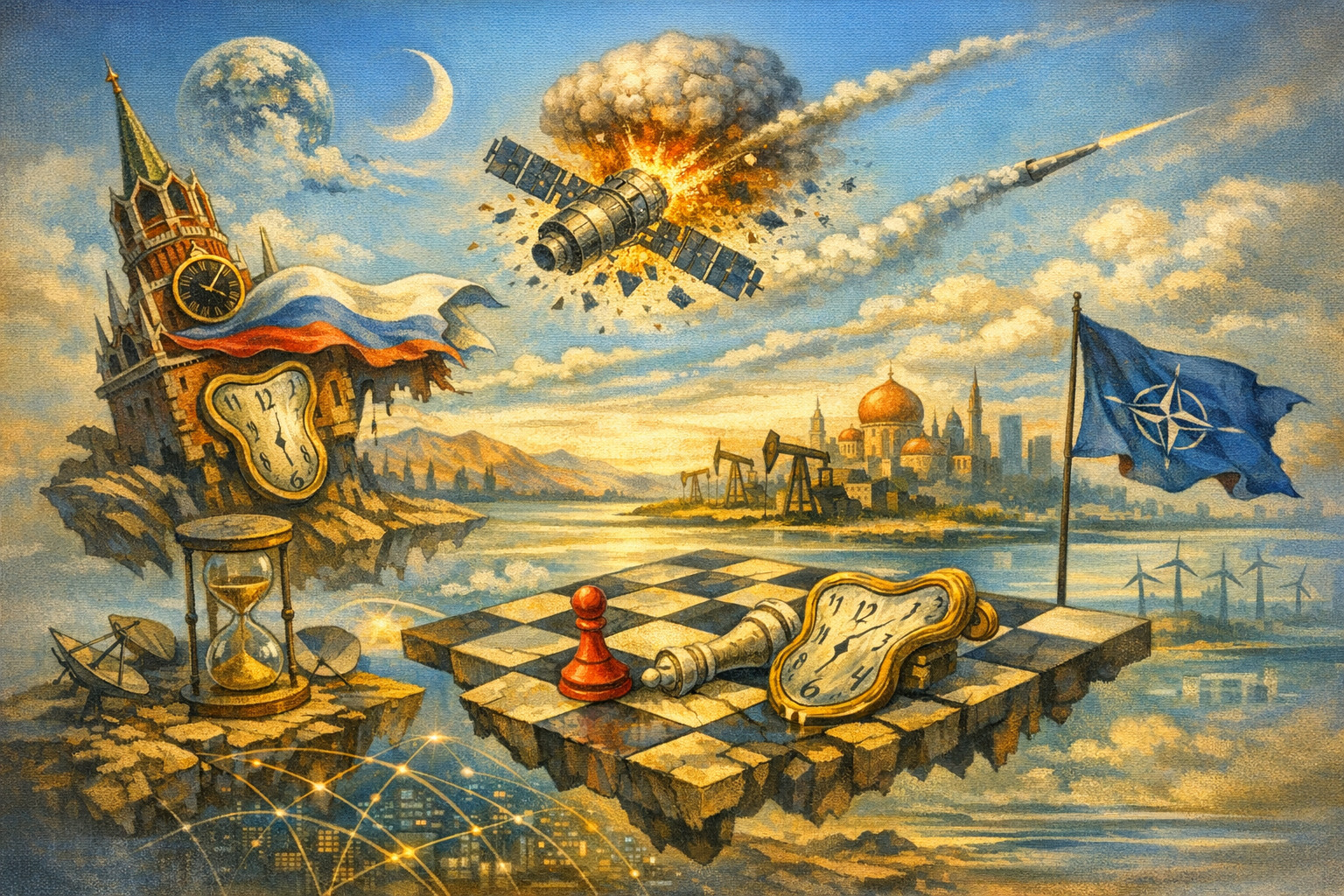
“Some threats build in the distance, others are already with us.”
Art and poetry by James Hall.
The point is that this is a major and urgent story, yet it is being overshadowed by the Iranian crisis.
Public debate in the United States and Europe often treats Iran as the primary geopolitical danger. Iran’s support for regional proxies and its nuclear ambitions dominate headlines. That focus, however, risks obscuring a more immediate and dangerous threat—Russia, our old Cold War adversary.
The troubling reality is that Russia is under genuine pressure from Ukraine’s long‑range drone campaign, particularly strikes against Russian oil and energy infrastructure. At the same time, Germany and the United Kingdom have publicly acknowledged—and even boasted about—supplying Ukraine with drones and components used in some of these attacks. From Moscow’s perspective, this combination is pushing toward a red line—one Russia views as existential.
The term existential threat is often used casually, but it has a precise meaning in strategic thinking. It refers to actions perceived as threatening the survival of a state itself. For Russia, sustained attacks on its energy infrastructure—combined with overt Western involvement—fall squarely into that category.
This is not speculation. Over the past two years, senior intelligence officials in Germany, the United Kingdom, and other European states have issued explicit, on‑the‑record warnings about Russia’s trajectory and how it may respond. Rather than moderating its behavior, Russia appears increasingly emboldened by the war in Ukraine.
Germany, in particular, has been unusually blunt. In public hearings before the Bundestag, the heads of Germany’s foreign, domestic, and military intelligence services have warned that Russia is already retaliating against the West through sabotage, espionage, drone incursions, and so‑called “hybrid attacks.” Crucially, many of these activities are not hypothetical—they are occurring inside Germany today.
In contrast, while Iran’s threat is typically framed through the lenses of regional proxies and nuclear ambition, Russia has moved the confrontation directly onto European soil. The frontline is no longer abstract or distant. It now intersects with logistics networks, infrastructure, and civilian spaces across Europe—and, by extension, affects Western allies, including the United States.
In 2024 and 2025, Russia’s main military intelligence directorate, commonly known as the GRU, was linked to a deeply alarming campaign involving incendiary devices disguised as consumer goods. These devices ignited inside major logistics facilities in Germany and the United Kingdom, narrowly avoiding catastrophic disasters. These were not symbolic gestures or mere warnings; they appear to have been failed attempts at mass‑casualty events on NATO territory.
Russia’s tactics have since evolved into what analysts increasingly describe as a “gig economy of sabotage.” Following the widespread expulsion of diplomats who doubled as intelligence operatives, Moscow began recruiting low‑level criminals and vulnerable individuals through encrypted platforms such as Telegram. Paid in cryptocurrency, these recruits have carried out arson and vandalism attacks, including fires at shopping centers and industrial sites in Poland. Even more troubling, authorities have disrupted plots targeting rail lines, water supplies, and dams across Northern Europe.
Iran undoubtedly destabilizes the Middle East. But Russia is engaged in something different—and more dangerous for the West which can only be described as a sustained effort to dismantle Europe’s security architecture from within. Through what Russian doctrine calls New Generation Warfare, Moscow blends cyber operations, disinformation, economic pressure, and political manipulation. Artificial‑intelligence‑generated content is used to amplify extremist parties, undermine democratic legitimacy, and erode public trust in elections.
At the same time, Russia has shifted decisively to a war economy. It now produces much of its weaponry domestically, reducing reliance on external partners—including Iran—and enabling it to sustain a prolonged confrontation with the West.
There are other disturbing indicators.
This month, Russia has recently issued explicit warnings toward Finland and the Baltic nations. Russian Security Council Secretary Sergei Shoigu has claimed—without evidence—that Ukrainian drones are passing through the airspace of Finland, Estonia, Latvia, and Lithuania during strikes on Russian territory. In response, Russia could invoke “self‑defense” under Article 51 of the UN Charter and potentially take military action. Meanwhile, Finland and the Baltic states strongly deny the accusations, calling them false and part of Russia’s broader disinformation efforts. Ukraine has suggested Russia may even be redirecting its own drones to create tension, meaning that while Russia is not announcing imminent strikes, it is clearly issuing diplomatic threats meant to intimidate NATO.
In past days, Western governments—particularly the United States—have publicly warned that Russia may be developing a nuclear anti‑satellite (ASAT) weapon intended for use in space. According to US Space Command officials, the concern is not a nuclear strike on cities, but a nuclear device placed into Earth orbit—likely low Earth orbit (LEO)—and detonated to disable or destroy satellites. Such a detonation could generate a powerful electromagnetic pulse (EMP), flood orbital regions with radiation, and disable or destroy large numbers of satellites simultaneously. A single explosion could affect many satellites at once.
A nuclear detonation in LEO would not immediately throw society “back to the 1800s,” but it would seriously disrupt the invisible infrastructure modern life depends on—especially satellites and precise timing systems. The damage would be widespread, uneven, and long‑lasting, which is precisely what makes such a weapon strategically alarming.
So what would the advantage be for Russia—why would it consider detonating a nuclear weapon in LEO?
The logic only makes sense when viewed through Russian strategic doctrine. From Moscow’s perspective, the value of such a weapon is not about mass destruction or civilian casualties. It is about exploiting a deep vulnerability of modern Western societies, being their reliance on satellites. The United States and its allies depend heavily on space‑based systems for military command and control, intelligence, GPS navigation, communications, financial timing, and aspects of everyday civilian life. Russia relies on these systems as well—but to a significantly lesser degree.
By detonating a nuclear device in orbit, Russia could disable or degrade large numbers of satellites at once, disrupting these critical systems and imposing disproportionate costs on its adversaries without firing a missile at a city or killing civilians directly.
Such a weapon is best understood as a tool of coercion. A true “Sword of Damocles” hanging above our heads!
A nuclear detonation in space could produce enormous strategic shock—interrupting communications, freezing financial systems, degrading military effectiveness, and sowing global uncertainty—while stopping short of the mass casualties that would almost certainly trigger an unquestioned full‑scale nuclear response. This creates a dilemma for Western leaders. That is the damage would be severe and global, but the response would be politically and legally complex, especially since the attack would target infrastructure rather than people.
This could turn the deterrence principle on its head.
The weapon also undermines one of the West’s main defensive strategies, being the deployment of large numbers of small, relatively inexpensive satellites to improve resilience. That approach works well against conventional anti‑satellite weapons, which must destroy targets individually, but it is far less effective against the radiation and electromagnetic effects of a nuclear detonation.
Perhaps most importantly, such a weapon has value even if it is never used. Simply possessing—or placing—an orbital nuclear device would signal Russia’s willingness to escalate conflict into space, holding the global satellite environment at risk. That persistent threat could influence Western decision‑making during a crisis, forcing leaders to weigh escalation risks far more cautiously.
Nuclear proliferation in Iran is undoubtedly a threat, but it pales in comparison to Russia’s established might. Russia possesses over 5,000 sophisticated warheads ready for immediate deployment. Even if Iran were to develop a weapon today, the specialized engineering required to deliver it effectively is just as complex as creating the core itself—a capability Russia has long since mastered.
Now Iran becomes an important factor when assessing the broader strategic environment surrounding Russia. In fact, Russia’s position has quietly strengthened as the Iran crisis and the disruption around the Strait of Hormuz have unfolded. Because so much of Asia depends on Middle Eastern oil that must pass through Hormuz, any instability there pushes countries like China, Japan, South Korea, and India into a vulnerable position. China, in particular, normally relies on the Gulf for a large share of its crude, so when that flow becomes uncertain, it leans harder on the supplies that aren’t affected by the crisis—especially Russian pipeline oil and discounted Russian seaborne crude. This shift gives Russia more leverage, because it becomes one of the few major exporters whose oil can reach China without passing through a war zone.
At the same time, China’s strategic petroleum reserve gives it a buffer, but only a temporary one. The SPR is large and tightly controlled, designed to smooth over short‑term shocks rather than replace months of lost Middle Eastern supply. So even with reserves, China still needs reliable imports, and Russia becomes an increasingly important partner. Higher global oil prices caused by the crisis also benefit Russia financially, since even discounted Russian crude sells for more when the world market is tight. Add in the fact that Russia’s shipping networks and “shadow fleet” become more valuable when Iran’s exports are disrupted, and the overall effect is that the crisis indirectly amplifies Russia’s influence in both energy markets and diplomacy.
As a notable sidebar to this article, the Strait of Hormuz is the world’s most important energy chokepoint, and when it becomes unstable, the shockwaves move far beyond oil markets. Nearly a fifth of global crude and a large share of refined fuels normally pass through that narrow waterway. When those flows slow or stop, Asia is hit first and hardest, but the effects ripple outward: higher shipping costs, rerouted tankers, longer delivery times, and rising prices for everything from plastics to fertilizer. Even countries that don’t buy Middle Eastern oil feel the pressure because global prices rise and shipping lanes become congested.
Russia’s role adds another layer of instability.
While Iran’s crisis disrupts supply, Russia benefits from the chaos—its oil becomes more valuable, its shipping networks more essential, and its leverage over China and parts of Asia increases. But Russia is also a mischievous player in the broader system. It can manipulate its own exports, restrict diesel or fertilizer shipments, or coordinate with Iran to pressure Western economies. That means the world isn’t just dealing with a single chokepoint crisis; it’s dealing with a crisis that empowers a major geopolitical actor who has every incentive to use that leverage.
In short, the supply chain impact could be significant: higher global energy prices, tighter fuel markets in Asia, more expensive manufacturing inputs, and a world economy that becomes more vulnerable to further shocks. The Iran crisis disrupts the flow of oil although Russia’s behavior amplifies the consequences.
In conclusion, the urgency of the Russian threat lies in both geography and intent. Iran, in contrast, targets US interests and regional rivals in the Middle East. Russia targets the foundational safety of European societies themselves. When intelligence chiefs warn that Europe is “one step away” from direct kinetic conflict, they are not speaking in abstractions. They are pointing to burning warehouses, sabotaged infrastructure, and Russian drones probing NATO airspace.
For Europe, and now the United States, the threat is no longer over the horizon.
It is already inside the house.
Michael and James Hall, authors of the popular The Sword of Damocles: Our Nuclear Age, now on Audible, Kindle and Amazon books.