
Will AGI Decode Our Computational Universe
“As frontier models like Google's Astra and OpenAI's next-generation systems edge closer to early definitions of AGI, a fundamental question emerges.”
By James Hall
James and Michael Hall—authors of the popular The Sword of Damocles: Our Nuclear Age, now on Audible, Kindle and Amazon books. jameshall042999@gmail.com
I am a young man, and unlike many who fear artificial intelligence, I see AI as both an enabler and challenge for my generation. We are living through what may become the most transformative as well as disruptive industrial revolution in human history. I have decided to thrive in this new era. We must not merely learn to use AI, but to master it. The same principle applies to science itself.
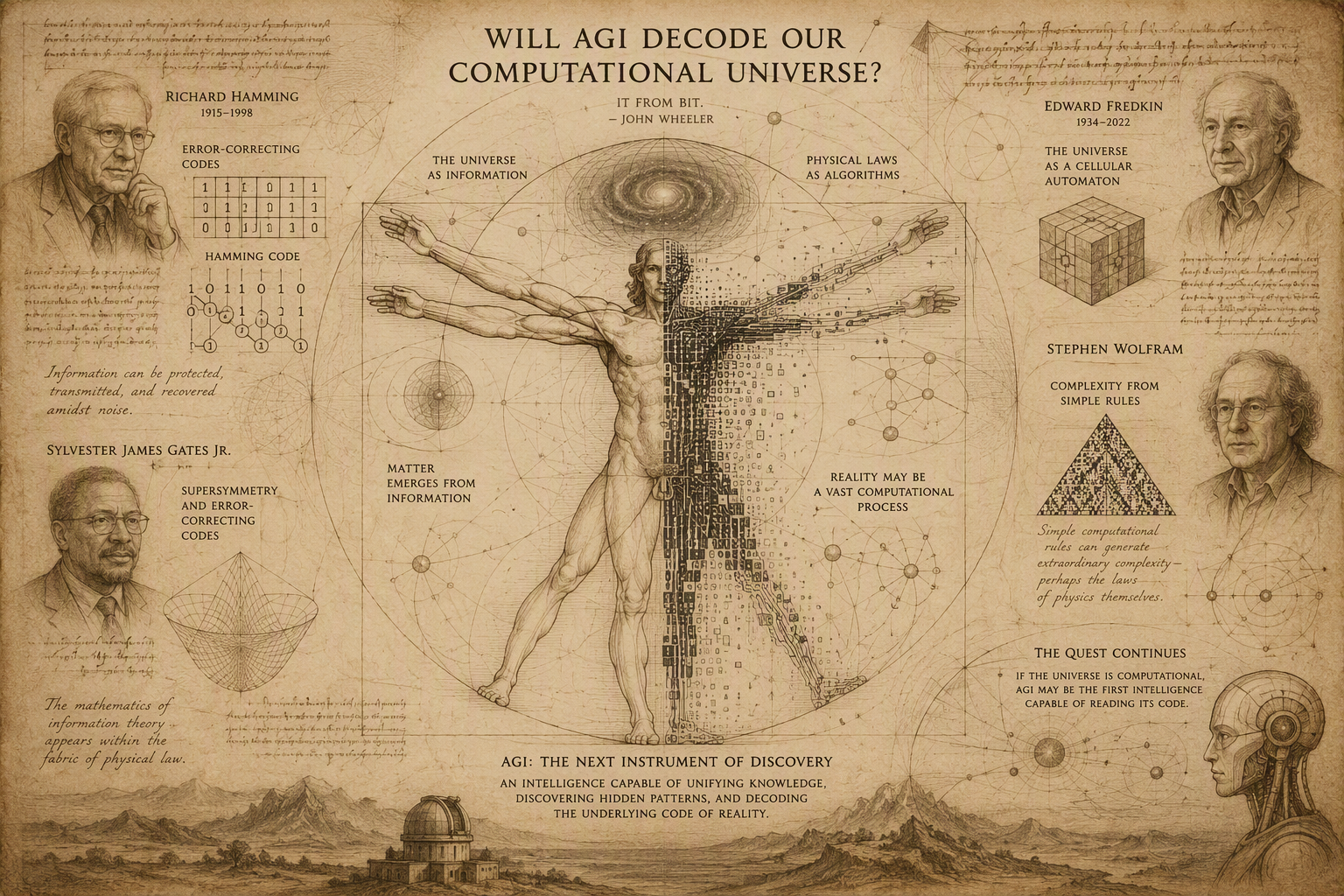
Between starlight and code, we search for the language of creation.
Art and poetry by James Hall
With increasingly powerful systems such as GPT, Astra, and the emerging generation of frontier AI models, many researchers believe we are approaching a form of Artificial General Intelligence, or AGI. This means a system that can teach itself new subjects, adapt to changing environments, and reason through completely novel situations without human assistance. While the exact timeline remains uncertain, the trajectory is clear and we are just about there:
Machines are becoming capable of reasoning across disciplines, discovering patterns, and solving problems that would be impossible for any individual human mind to tackle alone.
This raises a profound question.
If the universe is fundamentally computational, could AGI become the first intelligence capable of deciphering its underlying code?
For centuries, humanity has sought the ultimate foundations of reality. From Plato and the ancient Greeks searching for the elemental constituents of nature to Einstein and modern physicists probing the mysteries of quantum fields, each generation has uncovered deeper layers of the universe's architecture. Yet the deepest layer may not be matter or energy at all. It may be information originating from a higher realm: an underlying code from which a computational universe emerges.
Manhattan Project veteran Dr. Richard Hamming developed mathematical techniques that enabled computers and communication systems to detect and correct errors automatically. Although his work was motivated in part by the challenge of ensuring reliable communication over noisy telephone lines and other transmission systems, its impact soon extended far beyond telecommunications and helped lay the foundation for the computer revolution. His most famous contribution, the Hamming Code, introduced a method of adding carefully placed parity bits to data so that transmission or storage errors could be identified and, in many cases, corrected without human intervention. This breakthrough became a foundational element of modern digital communications, data storage, and computer systems.
The mathematics behind Hamming's error-correcting code was remarkably elegant. Yet it raises a deeper question: Do humans invent mathematics, or do we discover structures that already exist within nature? Some researchers and philosophers have argued that mathematics is part of a deeper computational framework woven into reality itself. If information and computation are fundamental features of the universe, then perhaps the cosmos has a kind of underlying code.
Again, do humans invent mathematics, or do we discover what is already there? What will AGI do with the puzzle of nature?
This question lies at the intersection of philosophy, science, and artificial intelligence. If mathematics is invented, then it is a language created by human minds to describe patterns we observe. If it is discovered, then mathematical truths exist independently of us, waiting to be uncovered like continents before explorers arrived.
AGI may force us to revisit this debate. An intelligence that surpasses human cognitive limits could discover mathematical relationships that no human has imagined, revealing structures hidden within reality itself. If these discoveries prove universally true and useful, they would strengthen the argument that mathematics is something we uncover rather than create. On the other hand, if AGI develops entirely new mathematical frameworks that are effective but fundamentally alien to human thought, it may suggest that mathematics is at least partly a construction shaped by the minds that use it.
In either case, AGI could become humanity's most powerful mathematical collaborator, expanding the boundaries of knowledge and perhaps exposing patterns in nature that humans have been unable to perceive. The deepest outcome may not be answering whether mathematics is invented or discovered, but revealing that the distinction itself is more complex than we currently understand.
Let’s bridge between digital physics (ontic information theory) and epistemology (the theory of knowledge).
Physicist John Wheeler captured this possibility with his famous phrase, “It from Bit.” Wheeler suggested that information may be more fundamental than matter itself. In this view, every particle, field, and force emerges from an underlying informational reality.
The idea gained additional intrigue when theoretical physicist Sylvester James Gates Jr. discovered mathematical relationships between supersymmetry and error-correcting codes similar to those developed by Hamming.
While this does not prove that the universe literally runs like a computer program, it suggests that informational structures may be woven deeply into the fabric of physical law.
Computer scientist and digital physics pioneer Edward Fredkin proposed that reality behaves like a vast computational process. Physicist, computer scientist, and Wolfram Research founder Stephen Wolfram argued that simple computational rules can generate extraordinary complexity, perhaps even the laws governing our universe. Digital physicists today continue exploring whether spacetime, matter, and energy emerge from fundamental information-processing systems.
If these ideas are correct, reality may not merely be described by mathematics; it may be mathematics in motion.
Yet this claim faces a profound philosophical hurdle grounded in the limits of the Church-Turing thesis: can discrete, algorithmic computation ever fully capture the physical cosmos? Thinkers like Sir Roger Penrose have long argued that certain physical phenomena—from quantum gravitational collapse to consciousness itself—may be fundamentally non-computable. If reality possesses continuous or non-algorithmic depths, treating the cosmos as software risks making the same historical mistake as early modern mechanists who mistook the universe for literal clockwork.
This is precisely where AGI enters the story—not merely as a calculator, but as an empirical test of these limits.
Human intelligence, remarkable as it is, faces limits. We struggle to visualize higher dimensions, manage immense datasets, and discover relationships across thousands of scientific disciplines simultaneously. AGI may not share those limitations. An advanced AGI could examine billions of experimental observations, analyze mathematical structures too vast for human comprehension, and identify hidden patterns connecting quantum mechanics, gravity, information theory, and computation.
Just as microscopes revealed invisible worlds and telescopes expanded our view of the cosmos, AGI may become a new instrument of discovery, extending cognition itself.
The most intriguing possibility is that AGI could detect organizing principles that humans have overlooked for centuries. It might reveal that physical laws emerge from deeper computational rules. It might uncover previously unknown symmetries, informational architectures, or mathematical frameworks that unify contradictory areas of physics. It could even determine whether spacetime is continuous or discrete, whether information is truly fundamental, and whether the universe operates according to a finite set of computational rules.
Yet caution is warranted.
Decoding reality is not the same as understanding it. An AGI may identify patterns that no human can fully comprehend. It could generate theories that accurately predict nature while remaining largely opaque to the minds that created it. In such a future, humanity may face a paradox: possessing answers to the deepest questions of existence while struggling to understand the answers themselves.
Ultimately, AGI may not prove that the universe is computational, nor may it uncover a literal source code hidden beneath reality. But if there is a deeper informational structure underlying the cosmos, AGI could become humanity's most powerful tool for discovering it.
For thousands of years, humans have looked outward toward the stars seeking answers about our origins and our place in existence. The next great scientific revolution may involve looking inward, into the informational fabric from which reality itself emerges. If the universe is a computation, AGI may be the first intelligence capable of reading the code. And if that day comes, humanity's greatest discovery may not be a new technology, but a new understanding of what reality truly is.